Water power: head, flow and the whole river
By How things work · myAudience
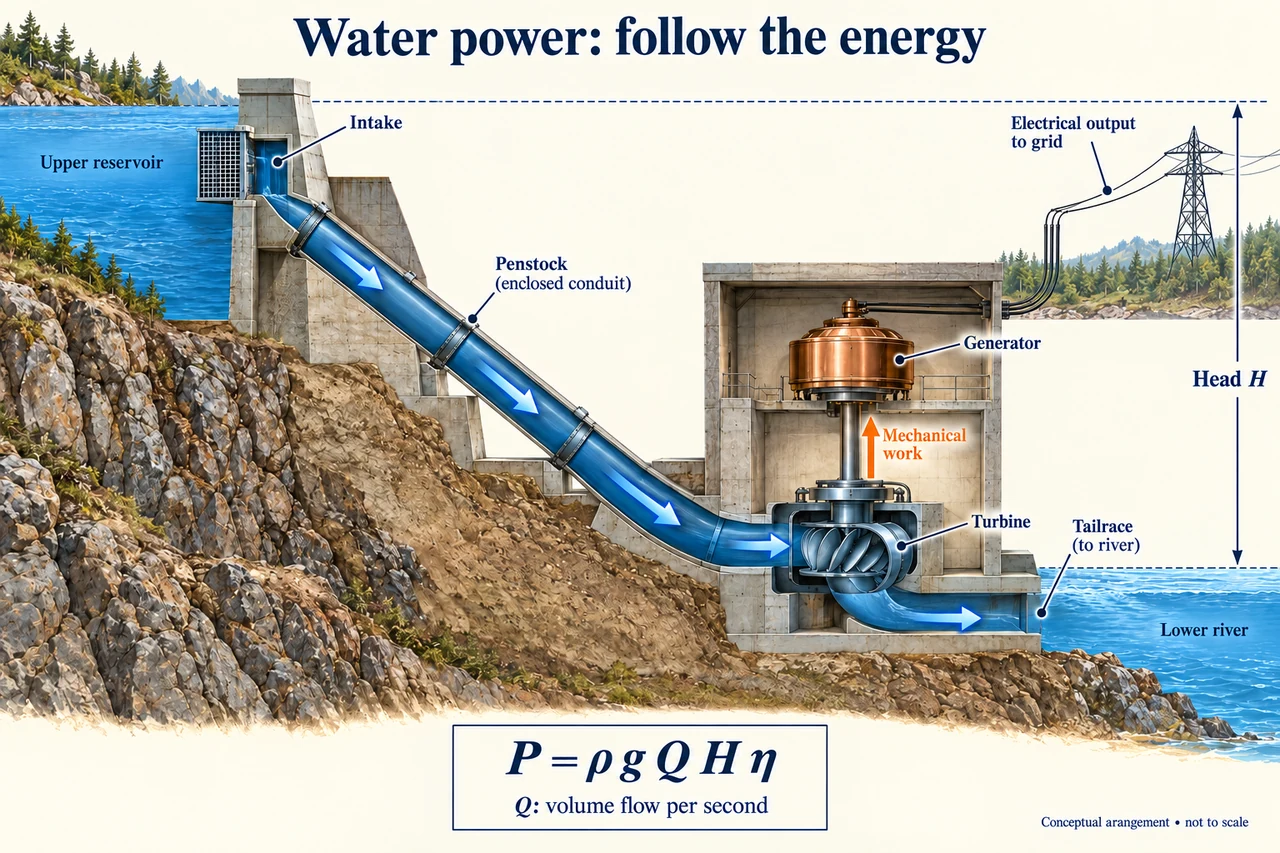
myAudience original rendered teaching illustration. Image: illustration, not a documentary photograph. · Operator-authored generated illustration; scientific model reviewed separately.
Water power: head, flow and the whole river
A hydroelectric plant converts the energy transferred by water into shaft work and then electrical output. In an ordinary reservoir arrangement, water descends through a penstock, turns a turbine, and leaves through a tailrace; the turbine drives a generator through a shaft. Water and electricity take different routes. A large dam is not necessary for every hydroelectric installation: river-diversion systems can also use a difference in water level.
Trace the plate’s blue arrows through the turbine and back to the river. Its orange mechanical arrow connects the turbine to the generator, not the water pipe to the electrical wire. The head H is the difference between upstream and downstream water levels in this simplified model. It is not automatically the height of the dam wall. A high downstream level can reduce useful head even when the reservoir appears full. The illustration is a conceptual cross-section, not a turbine construction drawing.
Derive the power estimate rather than memorising it. During a short interval Δt, volume QΔt passes through, where Q is volume flow per second. Its mass is ρQΔt, with ρ the water density. A head H represents a gravitational energy difference approximately ρQΔt gH. Divide by Δt to obtain ρgQH watts of available hydraulic power; multiply by the chosen combined efficiency η for useful electrical output. Dimensional checking gives kg/m³ × m/s² × m³/s × m = kg m²/s³, which is a watt.
Our model assumes steady incompressible flow, roughly constant density and head, and an efficiency defined across a stated boundary. If H is measured between reservoir surfaces, pipe friction and turbine/generator losses must be included in η. If an engineer supplies net head at the turbine instead, including the same pipe loss again double-counts it. Reservoir level, flow restrictions and machine operating point change with time; a nameplate maximum is not annual energy.
Consider two invented sites: one has twice the head but half the permitted flow. With equal combined efficiency they have equal modelled power, because QH is unchanged. Yet they are not socially or ecologically interchangeable. Who receives the electricity, whose land is affected, and what downstream water must remain available? A decision needs evidence about fish passage, sediment, water users and seasonal conditions, not merely a large calculated wattage. Discuss whether replacing an existing turbine is preferable to a new impoundment; justify the boundary and evidence that could change your judgement.
For a demanding transfer, suppose dry-season flow falls by 25% while head rises by 10%. At unchanged efficiency, output becomes 0.75 × 1.10 = 0.825 of its earlier value, a 17.5% reduction. Adding the percentage changes would incorrectly predict only a 15% reduction. If efficiency also changes, multiply by its ratio; do not assume a machine retains its best-point performance at every flow. This bounded lesson does not settle dam safety, site licensing or full turbine selection.
Image: illustration, not a documentary photograph.
Worked example: Invented plant: Q = 2.00 m³/s, H = 30.0 m, ρ = 1,000 kg/m³, g = 9.81 m/s² and combined η = 0.80. Calculate useful power and energy from four steady hours.
Hydraulic power = 1,000 × 9.81 × 2.00 × 30.0 = 588,600 W.
Useful power = 588,600 × 0.80 = 470,880 W = 470.88 kW.
Energy = 470.88 kW × 4 h = 1,883.52 kWh; report about 471 kW and 1.88 MWh with the stated model.
Answer: Approximately 471 kW and 1.88 MWh, conditional on constant conditions.
Check your understanding: With efficiency unchanged, flow becomes 80% and head becomes 90% of their initial values. Is the new power 70%,72% or 90%, and why?
Answer: 72%: power is proportional to their product, 0.80 × 0.90 = 0.72. The 28% reduction is not obtained by simply adding percentage reductions.
Why: Declare the system boundary and assumptions before applying conservation. Invented values test reasoning, not a real installation.