Pumped storage: time-shifting energy, not making it
By How things work · myAudience
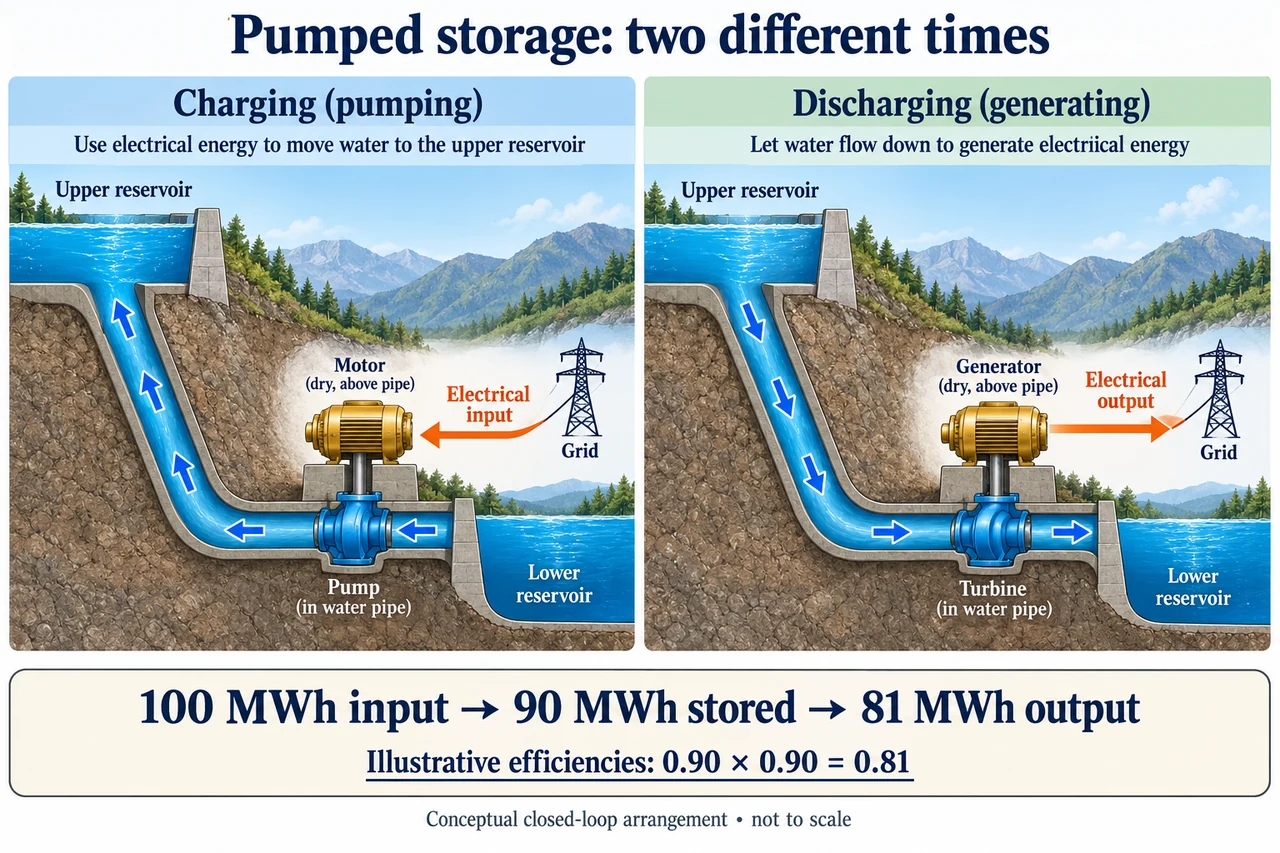
myAudience original rendered teaching illustration. Image: illustration, not a documentary photograph. · Operator-authored generated illustration; scientific model reviewed separately.
Pumped storage: time-shifting energy, not making it
Pumped storage connects reservoirs at different elevations. During charging, an electric motor drives a pump to lift water; during discharge, descending water drives a turbine and generator. The useful service is shifting when electrical energy is available. Charging consumes more electricity than a complete real cycle returns, so the installation is storage, not a new primary energy source.
The plate separates charging and discharging panels. Read each direction independently: electrical input accompanies upward water movement, while electrical output accompanies downward movement. Opposing arrows represent different operating periods, not simultaneous free circulation. A reversible pump-turbine and motor-generator are one possible arrangement; the system boundary includes pumps, pipes and machines. The reservoirs are shown without a river connection, a conceptual closed-loop arrangement; this does not mean evaporation, groundwater effects or replenishment can be ignored.
For a fixed transferred mass and nearly constant height difference, stored gravitational energy is E = mgH. Define charging efficiency ηc = stored gravitational energy/electrical input and discharge efficiency ηd = electrical output/stored energy. Their product is round-trip efficiency when other losses and auxiliary loads are absent or already included consistently. Thus electrical output = electrical input × ηc × ηd. Using one efficiency for each direction is not an excuse to count the same loss twice.
Duration and power are different constraints. A reservoir may contain sufficient usable energy for hours, yet its turbine and generator can deliver only their allowed power. Conversely, a powerful generator empties a small usable reservoir quickly. In our invented model, 1.0 GWh delivered at a constant 250 MW lasts four hours. That arithmetic alone cannot establish actual usable storage: changing head, environmental release obligations, reserve margin and machine limits must also be considered.
An electricity-price difference can reward charging at one time and discharging at another, but cheap charging electricity is not automatically low-emission electricity. Evaluate the marginal generation displaced and used, local water impacts, construction and affected communities. Discuss a storage proposal that improves peak reliability but requires new reservoirs: compare it with demand reduction and alternative storage under explicit duration and location constraints. Benefits to distant users do not erase local burdens.
Test a common misconception with an invented cycle. Charging needs 100 MWh, pumping stores 90 MWh, and discharge returns 81 MWh. Nineteen MWh reaches other energy transfers and auxiliary uses, not a missing energy account. Recovering electricity twice from the same falling water requires first restoring its height with work. This established storage mechanism is distinct from experimental storage claims and is not a pump-control or dam-operating procedure.
Image: illustration, not a documentary photograph.
Worked example: A fictional system receives 100 MWh during charging, has ηc = 0.90 and ηd = 0.90. What returns electrically? How much charging energy is needed for 90 MWh output?
Stored energy = 100 × 0.90 = 90 MWh.
Electrical output = 90 × 0.90 = 81 MWh; round-trip efficiency = 0.81.
Required charging input = 90/0.81 = 111.111… MWh.
Answer: 81 MWh returned; about 111 MWh input is required for 90 MWh output.
Check your understanding: A usable electrical-energy estimate is 360 MWh and discharge power is 120 MW. What ideal constant-power duration follows? Why does higher power not increase stored energy?
Answer: 360 MWh/120 MW = 3 h. Power is a rate; the reservoir energy capacity has not increased. Real duration requires head, efficiency and usable-volume limits.
Why: Declare the system boundary and assumptions before applying conservation. Invented values test reasoning, not a real installation.