Recovering motion without creating energy
By How things work · myAudience
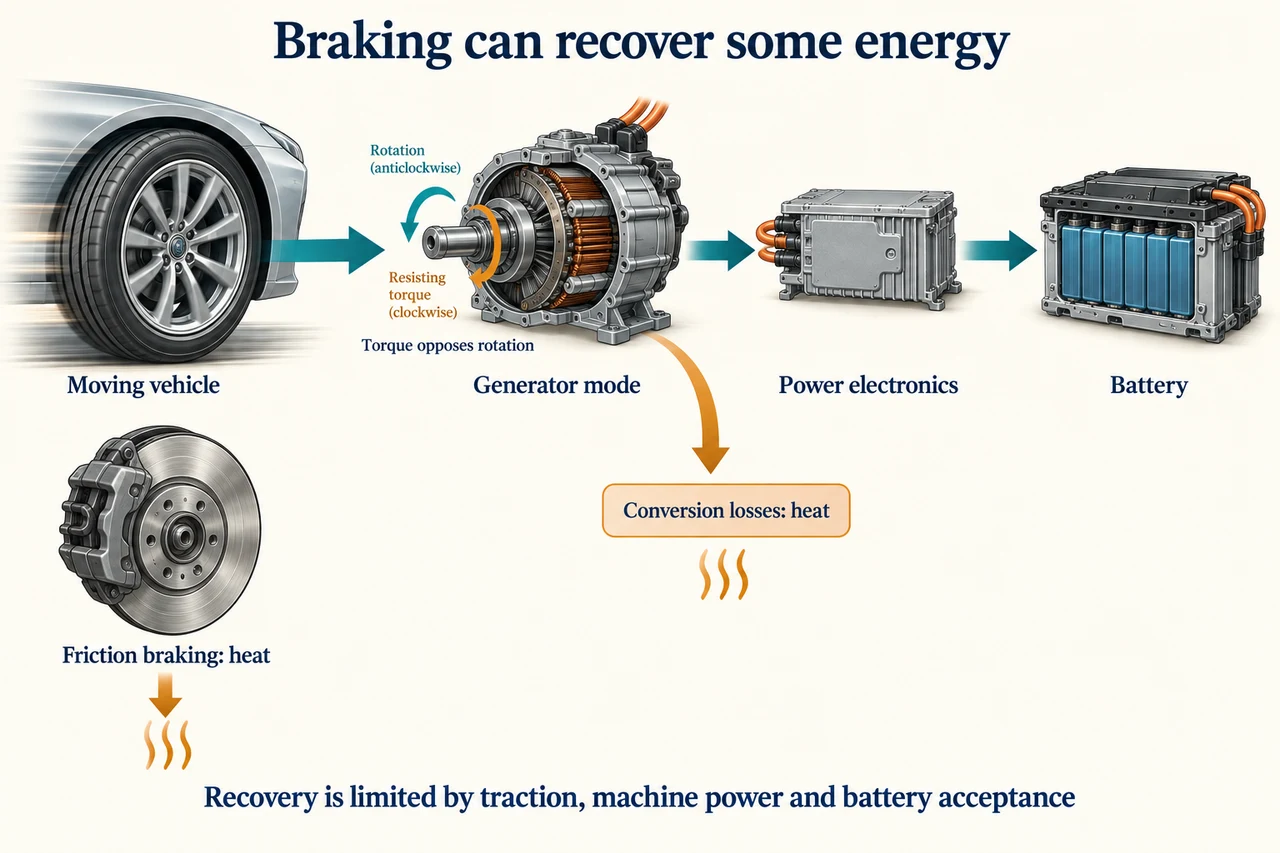
myAudience original rendered teaching illustration. Image: illustration, not a documentary photograph. · Operator-authored generated illustration; scientific model reviewed separately.
Recovering motion without creating energy
Regenerative braking redirects some of a moving vehicle’s kinetic energy through an electrical machine and back into its energy store. In generating mode the electromagnetic torque opposes the shaft’s rotation. The shaft need not reverse direction: torque and angular velocity have opposite signs, so the machine receives mechanical power rather than delivering it to propel the wheels. Saying the motor runs in reverse is an informal energy-flow description, not a command to spin the road wheels backwards.
The diagram deliberately follows one braking-mode energy path: vehicle motion to generator to power electronics to battery. Conversion losses leave as heat, while conventional friction braking transfers mechanical energy to heat directly. The battery is not drawn powering the generator in this mode. An actual vehicle blends braking according to its control system and conditions; the drawing is not a universal vehicle circuit. Tyre adhesion, machine and electronics power limits, battery temperature and charge acceptance can constrain recovery. A battery already near its permitted charge limit cannot necessarily accept more energy merely because the vehicle is moving.
For a level-road teaching boundary that ignores rotational kinetic energy, air drag and rolling resistance during the stopping interval, the available kinetic-energy decrease is one half × mass × (initial speed squared − final speed squared). Recovery efficiency applies to the portion sent through the regenerative path, not automatically to all the vehicle’s initial kinetic energy. The first question is how much energy reaches that path; the second is how much survives the conversions. Recovery does not make acceleration free or eliminate reliable friction brakes.
Consider a fictional 1,500 kg vehicle slowing from 20 m/s to rest. Its translational kinetic energy decreases by 300,000 J. If a stated simplified model routes all this energy through a regenerative conversion of 70%, the stored energy increase is 210,000 J, or approximately 58.3 Wh. The remaining 90,000 J reaches other outputs. These values illustrate bookkeeping, not a measured vehicle rating; a real stop may route less energy through the generator and include additional mechanical losses.
Power imposes a different limit from total energy. Suppose a fictional battery can accept at most 20 kW during a five-second stop. It can receive at most 100 kJ over that interval if acceptance remains at the ceiling throughout. A nominal 70%-of-300-kJ estimate of 210 kJ exceeds that bound. The two figures cannot both describe the same stop. The actual control must reduce regenerative transfer, prolong the interval where appropriate, or use other braking paths; a safety-critical stopping requirement cannot be negotiated away to increase an efficiency score.
Compare energy-saving proposals with explicit boundaries. Smoother traffic flow may reduce repeated energy conversion, while recovering braking energy may reduce friction-brake use; neither observation proves zero environmental cost. Battery production, electricity supply, vehicle mass, access to transport and safe public space remain relevant. A learner may analyse fictional data but should not modify vehicle brakes or rely on this explanation for driving instructions. Assess claims about recovery using measured conditions, total-energy balance and manufacturer limits, not a universal percentage.
Image: illustration, not a documentary photograph.
Worked example: A fictional 1,500 kg vehicle stops from 20 m/s on level ground. Ignore rotational motion and other mechanical losses; assume all translational kinetic-energy decrease enters a 70%-efficient regenerative path. Calculate stored energy in J and Wh.
Initial kinetic energy = 0.5 × 1,500 × 20² = 300,000 J; final translational kinetic energy is zero.
Stored increase = 0.70 × 300,000 = 210,000 J.
One Wh = 3,600 J, so 210,000/3,600 = 58.333... Wh. Other outputs receive 90,000 J within this simplified boundary.
Answer: 210 kJ, approximately 58.3 Wh, conditional on the assumed path and efficiency.
Check your understanding: The same vehicle instead slows from 20 to 10 m/s over five seconds. First find the ideal energy decrease and a hypothetical 70% recovery. Then check it against a 20 kW battery-acceptance limit. Does halving speed remove half the kinetic energy?
Answer: Energy decrease = 0.5 × 1,500 × (400 − 100) = 225,000 J. Hypothetical 70% stored increase is 157,500 J, but the acceptance bound is 20,000 × 5 = 100,000 J, so that hypothesis cannot hold for this interval. Actual storage is at most 100 kJ and may be lower. Remaining kinetic energy is 75 kJ, one quarter of 300 kJ: halving speed removes three quarters of the initial kinetic energy, not half.
Why: Distinguish energy available, conversion efficiency and power acceptance over time. Square speed in the kinetic-energy relation and reject inconsistent assumptions instead of silently exceeding a physical bound.