From sunlight to useful electricity
By How things work · myAudience
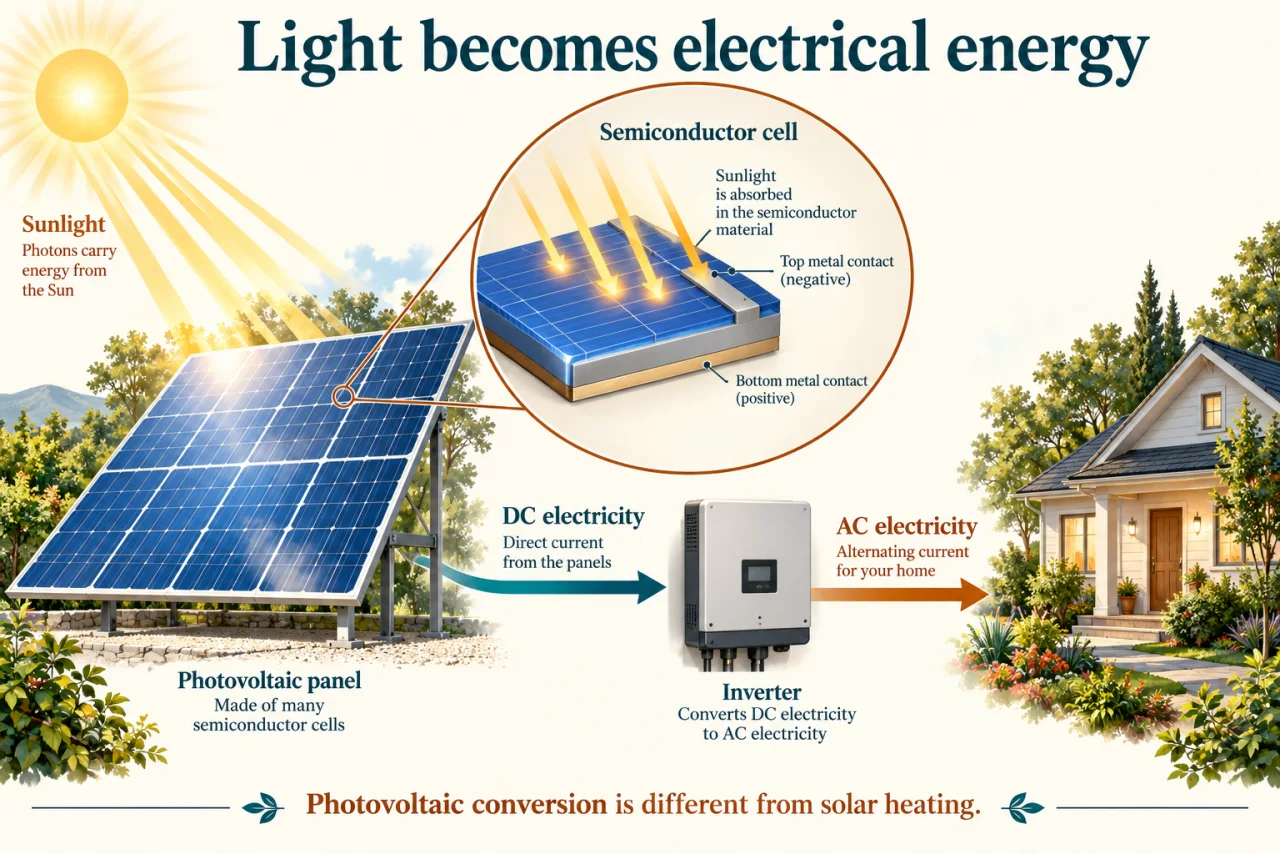
myAudience original rendered teaching illustration. Image: illustration, not a documentary photograph. · Operator-authored generated illustration; scientific concept model reviewed separately.
From sunlight to useful electricity
A photovoltaic cell produces electrical output when absorbed light supplies energy to charge carriers in a semiconductor. It is not a miniature steam engine, and it does not need sunlight first to boil water. The important chain is light absorption, separation and collection of charge, then transfer of electrical energy to an external circuit. Some incident light is reflected or transmitted, and some absorbed energy becomes thermal energy rather than useful electrical output. Why is absorbed light not all converted? In an ordinary single-bandgap absorber, photons below the bandgap cannot cause the required excitation; energy above that threshold can become heat after absorption. Better collection cannot recover every spectral loss. Multi-junction devices use different absorbing layers, but the image does not depict that architecture and a laboratory efficiency does not establish installed lifetime performance.
Follow the illustration from left to right: light reaches a panel containing many cells; metal contacts collect the electrical output; the teal arrow leads to an inverter; the orange arrow represents AC output to a home. The inset is a simplified cell with contacts, not a complete junction cross-section. Its contact polarity represents one illustrative cell arrangement; it is not a rule for every photovoltaic architecture. A contact alone cannot create electricity without the active device and suitable light.
The cell output is DC. An inverter uses controlled electronic switching and filtering to provide AC output suited to its application. Connecting an ordinary panel directly to a household socket would miss essential conversion, protection and installation requirements. A grid-connected installation also needs to respond safely to supply interruptions. The illustrated home is not a promise that every solar installation will power a building during a grid outage: that depends on its inverter, controls, storage and electrical design.
Power is an energy-transfer rate. Let G be irradiance in watts per square metre and A the illuminated area in square metres. Under a uniform-light model, incident power is G × A. If cell/module efficiency is η, DC output is approximately ηGA; a subsequent converter efficiency multiplies that result again. These are separate boundaries. A 20% photovoltaic efficiency followed by 90% inverter efficiency gives 18% from incident light to AC output, not 110%. This multiplication is a model at a specified operating point. An inverter also has a finite output rating. If a simplified system clips AC output at a limit L, model delivered power as the smaller of ηinverterηPVGA and L. Loss and clipping are different: conversion inefficiency acts throughout operation, while clipping matters only above the declared limit.
Energy over a fixed interval is power multiplied by time only when power can reasonably be treated as constant. A panel that produces 400 W for one hour transfers 400 Wh, or 0.4 kWh. Real output changes with weather, shading, temperature, orientation and electrical operating conditions. An installed peak-power rating therefore differs from energy delivered over a day. Estimating annual production requires a time series or an appropriately justified model, not the peak rating multiplied by every hour of the year. For changing conditions, divide time into intervals and sum each power multiplied by its duration. Do not substitute an average irradiance into a nonlinear clipped system without checking it: two intervals can have the same mean input but a different delivered energy when only one clips. The interval model assumes constant efficiencies and ignores temperature and other effects, so its result is conditional.
Photovoltaic generation and electronic conversion are established technologies; new materials and architectures still need independent reliability and manufacturing evidence. Treat a promising laboratory cell and a durable installed system as different achievements. To compare two proposals, request the same measurement boundary, conditions, area convention and lifetime assumptions. Neither the attractive illustration nor a single efficiency number settles maintenance, lifecycle impacts or who can benefit from the electricity.
Discuss: a community can subsidise private roofs or a shared installation accessible to renters. Compare cost, reliability, fair access and community control. Explain why one option might fit the local circumstances better, and what evidence could change your conclusion.
Image: illustration, not a documentary photograph.
Worked example: A 4 m² array has assumed photovoltaic efficiency 20%, inverter efficiency 90%, and AC output limit 300 W. Irradiance is 250 W/m² for 30 minutes, then 1,000 W/m² for 30 minutes. Calculate AC energy. Would using the mean irradiance give the same result?
At 250 W/m²: incident power = 250 × 4 = 1,000 W; DC = 200 W; potential AC = 180 W, below the 300 W limit.
At 1,000 W/m²: incident power = 4,000 W; DC = 800 W; potential AC = 720 W, clipped to 300 W.
Energy = 180 × 0.5 + 300 × 0.5 = 240 Wh = 0.240 kWh.
Mean irradiance = 625 W/m². Applying the efficiencies gives 450 W potential AC, then clipping gives 300 W for one hour, or 300 Wh.
The mean-input shortcut overestimates by 60 Wh because clipping and averaging cannot be exchanged. These are supplied model assumptions, not measured array ratings.
Answer: 0.240 kWh; the mean-irradiance shortcut predicts 0.300 kWh and is invalid for this clipped time series.
Check your understanding: A proposal says doubling panel area must double the day’s delivered AC energy, although the inverter is unchanged and some intervals already clip. Is that conclusion justified? Identify the missing information.
Answer: No. Recalculate the time series with the same inverter limit; clipped intervals cannot simply double. Irradiance, efficiencies, temperatures and operating limits are needed.
Why: Area doubles the modeled incident power, but a downstream constraint can prevent its conversion into twice the delivered energy. A peak number cannot establish an energy yield.