A battery needs two different paths
By How things work · myAudience
myAudience original rendered teaching illustration. Image: illustration, not a documentary photograph. · Operator-authored generated illustration; scientific concept model reviewed separately.
A battery needs two different paths
A rechargeable battery stores energy through chemical states that can be changed and, within limits, reversed. During discharge, reactions at its two electrodes support electron transfer through an external load and ion transport inside the cell. A lithium-ion cell is not a container in which electricity sits as a fluid. Its materials and their chemical potential differences make electrical work possible when a suitable circuit is completed.
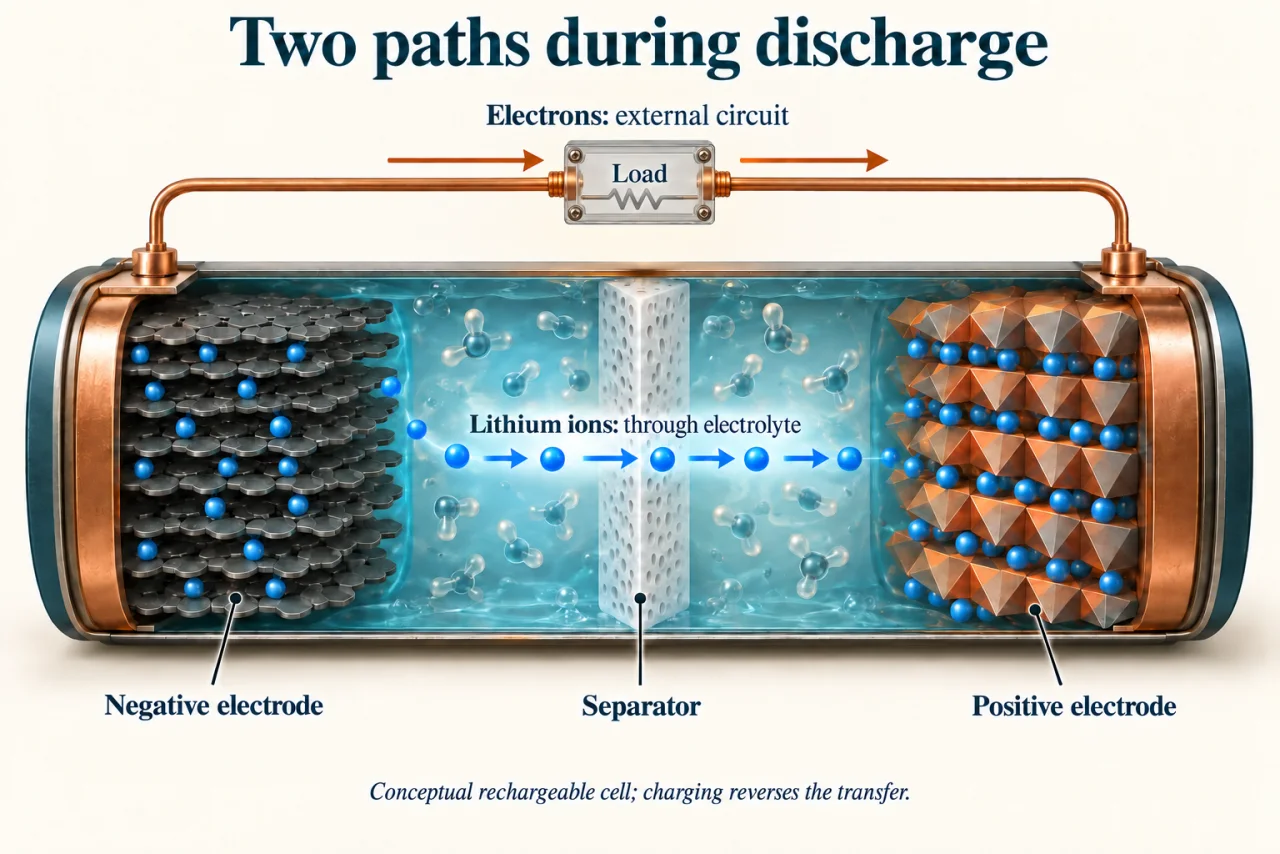
The picture shows one conceptual discharge arrangement: a graphite-based negative electrode is on the left, a positive electrode is on the right, and a separator lies between them. Follow the electron arrows around the external circuit through the load. Follow the lithium-ion arrows through the electrolyte and separator toward the positive electrode. The large coloured particles show pathways, not literal atomic sizes or the exact composition of a commercial cell. Charging reverses the net transfers in this elementary model.
The separator prevents direct electronic contact between the electrode materials while allowing ionic transport through electrolyte-filled pores. If electrons had an easy internal short-circuit path, energy could be released without doing the intended useful work at the load. The internal and external paths are therefore complementary rather than interchangeable. Calling both arrows “current” without saying which charge carrier and which convention is meant can obscure the mechanism; electron motion and conventional-current direction are opposite.
Ampere-hours measure charge capacity, not energy by themselves. One ampere-hour corresponds to 3,600 coulombs because an ampere is one coulomb per second. Electrical energy is the integral of voltage over transferred charge; using a representative constant voltage gives the approximation E ≈ V × Q. This is why a 2 Ah cell at nominal 3.6 V suggests 7.2 Wh, while another 2 Ah cell at a different voltage has a different estimated energy. Real voltage varies during discharge. A second distinction is series versus parallel connection in an ideal model of matched cells. Series adds cell voltages while the same charge passes through each; parallel paths add available charge capacity at a common voltage. Eight identical cells do not gain energy merely because their connections change. The diagram is a single cell and does not show either pack arrangement.
Runtime also depends on the load and useful-energy boundary. Dividing estimated watt-hours by constant watts gives an ideal duration, but conversion losses, temperature, discharge rate, reserve limits and aging can reduce usable time. A pack label alone does not tell you every condition under which its energy was measured. Several cells, protective electronics and thermal arrangements can form a pack; the pictured single-cell mechanism does not replace those systems. For a theoretical pack with s cells per series string and p identical strings in parallel, nominal voltage is sVcell and charge capacity is pQcell, so their product is sp times the single-cell nominal energy. This assumes compatible, equally charged cells and excludes protective-system losses. It is a bookkeeping model, not a pack-building procedure: balancing, fault protection and charging remain separate requirements.
Lithium-ion batteries are established commercial systems with several electrode chemistries. Research into electrode transport and stability does not establish that every new material is ready for mass production. The 2013 Sandia handbook is used here for basic pathways, not current prices or market forecasts. Damaged cells, unsuitable charging and internal short circuits can be hazardous, so this conceptual lesson is not an instruction to open, rebuild or improvise charging for a cell.
Discuss: a low-cost device has a sealed battery that becomes difficult to replace. Compare product durability, repair access, safety, material demand and affordability. Propose a repair policy that addresses both access and competent handling rather than assuming either unrestricted rebuilding or total non-repairability is the only choice.
Image: illustration, not a documentary photograph.
Worked example: Eight theoretical matched cells each have nominal 3.6 V and 2 Ah. Compare four cells per series string with two strings in parallel against two per series string with four strings in parallel. If either arrangement has 80% useful energy at the load, estimate operation with a 2 W load for two hours, then 4 W afterward.
Each cell has nominal energy 3.6 × 2 = 7.2 Wh; eight have 57.6 Wh.
Four in series, two strings in parallel: nominal 14.4 V and 4 Ah; energy = 57.6 Wh.
Two in series, four strings in parallel: nominal 7.2 V and 8 Ah; energy = 57.6 Wh. Different Ah labels do not imply different total energy.
Useful load energy = 0.80 × 57.6 = 46.08 Wh. The first two hours use 2 × 2 = 4 Wh.
Remaining energy = 42.08 Wh; at 4 W this gives 10.52 hours. Total modeled runtime is 12.52 hours.
The same energy arithmetic does not establish electrical interchangeability: output voltage, allowable current, conversion, protection and discharge characteristics must suit the load.
Answer: Both arrangements contain nominal 57.6 Wh and give a conditional 12.52-hour load runtime, but their voltages and Ah ratings differ.
Check your understanding: A seller compares a 14.4 V, 4 Ah pack with a 7.2 V, 8 Ah pack and says the second must run the same device twice as long. Explain the error and what must be checked.
Answer: Both nominal energy products are 57.6 Wh. Runtime depends on useful delivered energy and load power; voltage compatibility, conversion losses and discharge conditions must also be checked.
Why: Ampere-hours are charge, not a voltage-independent energy measure. Equal nominal watt-hours are a useful comparison boundary but not proof of equal usable performance.