From iron-bearing feedstocks to useful steel
By How things work · myAudience
myAudience original rendered teaching illustration. Image: illustration, not a documentary photograph. · Operator-authored generated illustration; scientific concept model reviewed separately.
From iron-bearing feedstocks to useful steel
Steelmaking changes both material form and composition. Iron ores contain iron chemically combined with other elements, so producing metal is not simply melting an ore-shaped piece into a steel-shaped one. An ore-based route must first remove oxygen from iron-bearing compounds and separate unwanted material. Refining then adjusts composition. Steel is a family of materials rather than one universal recipe with identical properties. A carbon-bearing material can have more than one role: supporting oxygen removal, supplying energy in parts of the process and contributing carbon to a final alloy. These roles cannot be replaced by simply matching total feed mass. A different reducing agent requires an appropriate process and energy supply; it does not eliminate the need to verify final composition.
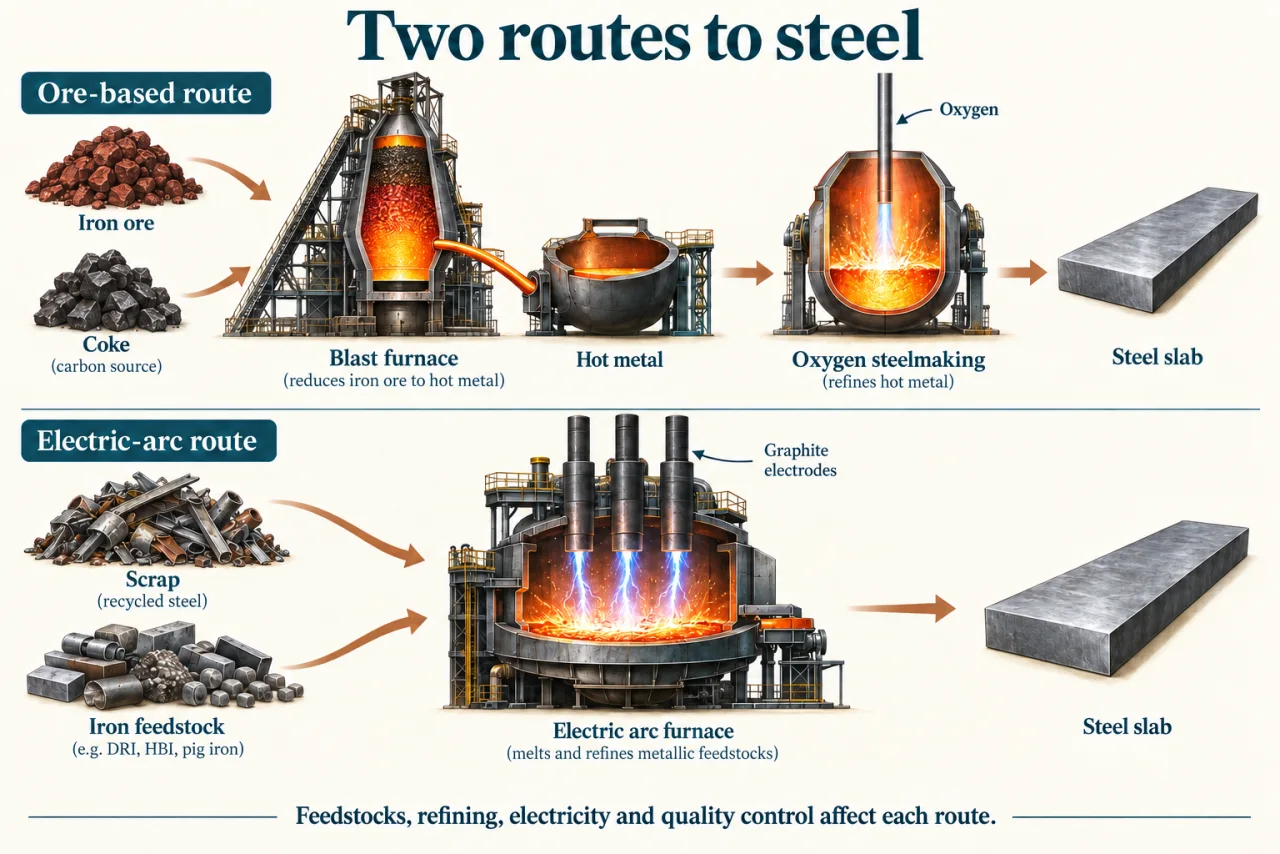
The upper image chain separates these stages: iron ore and a carbon source feed a blast-furnace concept; hot metal then goes to oxygen steelmaking before a steel product is shown. The oxygen-refining stage must not be mistaken for the first extraction of iron from ore. The depicted slab is a product symbol, not evidence that its final grade, dimensions or mechanical properties have been checked.
The lower chain illustrates an electric-arc route using metallic feedstocks such as steel scrap and appropriately prepared iron feed. The arcs provide heat, and the process also requires refining and control of composition. It is not a general claim that an electric furnace can accept arbitrary raw ore and directly produce a certified steel grade. The appropriate mix of scrap, direct-reduced iron, hot-briquetted iron or other metal depends on the plant and product requirements.
Recycling preserves useful metal but does not remove every quality problem automatically. Feedstock composition, contaminants, collection and sorting affect the resulting material. Alloying and further treatment can be essential when a product must meet demanding properties. “Both routes produce steel” means they belong to the same broad material family; it does not mean the two illustrated outputs necessarily have the same grade or that either route is suitable for every product. A simple mixing calculation makes the quality issue visible. If two metallic feeds contain different amounts of an unwanted constituent, its input mass is the sum of feed mass multiplied by constituent fraction. Divide by total feed mass for the mixture concentration. That calculation assumes no selective removal or additions. Melting is not evidence that the constituent vanishes; a refining claim needs a separate balance and process evidence.
A mass-yield calculation needs an explicit boundary. If the input is already metallic feed, recovered product mass divided by that feed mass can describe a stated recovery model. If the input is ore, oxygen removal, gangue, added materials, slag and gases make the balance different. A 95% recovery of metallic feed is not a universal 95% conversion of ore to steel. Compare like boundaries before interpreting a percentage as waste, efficiency or environmental performance. Recovery and composition are different acceptance tests. Removing 5% of a well-mixed material without selectively removing an impurity reduces both masses by the same fraction, leaving impurity concentration unchanged. A high mass yield can still fail a specification; a lower yield is not automatically proof of better quality or lower lifecycle impacts.
Blast-furnace/oxygen and electric-arc routes are established. Alternative reduction and lower-emissions processes have varying degrees of deployment; the image does not rank them or imply zero emissions. World Steel Association is an industry source, so its general process explanation is used separately from promotional comparisons and forecasts. Electricity supply, feedstock preparation, process emissions, durability and recycling systems all affect a fair environmental comparison.
Discuss: a region needs infrastructure steel but has limited clean electricity and scrap supply. Compare feasible routes, local employment, worker protection, pollution control and long-term electricity investment. Which improvements are justified now, and which require new evidence or infrastructure before they can be promised?
Image: illustration, not a documentary photograph.
Worked example: A theoretical metallic batch mixes 600 kg of feed containing 2.0% constituent X and 400 kg containing 0.50% X. The product target is at most 1.0% X. Suppose 95% of the homogeneous mixture is recovered, with X lost in the same proportion as the other metal. Find initial and recovered X concentrations. Would the recovery step meet the target?
First feed contains 600 × 0.020 = 12 kg X; second contains 400 × 0.0050 = 2 kg X.
Total feed = 1,000 kg and X = 14 kg, giving 14/1,000 × 100% = 1.4%.
Recovered product = 950 kg; X retained = 14 × 0.95 = 13.3 kg.
Recovered concentration = 13.3/950 × 100% = 1.4%, above the 1.0% target.
The homogeneous recovery removes material, not selectively X. Meeting the target requires a justified change in feed selection, dilution or selective processing, then verified product measurements.
This is an original abstract mass-balance example: X is not identified as a specific removable element, and no metallurgical removal process is asserted.
Answer: Both concentrations are 1.4%; 95% homogeneous recovery does not meet a 1.0% composition target.
Check your understanding: Keeping the original 14 kg X and assuming an ideal X-free added metallic feed, what minimum addition brings the mixture to 1.0% X? Does that prove a real steel grade is acceptable?
Answer: Total mass must be at least 14/0.010 = 1,400 kg, so add at least 400 kg of ideal X-free feed. No: other composition, processing and property requirements remain untested.
Why: Dilution changes the denominator without removing X. A single constituent calculation is not a grade certification or proof that the assumed X-free feed exists.