Making flat glass and controlling its stress
By How things work · myAudience
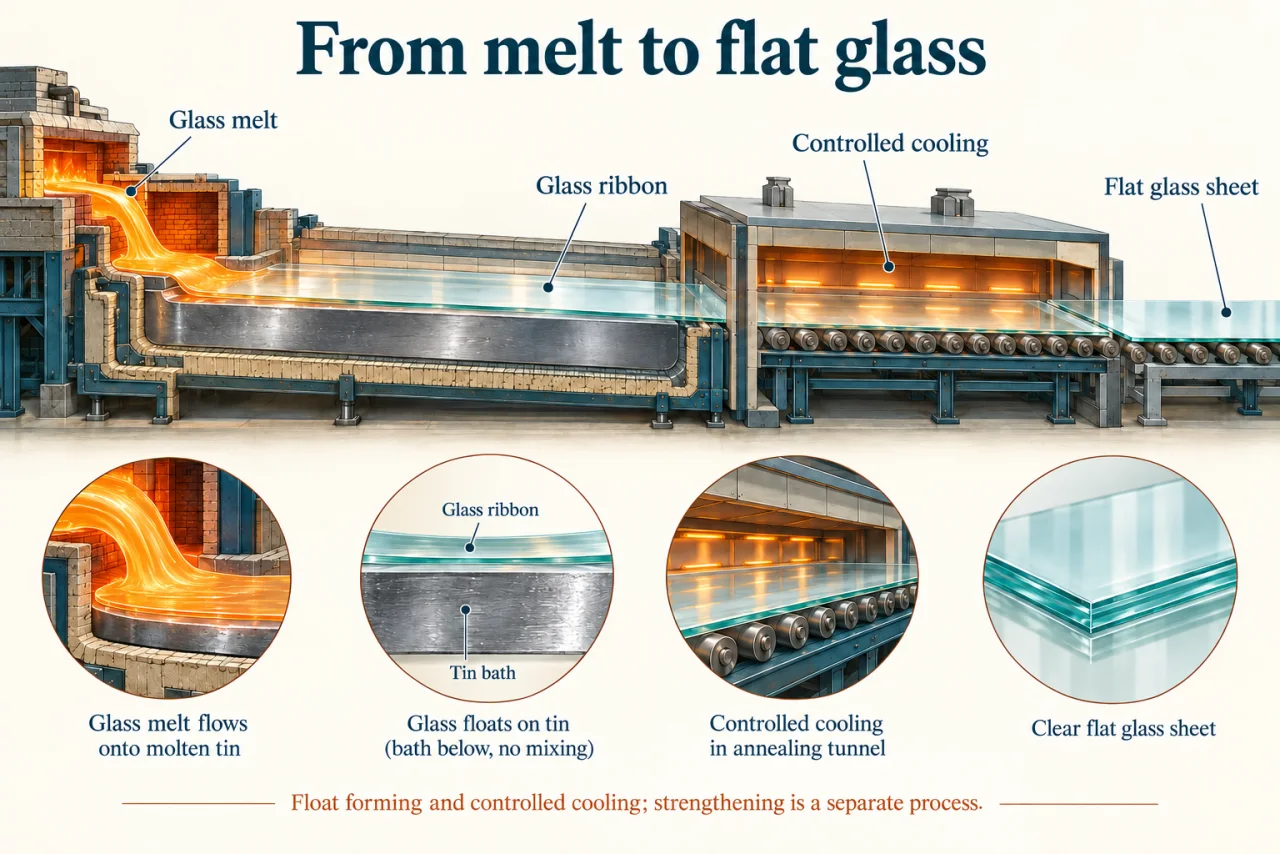
myAudience original rendered teaching illustration. Image: illustration, not a documentary photograph. · Operator-authored generated illustration; scientific concept model reviewed separately.
Making flat glass and controlling its stress
Flat glass manufacture is a sequence of forming and thermal control, not just cooling a puddle on a table. In the established float process, glass melt flows onto a bath of molten tin and forms a smooth ribbon. The liquid support helps establish flat surfaces. Glass and tin remain distinct materials in this model: the tin bath is not an ingredient that must be stirred into the glass.
Trace the image from furnace to tin bath, then through the controlled-cooling tunnel to a sheet. In the central inset, the upper transparent ribbon is glass and the lower silver layer is the tin bath; those leaders identify separate layers. Rollers and the tunnel indicate transport and cooling. The drawing omits detailed furnace chemistry, atmosphere control and plant equipment. It should explain the mechanism without being read as a construction or operating plan.
Cooling rate matters because different parts of glass can contract differently. Annealing uses a controlled cooling history to reduce unwanted residual stress. A sheet that looks flat can still contain stress that affects later cutting or service behaviour. Smooth surfaces and visual transparency are not substitutes for knowing the thermal history and required material properties. During uneven cooling, a surface and interior may try to contract by different amounts while remaining attached. The resulting constraint can leave stress after temperatures equalise. Annealing controls that history to reduce unwanted stress; it does not mean all later thermal gradients are harmless. A sheet’s appearance cannot reveal the full stress state.
Thermal toughening is a separate strengthening process, not the same thing as making a float ribbon. A suitable heat-and-cooling treatment leaves surface compression balanced by stress in the interior. Compression at the surface makes it harder for some cracks to open under a given applied load. This does not make the glass unbreakable, and damage, edges, installation and the particular loading conditions still matter. The image shows forming and annealing, not a certified toughening cycle. Think of surface compression as a pre-existing stress that an applied tensile stress must first counteract before opening a surface crack in that simplified location. This explains a mechanism, not a safe load rating: internal tension, edges, flaws and the actual stress distribution remain important. Toughening changes the stress state rather than removing every possible failure mode.
Laminated glass addresses a different problem by joining layers with an interlayer that can retain fragments after breakage. Toughened and laminated are therefore not interchangeable words for “strong glass.” A design may need more than one property, including impact response, fragment retention or insulation. Selecting a construction for a building or vehicle depends on applicable requirements and qualified engineering, not the appearance of this conceptual plate. Fragment retention is distinct from preventing first fracture. An interlayer can keep broken pieces together without making the intact laminate identical to an unbroken thick monolithic sheet. A retained fragment test, a strength test and an insulation test answer different questions. The float-process plate contains none of those test results.
For a uniform sheet, volume is length × width × thickness, and mass is density × volume. Convert millimetres to metres before multiplying: a missing factor of 1,000 in thickness produces a 1,000-fold mass error. This geometry model estimates mass under an assumed density; it cannot establish safe span or load capacity. Float forming, annealing, toughening and lamination are established processes, but their purposes and checks remain distinct.
Discuss: large glazed buildings can improve daylight while increasing material demand and affecting heating, cooling and wildlife. Compare climate, shade, comfort, energy, bird protection, repair and accessibility. Describe how a design could preserve the benefits without assuming that more glass is always better.
Image: illustration, not a documentary photograph.
Worked example: Estimate mass of a theoretical laminate covering 3 m²: two glass sheets each 4 mm thick with density 2,500 kg/m³, plus a 0.76 mm interlayer of assumed density 1,100 kg/m³. Ignore adhesive additions and edge features. Compare with a single 8 mm glass sheet of the same area. What performance conclusion is justified?
Convert thicknesses: each glass sheet 0.004 m; interlayer 0.00076 m.
Each glass sheet has volume 3 × 0.004 = 0.012 m³ and mass 30 kg; the two sheets give 60 kg.
Interlayer volume = 3 × 0.00076 = 0.00228 m³; mass = 0.00228 × 1,100 = 2.508 kg.
Total modeled laminate mass = 62.508 kg, approximately 62.5 kg.
The single 8 mm glass sheet has mass 3 × 0.008 × 2,500 = 60 kg.
The laminate is approximately 2.5 kg heavier under these assumptions. Equal total glass thickness does not establish equal strength, stiffness, fragment retention or thermal performance; those need appropriate material and construction tests.
Answer: Approximately 62.5 kg versus 60 kg; mass and layer construction alone do not establish a safe span or equivalent performance.
Check your understanding: A sheet is annealed and visibly flat. A second sheet is toughened, and a third is laminated. Which of those descriptions alone establishes that broken fragments will remain attached, and why is that not a complete safety guarantee?
Answer: Lamination is intended to provide fragment retention through an interlayer. Annealing reduces residual stress; toughening creates a strengthening stress state. None of those labels alone certifies every installation or failure condition.
Why: The processes address different mechanisms. Retention depends on the specified interlayer, construction and conditions; appearance and a mass calculation cannot substitute for product testing.