Nuclear electricity: fission heat and three separate routes
By How things work · myAudience
myAudience original rendered teaching illustration. Image: illustration, not a documentary photograph. · Operator-authored generated illustration; scientific model reviewed separately.
Nuclear electricity: fission heat and three separate routes
Nuclear fission releases energy when a heavy nucleus splits. A controlled chain reaction supplies heat, rather than electricity directly. In a light-water reactor, water transfers heat and also slows neutrons; neutron absorption is a different function from moderation. This lesson follows an established pressurised-water reactor concept. A boiling-water reactor has a different route: steam is produced in the reactor vessel itself, so the two architectures must not be merged into one diagram.
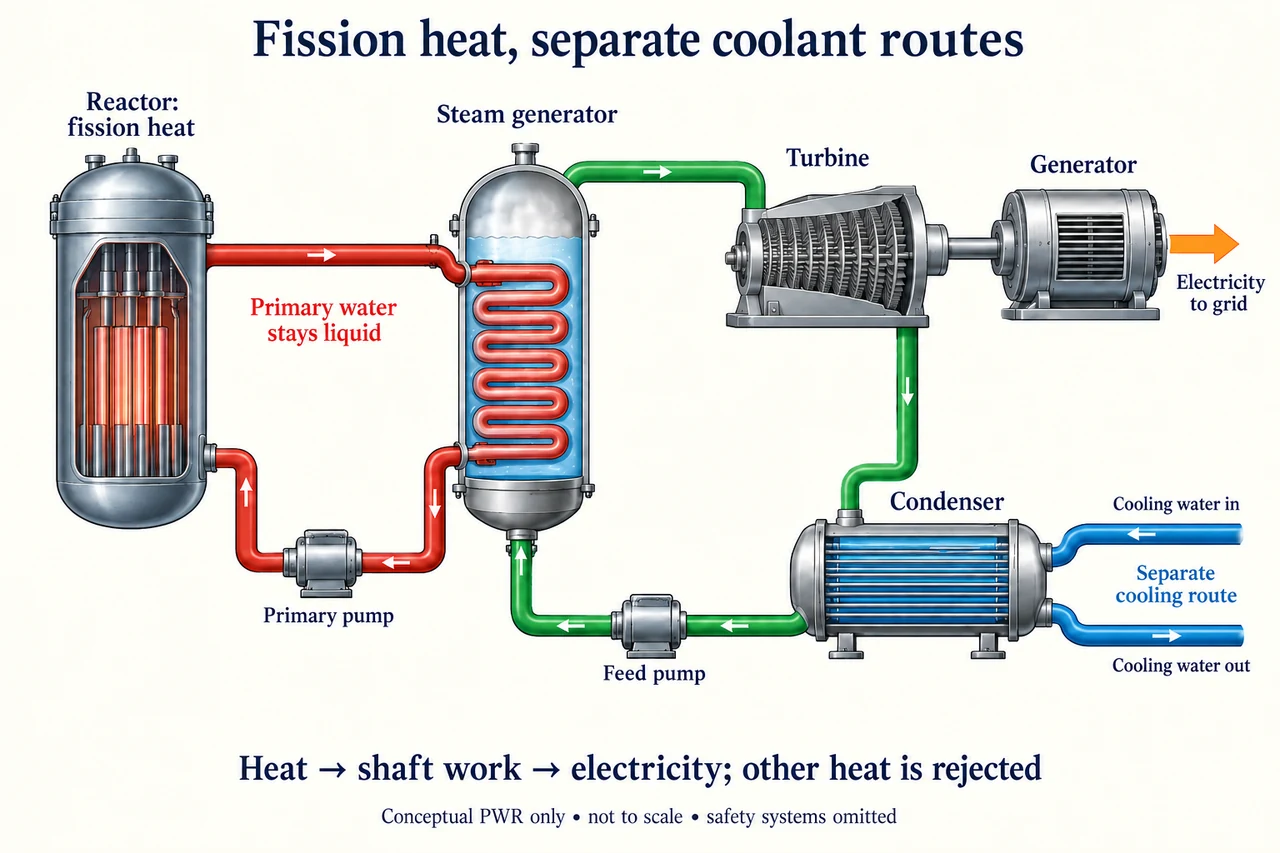
Trace the plate’s red primary loop from the reactor into a sealed steam-generator coil, down through the primary pump and back into the reactor. That water remains liquid in this model. Heat crosses the coil wall into the separate secondary water; the red and green routes do not join. Green steam reaches the turbine, whose shaft drives a separate generator. The green route then enters the condenser, returns as liquid through the feed pump and reaches the steam generator again. Blue cooling water follows a third separate path through the condenser.
The image therefore distinguishes energy crossing a wall from matter crossing a wall. Steam is not piped into the electrical windings, and cooling water does not need to enter the reactor to accept rejected heat. A cycle must reject heat as well as deliver work. Define thermal input power, gross electrical output and internal electrical demand before quoting an efficiency; subtracting internal demand once gives net export, whereas treating gross output as export hides that demand.
Invent a steady account with 3,000 MW of reactor thermal input and 1,050 MW gross electrical output. Gross conversion is 35%. If auxiliaries consume 50 MW, export is 1,000 MW and net conversion is one third. For a simplified complete plant boundary with no changing stored energy and no other useful export, 2,000 MW ultimately reaches the surroundings as heat. Do not subtract 50 MW twice: internal electricity is already inside that whole-plant balance.
For transfer, suppose gross output rises to 1,080 MW but auxiliary demand rises to 90 MW at the same thermal input. Export falls to 990 MW, even though the generator produces more. The net ratio is 33%, below the earlier 33.33%. This makes a useful general distinction between component improvement and system improvement. These fictional figures teach accounting, not a typical plant efficiency, permitted operating state or a prediction of reactor behaviour.
Discuss a proposal balancing dependable electricity, cooling-water impacts, waste stewardship, financing and the views of nearby communities. Give future generations an explicit place in the decision rather than treating a short-term electricity price as the whole answer. The plate omits protective systems and is not a construction or control plan. It cannot establish accident risk, lifecycle emissions or waste-storage suitability; those require separate site-specific evidence and regulation.
Image: illustration, not a documentary photograph.
Worked example: A fictional plant takes 2,400 MW thermal input, makes 840 MW gross electricity and uses 60 MW internally. Find net export, gross and net efficiency, and total eventual heat to surroundings in the steady whole-plant model.
Net export = 840 − 60 = 780 MW.
Gross efficiency = 840/2,400 = 35%; net = 780/2,400 = 32.5%.
With no other export or energy accumulation, eventual heat = 2,400 − 780 = 1,620 MW.
Answer: 780 MW net; 35% gross; 32.5% net; 1,620 MW eventual heat.
Check your understanding: Why is 2,400 − 840 − 60 = 1,500 MW the wrong complete-plant rejected-heat account?
Answer: It subtracts auxiliary electricity as though it left the plant usefully. The 60 MW is internal and eventually contributes to heat. Gross 840 MW contains both exported 780 MW and internally used 60 MW.
Why: Declare boundaries, keep units consistent and distinguish an invented explanatory model from measured installation performance.