Combined-cycle turbines: useful exhaust, counted once
By How things work · myAudience
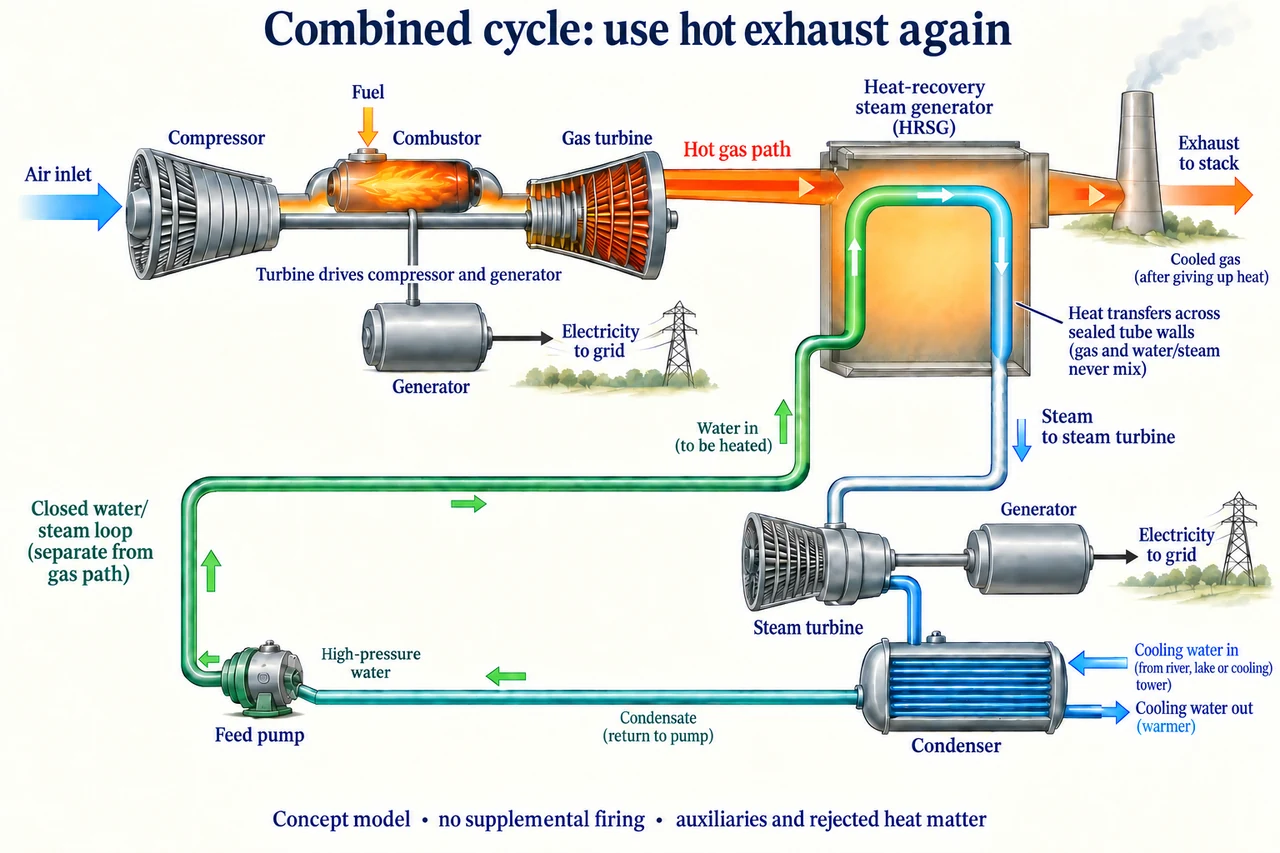
myAudience original rendered teaching illustration. Image: illustration, not a documentary photograph. · Operator-authored generated illustration; scientific model reviewed separately.
Combined-cycle turbines: useful exhaust, counted once
A gas turbine draws in air, compresses it, adds fuel in a combustor and expands the hot gas through a turbine. Some turbine shaft work drives the compressor; the remaining shaft work can drive an electrical generator. Compression is therefore a real internal demand, not a free preparation step. This is an established open gas-flow architecture, while its detailed materials, emissions controls and fuel compatibility depend on the engineered machine.
In the plate, trace the top gas route through compressor, combustor and gas turbine toward the heat-recovery steam generator and exhaust. The mechanical shaft is distinct from that route: gas does not flow through electrical windings. At the heat-recovery unit, exhaust transfers energy across sealed tube walls to a separate water/steam circuit. Steam drives the lower turbine, is condensed and returns through a feed pump. Condenser cooling water follows another separate route.
A combined cycle uses some exhaust energy in a second cycle. That is different from using exhaust heat directly for a useful heating service, known as combined heat and power, and different again from a recuperator preheating compressed air before combustion. This model includes no supplementary firing in the heat-recovery unit. If another burner were added, its fuel input would have to be counted; otherwise apparent efficiency would be exaggerated.
Create an original energy account with 100 MW fuel input on a declared consistent energy basis. Suppose gas-turbine electrical output after its compressor demand is 35 MW, 55 MW reaches the exhaust-recovery boundary and 10 MW reaches other thermal outputs. If the steam cycle turns 30% of that 55 MW into gross electricity, it adds 16.5 MW. Gross total is 51.5 MW; plant auxiliaries using 1.5 MW leave 50 MW net export. The 55 MW is part of the original 100 MW, not a second free input to add in the denominator.
For transfer, imagine only 40 MW reaches the recoverable-exhaust boundary and the steam cycle converts 25% of it, while gas electrical output remains 35 MW. Steam adds 10 MW; with the same 1.5 MW auxiliary demand, export becomes 43.5 MW. Other thermal outputs must then account for 25 MW before bottoming-cycle rejection in this stipulated model. A component ratio alone cannot establish whole-plant performance, and actual changing exhaust conditions require a thermodynamic model rather than these independent fictional assumptions.
Discuss a power-service choice including reliability, local air pollution, upstream fuel impacts, cooling demand, cost and who lives near the site. Higher fuel-to-electricity conversion does not imply zero lifecycle emissions, nor that any proposed hydrogen blend is compatible with any turbine. Historical programme targets and world-record claims are not adopted as current performance. The plate teaches flows and accounting, not combustion settings, maintenance or equipment construction.
Image: illustration, not a documentary photograph.
Worked example: A fictional unfired combined cycle has 80 MW fuel input, 28 MW gas-cycle electricity and 44 MW exhaust heat at the recovery boundary. The bottoming cycle converts 25% of that heat into electricity; other plant auxiliaries use 2 MW. Find gross and net output and net efficiency.
Bottoming-cycle electricity = 44 × 0.25 = 11 MW.
Gross = 28 + 11 = 39 MW; net = 39 − 2 = 37 MW.
Net efficiency on the stated fuel basis = 37/80 = 46.25%.
Answer: 39 MW gross, 37 MW net, 46.25% net on the declared boundary.
Check your understanding: Why are 28/80 and 11/44 not percentages to add directly? What denominator allows combined net comparison?
Answer: They refer to different input boundaries. The bottoming input 44 MW is already derived from the original 80 MW fuel. Add actual electrical outputs, subtract stated auxiliaries and divide net 37 MW by original fuel input 80 MW.
Why: Declare boundaries, keep units consistent and distinguish an invented explanatory model from measured installation performance.