Geothermal power: heat flow, working fluid and net output
By How things work · myAudience
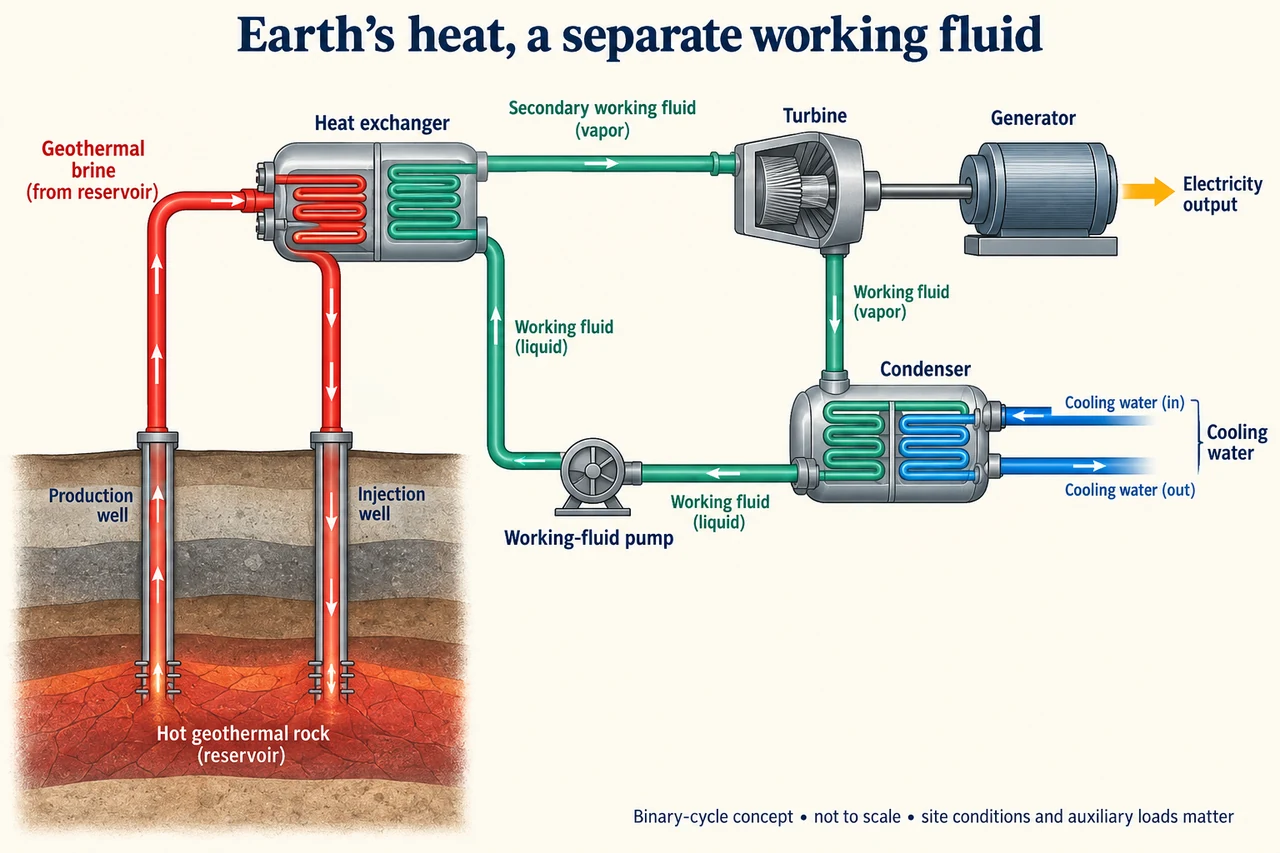
myAudience original rendered teaching illustration. Image: illustration, not a documentary photograph. · Operator-authored generated illustration; scientific model reviewed separately.
Geothermal power: heat flow, working fluid and net output
A geothermal resource needs more than hot rock. Accessible heat, fluid transport and flow pathways determine whether useful thermal power can reach the surface. Conventional hydrothermal resources provide these conditions naturally. Enhanced geothermal systems engineer flow pathways, while underground closed-loop designs keep fluid within pipes. These are different reservoir approaches; current research or projected capacity is not evidence that every location can already supply commercial electricity.
The plate shows one established surface conversion architecture: a binary cycle. Red geothermal brine rises through the production well, gives up heat in an exchanger and returns through an injection well. A separate green working fluid receives heat, becomes vapour, drives the turbine and is condensed before the pump returns it. A shaft links turbine to generator; no geothermal brine travels through the generator. Blue cooling water is separate again. Adjacent coils symbolise heat transfer across metal, not fluid mixing or an actual exchanger construction.
Dry-steam and flash-steam plants use different routes from this binary model. In particular, pressure reduction can turn part of a hot liquid stream into vapour in a flash plant; a binary plant transfers energy to another fluid. Do not assign a single temperature cutoff as a universal law for choosing a plant. Resource composition, heat rejection, available flow and engineering economics all influence a design. Reinjection helps manage the resource but does not promise immediate replacement of extracted heat.
Construct an invented liquid-side heat balance with mass flow 20 kg/s, effective specific heat 4,000 J/(kg K) and a 30 K temperature fall. Assume liquid remains liquid and effective heat capacity is constant: thermal transfer is mass flow × specific heat × temperature change = 2.4 MW. If gross electrical conversion of that transfer is 12%, gross output is 288 kW. Subtract 48 kW auxiliary demand to obtain 240 kW net, which is 10% of this extracted thermal input.
Test a flow change without hiding its cost. Holding the same temperature fall and conversion assumption, doubling flow gives 4.8 MW extracted heat and 576 kW gross electricity. If higher pumping demand becomes 200 kW, net output is 376 kW: it increased, but not to twice the earlier 240 kW. The net ratio is about 7.83%. A real reservoir may not maintain the same temperature and pumping relation, so this conditional calculation is a reasoning exercise rather than a well-production forecast.
Discuss a local project using geological evidence and monitoring rather than declaring geothermal universally harmless. Include water management, nearby residents, land access, possible induced seismic effects of reservoir engineering and transparent reporting of uncertainty. Established binary plants and experimental or developing reservoir approaches deserve different evidence labels. Compare sustained net useful service, not only installed generator capacity or a claim that renewable heat can be removed indefinitely without consequences.
Image: illustration, not a documentary photograph.
Worked example: A fictional liquid stream flows at 15 kg/s and cools 25 K with constant specific heat 4,000 J/(kg K), no phase change. Gross conversion is 10%; auxiliaries use 25 kW. Find thermal transfer and net electricity.
Thermal transfer = 15 × 4,000 × 25 = 1,500,000 W = 1.5 MW.
Gross electricity = 0.10 × 1.5 MW = 150 kW.
Net = 150 − 25 = 125 kW; net thermal conversion = 125/1,500 = 8.33%.
Answer: 1.5 MW transferred, 125 kW net, approximately 8.33% on this boundary.
Check your understanding: Can you infer reservoir lifetime from the 1.5 MW calculation? Which missing information matters?
Answer: No. This is a stream heat balance at one assumed condition. Reservoir volume, stored energy, recharge, rock-fluid heat transfer, changing temperatures and sustainable flow over time are not supplied.
Why: Declare boundaries, keep units consistent and distinguish an invented explanatory model from measured installation performance.