Concentrating solar thermal: collect heat, then choose when to use it
By How things work · myAudience
myAudience original rendered teaching illustration. Image: illustration, not a documentary photograph. · Operator-authored generated illustration; scientific model reviewed separately.
Concentrating solar thermal: collect heat, then choose when to use it
Concentrating solar thermal equipment reflects sunlight onto a receiver and heats a fluid. This differs from photovoltaics, which convert light into electrical output in semiconductor devices. A power tower uses steerable mirrors to direct light toward a receiver; trough and other concentrating designs have different geometries. The mirrors are not extra energy sources: concentration redistributes collected radiant power into a smaller receiver area.
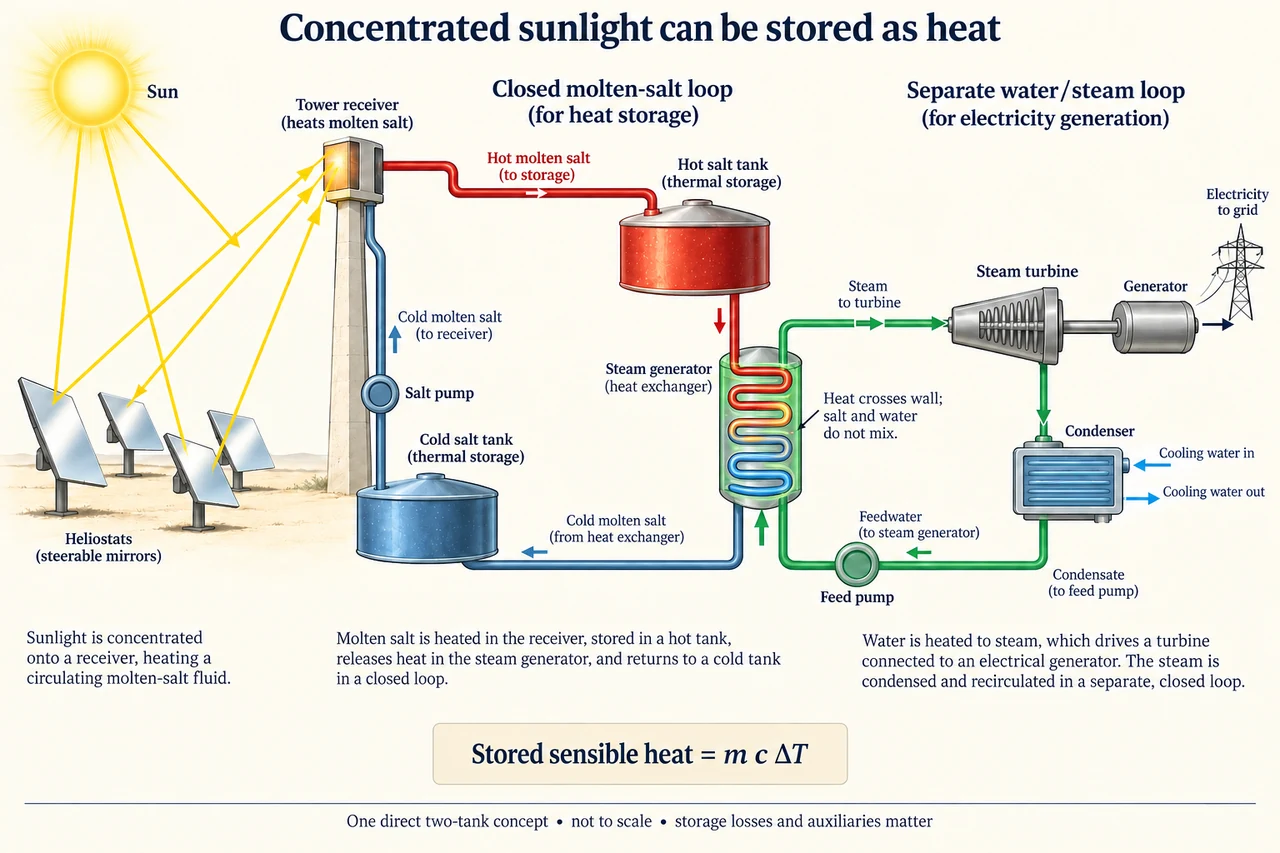
The plate depicts one direct two-tank molten-salt concept. Follow cooler liquid salt from its tank through a pump toward the tower receiver, then heated salt toward the hot tank. Hot salt transfers energy in a steam generator before returning to the cooler tank. A separate water/steam loop drives a turbine and generator, then condenses and returns through a feed pump. Salt and water do not mix across the sealed exchanger wall. Both salt tanks contain liquid in this illustration; cold means cooler than the hot store, not frozen.
Collection and electricity production can occur at different times because the store holds thermal energy. Without fresh sunlight, hot inventory can still supply the power cycle, but only until available stored energy or operating limits are reached. Real storage has losses and plant auxiliaries; thermal megawatt-hours are not the same as electrical megawatt-hours. This direct-storage architecture is established, while proposed higher-temperature materials or new working-fluid cycles need separate evidence before performance is claimed.
For an invented sensible-heat model, 600,000 kg of liquid storage material with constant effective specific heat 1,500 J/(kg K) cools through 200 K without phase change. Stored energy difference is m c ΔT = 180 billion J = 50 MWh thermal. If 95% reaches the power-cycle heat-input boundary and gross electrical conversion is 40%, gross electricity is 19 MWh. A stipulated total 1 MWh auxiliary demand over dispatch leaves 18 MWh export, enough for six hours at a constant 3 MW net output under those assumptions.
A second original boundary check starts with 8 MW incident sunlight on the collection area. If optical collection delivers 70% to the receiver and 90% of that becomes useful fluid heat, the result is 5.04 MW thermal. At 35% gross electrical conversion, gross output is 1.764 MW. Subtract an invented 0.164 MW auxiliary demand to get 1.6 MW net: 20% of original incident power. Quoting only the power-cycle 35% as sunlight-to-grid efficiency would skip optical, thermal and auxiliary losses.
Discuss where a project would offer useful dispatchable service while considering land, habitat, water or air cooling, maintenance access and neighbouring communities. Thermal storage shifts a finite resource in time; it cannot guarantee uninterrupted power without enough collection and storage. Compare evidence on lifetime service and site effects rather than beautiful mirror fields alone. The image and examples are not optical alignment, hot-salt handling or pressure-equipment instructions.
Image: illustration, not a documentary photograph.
Worked example: A fictional store contains 400,000 kg of liquid material, constant specific heat 1,500 J/(kg K), available 180 K temperature fall, no phase change. Heat delivery is 90% and gross power-cycle conversion is 40%; total dispatch auxiliaries use 0.8 MWh. Find thermal inventory and net electrical export.
Inventory = 400,000 × 1,500 × 180 = 108 billion J = 30 MWh thermal.
Delivered heat = 30 × 0.90 = 27 MWh; gross electricity = 27 × 0.40 = 10.8 MWh.
Net export = 10.8 − 0.8 = 10 MWh, under the stated fixed dispatch auxiliary account.
Answer: 30 MWh thermal inventory and 10 MWh net electrical export.
Check your understanding: If only half the available temperature fall is used but the same fixed 0.8 MWh auxiliary demand applies, does net export halve? State the conditional result.
Answer: Thermal inventory halves to 15 MWh; gross electrical output becomes 15 × 0.90 × 0.40 = 5.4 MWh. Net is 4.6 MWh, less than half the earlier 10 MWh because the same fixed auxiliary demand was stipulated. Actual auxiliaries may change with duration and operating state.
Why: Declare boundaries, keep units consistent and distinguish an invented explanatory model from measured installation performance.