Lead-acid batteries: charge, chemistry and the load
By How things work · myAudience
myAudience original rendered teaching illustration. Image: illustration, not a documentary photograph. · Operator-authored generated illustration; scientific model reviewed separately.
Lead-acid batteries: charge, chemistry and the load
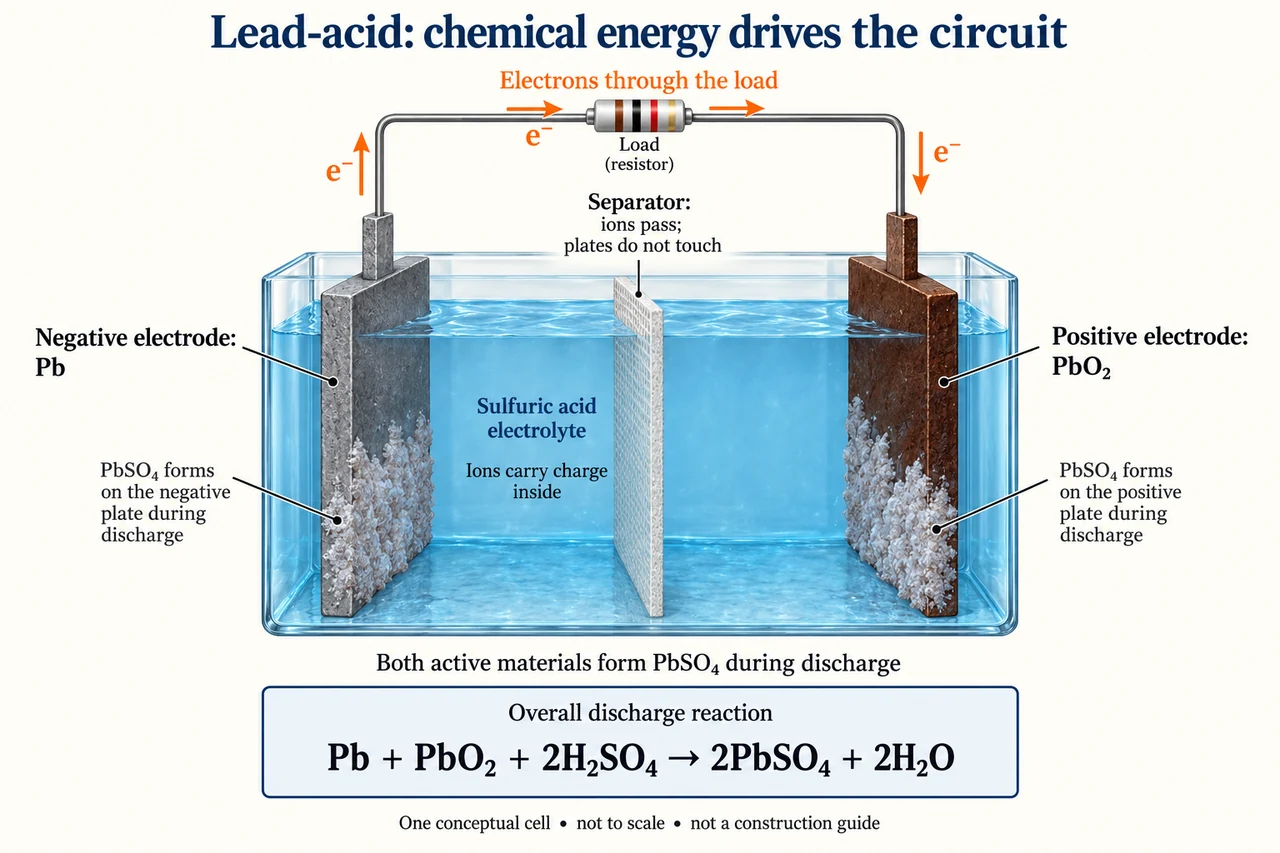
A lead-acid battery transfers chemical energy into electrical energy while discharging. Its negative active material is lead and its positive active material is lead dioxide; both react with sulfuric acid electrolyte to form lead sulfate and water. Oxidation supplies electrons at the negative electrode, and reduction consumes electrons at the positive electrode. Connecting a load provides the external path; the electrolyte provides ionic charge transport, not a stream of free electrons crossing between the plates.
The plate shows one conceptual discharging cell, not an entire car battery. Trace orange electron arrows out of the lead plate, through the external load, and into the lead-dioxide plate. The separator prevents direct plate contact while allowing ionic transport. The overall equation is Pb + PbO₂ + 2 H₂SO₄ → 2 PbSO₄ + 2 H₂O. Count two lead atoms, two sulfur atoms, four hydrogen atoms and ten oxygen atoms on each side. Electrons cancel from a balanced overall reaction rather than appearing as an extra material product.
Charging supplies electrical work to drive the desired chemical changes in the reverse direction. Reversible chemistry does not imply an indestructible battery: current, temperature, time and charging conditions influence degradation and useful capacity. This is an established rechargeable chemistry, but a safe charging method is specific to the complete engineered battery and its controls. Lead toxicity, corrosive electrolyte and potential gas release rule out opening or improvising a cell as a learning activity.
Distinguish voltage, charge capacity and energy. One ampere-hour is 3,600 coulombs. A nominal 12 V, 40 Ah rating gives the rough energy estimate 12 × 40 = 480 Wh if voltage is approximated as constant. It does not promise 480 Wh at every discharge rate or temperature. Actual delivered energy is the time integral of terminal voltage times current until an allowed cutoff, so a changing voltage profile and internal heating matter.
Test a transfer model rather than simply copying a rating. Suppose a fictional permitted discharge delivers 5 A for two hours at 12 V and then 5 A for two hours at 11 V. Charge delivered is 20 Ah, while energy is 120 + 110 = 230 Wh. Multiplying all 20 Ah by the initial 12 V gives 240 Wh and overstates this modelled result by 10 Wh. A sudden high-current load can also increase resistive heating; useful runtime cannot be inferred from a low-rate rating without appropriate data.
Discuss a backup-power decision where lead-acid cells are cheaper initially but heavier and require carefully managed replacement and recycling. Include who handles discarded material and who receives reliable electricity. Recycling has value but does not make lead harmless: evidence about worker protection, containment and local collection systems matters. Compare useful lifetime service and recovery conditions, not merely purchase price or a universal claim that one chemistry is best.
Image: illustration, not a documentary photograph.
Worked example: A fictional allowed profile supplies 4 A at 12.0 V for 1.5 h, then 4 A at 11.0 V for 0.5 h. Find charge and terminal electrical energy.
Charge = 4 × (1.5 + 0.5) = 8 Ah = 28,800 C.
First energy = 12 × 4 × 1.5 = 72 Wh.
Second energy = 11 × 4 × 0.5 = 22 Wh; total = 94 Wh.
Answer: 8 Ah and 94 Wh; nominal 12 V × 8 Ah would predict 96 Wh.
Check your understanding: Why can two discharges deliver the same ampere-hours but different watt-hours? State the numerical distinction.
Answer: Ampere-hours integrate current over time. Watt-hours integrate voltage times current. In this profile 8 Ah includes different voltages, so 94 Wh rather than a constant-voltage 96 Wh follows.
Why: Declare the system boundary and assumptions before applying conservation. Invented values test reasoning, not a real installation.