Hydrogen: separate electrons from the ionic route
By How things work · myAudience
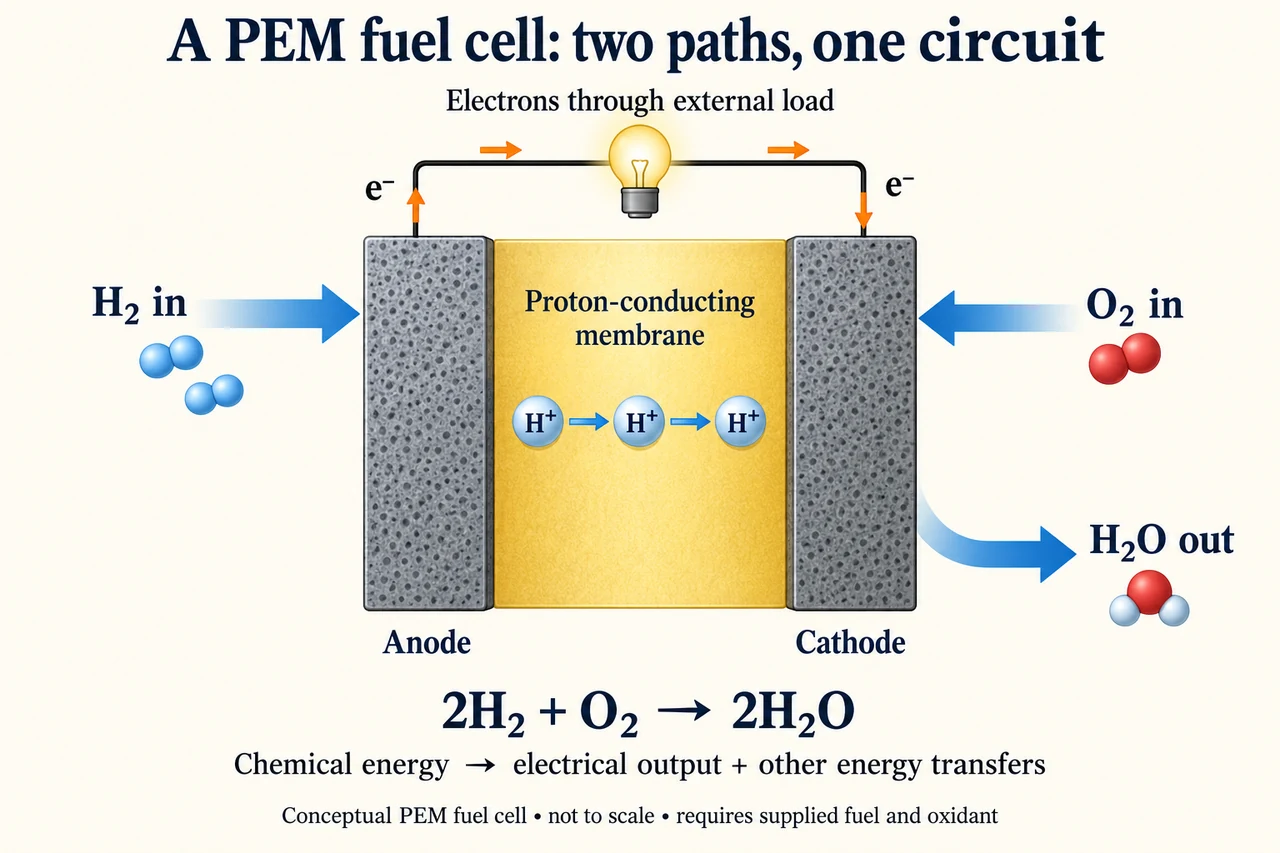
myAudience original rendered teaching illustration. Image: illustration, not a documentary photograph. · Operator-authored generated illustration; scientific model reviewed separately.
Hydrogen: separate electrons from the ionic route
An electrolyser uses supplied energy to split water into hydrogen and oxygen. A fuel cell instead uses fuel and oxidant to produce electrical output through electrochemical reactions. Hydrogen is an energy carrier: water is not a free fuel that repeatedly supplies electricity without an energy input. A complete storage pathway includes production, storage and delivery as well as the cell itself.
The plate depicts a polymer-electrolyte-membrane fuel cell; the written comparison also explains PEM electrolysis, not a claim that every device transports the same ion. In the PEM electrolyser, water at the anode forms oxygen, protons and electrons; protons cross the membrane toward the cathode, while an external powered circuit supplies the electron route. The cathode combines protons and electrons to form hydrogen. In the PEM fuel cell, hydrogen reacts at the anode; protons cross toward the cathode, and electrons pass through an external load before joining oxygen and protons to form water.
Write atom- and charge-balanced reactions. Electrolysis overall is 2 H₂O → 2 H₂ + O₂. For its PEM anode: 2 H₂O → O₂ + 4 H⁺ + 4 e⁻; for its cathode: 4 H⁺ + 4 e⁻ → 2 H₂. Reverse the overall chemical direction for a hydrogen fuel cell: 2 H₂ + O₂ → 2 H₂O. The electrode names refer to oxidation at the anode and reduction at the cathode; their electrical signs differ between an externally driven electrolyser and a power-producing fuel cell. Copying one sign convention to both would be wrong.
Using a deliberately specified chemical-energy basis, an invented electrolyser stores 65 kWh of hydrogen energy from 100 kWh electrical input. A fuel-cell system delivering 50% of that same chemical-energy basis returns 32.5 kWh electrically. Round-trip electrical efficiency is 32.5%, before any additional storage and delivery losses not already included. Hydrogen heating-value conventions and boundary choices must match: combining an efficiency on one basis with an energy value on another corrupts the calculation.
For a demanding transfer, add a compression step that requires 5 kWh per 100 kWh electrolyser input without changing the stored hydrogen energy in this simplified account. Total electrical input becomes 105 kWh; the same 32.5 kWh returns, giving 30.95% rather than 32.5%. If recovered heat has a useful local demand, account for it separately; it is not extra electricity. Economic value and storage duration can differ from electrical round-trip efficiency, so one ratio alone cannot decide the application.
Discuss using low-carbon electricity to produce hydrogen versus delivering that electricity directly to a nearby demand. Include timing, transport constraints, water supply, material durability and who bears infrastructure costs. Established electrolyser and fuel-cell types exist, while new membranes/catalysts require application-specific evidence about scale and lifetime. Do not infer zero lifecycle emissions from water at the exhaust, adopt dated cost targets as achieved prices, or use this conceptual lesson as a gas-handling procedure.
Image: illustration, not a documentary photograph.
Worked example: An invented pathway stores 70 kWh of hydrogen energy from 100 kWh electrical input and returns 55% of that same energy basis as electricity. Extra handling uses 10 kWh. Find electrical output and full-input round-trip efficiency.
Output = 70 × 0.55 = 38.5 kWh.
Electrical input including handling = 100 + 10 = 110 kWh.
Round-trip efficiency = 38.5/110 = 0.35 = 35%.
Answer: 38.5 kWh output and 35% efficiency under the declared model.
Check your understanding: For PEM fuel-cell reaction 2 H₂ + O₂ → 2 H₂O, which path carries electrons and which carries protons? Why does mixing those paths break the model?
Answer: Electrons travel through the external load, while protons cross the membrane. The membrane separates reactants and selectively transports ions; drawing electron current directly through it bypasses the claimed useful external circuit.
Why: Declare the system boundary and assumptions before applying conservation. Invented values test reasoning, not a real installation.