Hydraulic actuators: force, flow and the pump behind them
By How things work · myAudience
myAudience original imagegen teaching illustration; illustration, not a documentary photograph. · Original generated illustration; scientific and publication acceptance pending independent review.
Hydraulic actuators: force, flow and the pump behind them
A positive-displacement pump traps fluid and reduces the chamber volume to deliver it. In a piston version, check valves admit fluid on intake and prevent return on delivery. Unlike the accepted centrifugal-pump lesson, displacement per cycle sets the ideal flow. Pressure is the response to the downstream load and resistance, not an independent promise of constant pressure.
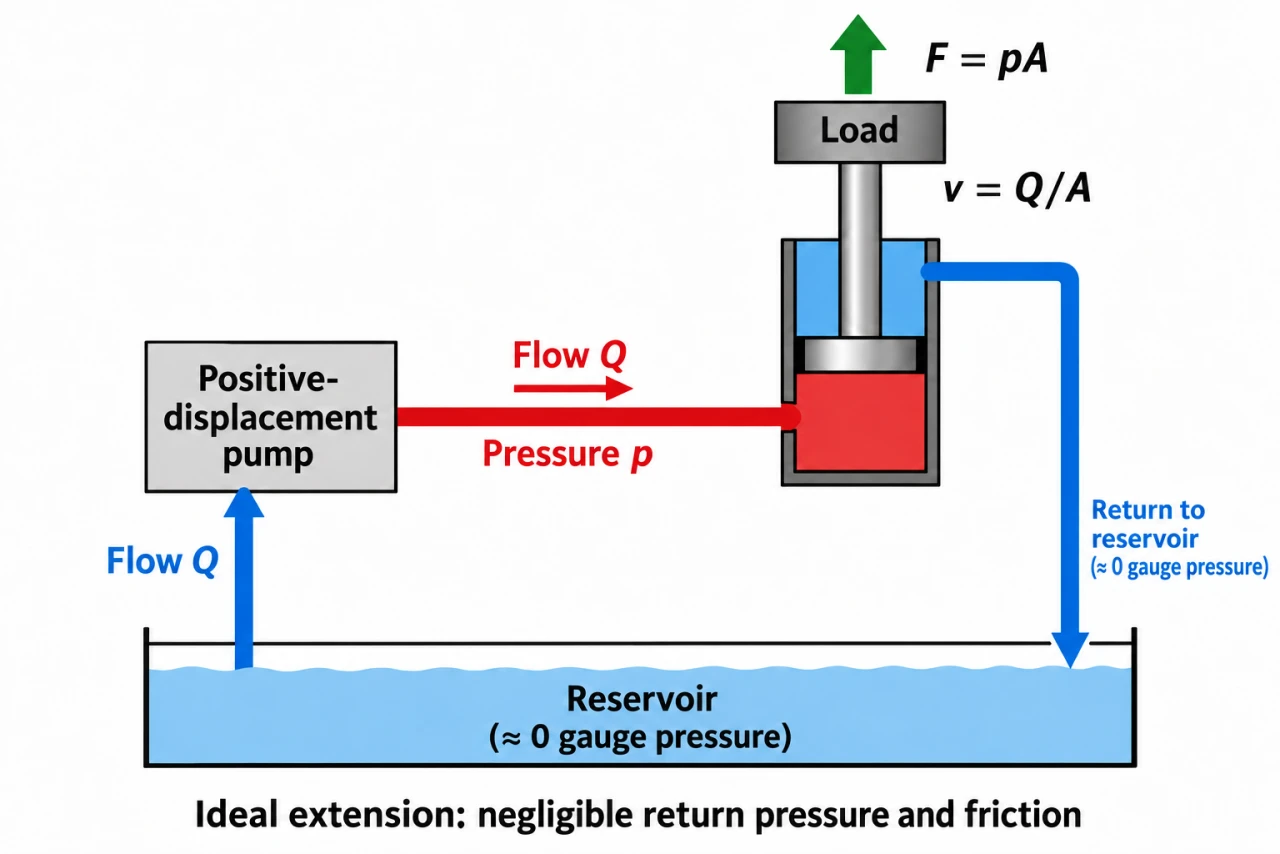
For steady full-area extension with negligible return gauge pressure and friction, force is F = pA, with p the supply gauge pressure. We write Δp for this pressure above return in the model. A rod cylinder with significant return pressure instead needs the force on each different effective area. For nearly incompressible fluid without actuator leakage, Q = Av, so a larger area gives more force but less speed at the same pressure and flow. Multiplying gives Fv = Δp Q: a force advantage does not multiply power.
The rod-side effective area is smaller than the full piston area, so equal flows need not give equal extension and return speeds. Real seals leak, valves dissipate pressure, and oil and trapped gas store energy through compression. These mechanisms explain departures from the steady ideal model. Blocked discharge cannot be treated as harmless zero output; engineered protection belongs to qualified design, not this calculation.
Separate efficiencies: volumetric efficiency reduces delivered flow relative to displacement × cycle rate; overall pump efficiency compares hydraulic output with shaft input. A slow actuator may reflect low flow rather than low pressure. Throttling wastes available fluid power as heating; selecting a larger actuator trades speed for force without itself solving pump losses.
Compare options using duty cycle, leak containment, service access and electrical alternatives. A steady force calculation cannot establish lifting safety, fatigue life or a suitable pressure rating. The model below uses invented moderate values solely to reveal the energy path.
Read the plate from reservoir through pump and red supply into the full piston face, then out of the smaller rod-side chamber along the blue return. Its force and speed equations describe extension only with negligible return gauge pressure and friction. The two labelled Q arrows are pump inlet and delivery, not a claim that rod-side displaced return volume equals full-area delivery.
For discussion, compare a hydraulic lifting service with an electrical alternative: who maintains leaks, who pays for inspections and who bears injury risk? A justified choice needs containment and service evidence alongside useful force and energy; this model supplies no permission to lift people or loads.
Image: illustration, not a documentary photograph.
Worked example: A pump displaces 20 cm³ per cycle at 10 cycles/s; volumetric efficiency is 0.90. It supplies a 0.003 m² piston at Δp = 2 MPa. Overall shaft-to-fluid efficiency is 0.75. Find speed, force and shaft input.
Convert displacement: 20 cm³ = 20 × 10⁻⁶ m³. Q = 0.90 × 20 × 10⁻⁶ × 10 = 0.000180 m³/s.
v = Q/A = 0.000180/0.003 = 0.060 m/s; F = 2 × 10⁶ × 0.003 = 6000 N.
Fluid power = Δp Q = 360 W = Fv. Shaft input = 360/0.75 = 480 W; other outputs total 120 W.
Answer: 0.060 m/s, 6000 N, 480 W shaft input; steady full-area extension, negligible actuator friction and return pressure beyond the declared Δp.
Check your understanding: 1: Double piston area with unchanged delivered Q and Δp. 2: Then let volumetric efficiency fall to 0.80. What changes, and is force now also reduced by 0.80/0.90?
Answer: Area 0.006 m² gives 12,000 N and 0.030 m/s. With efficiency 0.80, Q = 0.000160 m³/s and v = 0.0267 m/s. Force remains 12,000 N if Δp is maintained; the pump must still be able to supply it.
Why: Credit requires preserving both continuity and power, separating flow loss from pressure availability, and stating that speed-dependent leakage and pressure limits could invalidate fixed-efficiency transfer.