Refrigerators: moving heat through a cycle
By How things work · myAudience
myAudience original imagegen teaching illustration; illustration, not a documentary photograph. · Original generated illustration; scientific and publication acceptance pending independent review.
Refrigerators: moving heat through a cycle
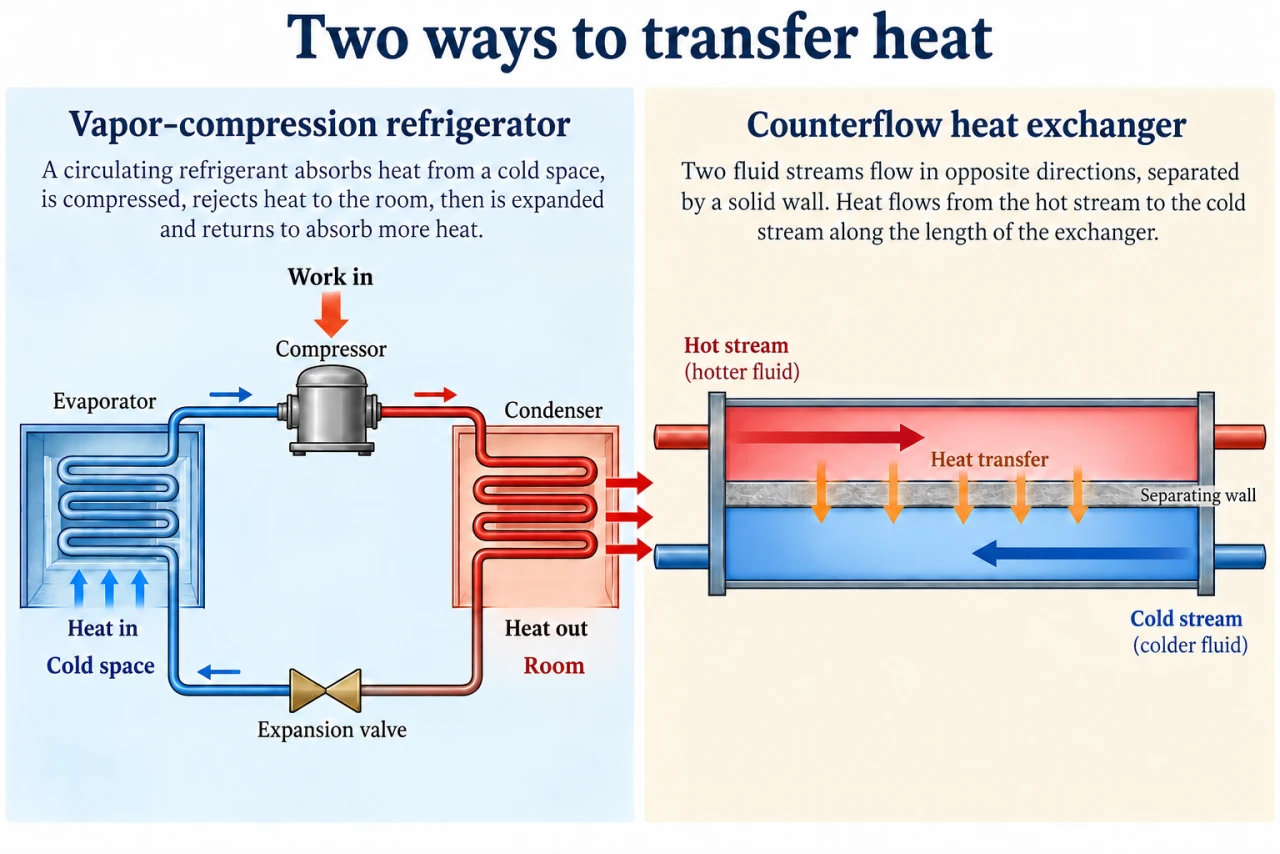
Inside a refrigerator, low-pressure refrigerant evaporates while taking in heat from the cold compartment. The compressor supplies work and raises the vapor pressure and temperature. At the condenser the refrigerant gives heat to the warmer room and condenses. An expansion restriction drops pressure before the evaporator; this is a dissipative throttling step, not a work-producing turbine.
At steady cyclic operation, stored internal energy returns to its initial value each cycle. Thus heat rejected to the room equals heat removed from the compartment plus compressor input: Qh = Qc + W. Cooling COP = Qc/W measures heat moved per work supplied. It is not a fraction of energy converted and can exceed one without creating energy.
The reversible reservoir bound is COPc = Tc/(Th − Tc), using kelvin. It bounds an ideal cycle between fixed reservoirs; actual refrigerant must be colder than the compartment and hotter than the room to transfer heat at a finite rate. Friction, throttling and those extra temperature differences lower performance. Name the reservoir temperatures before using the bound.
A door opening increases the cooling load; it does not make a fixed nameplate COP a guarantee of daily energy consumption. Cycling controls, insulation, humidity and defrost change the energy balance over time. A refrigerator with its door open rejects the extracted room heat plus its input work back to that same room.
Use the left half of the shared plate for this lesson: heat enters the blue evaporator from the cold space, work enters the compressor, heat leaves the red condenser to the room and the expansion restriction returns refrigerant toward the evaporator. The right half is a different, passive heat-exchanger mechanism. Heat arrows cross boundaries; pipe arrows track refrigerant.
For discussion, a community cold store may prioritise reliable food preservation, repair access and refrigerant leakage management as well as electricity. How would you compare lifetime service and access without assuming that the best steady COP guarantees the best real outcome?
Image: illustration, not a documentary photograph.
Worked example: An invented steady refrigerator removes 240 W with 80 W electrical input. Cold and hot reservoirs are 270 K and 300 K. Find cooling COP, room heat and reversible bound.
COPc = 240/80 = 3. Room receives 240 + 80 = 320 W.
Reversible COPc = 270/(300 − 270) = 9. The observed COP is one third of this bound, not a 33% energy conversion efficiency.
For one hour at constant load, input is 80 Wh = 0.080 kWh; heat removed is 0.240 kWh.
Answer: COP 3; 320 W room heating; ideal bound 9. Invented steady values omit defrost and cycling.
Check your understanding: 1: With the cold reservoir still 270 K but room at 310 K, find the new bound. 2: Can you use the original COP 3 to predict exact new input? Explain the open-door room result.
Answer: The bound falls to 270/40 = 6.75. Actual input needs a performance model at the new conditions; the bound alone does not give it. An open-door unit warms the room by its input work overall, after accounting for both extracted and rejected room heat.
Why: Credit requires a kelvin temperature ratio, a distinction between a bound and measured performance, and a whole-room energy boundary. Unsupported exact predictions receive no credit.