The pan becomes the heater
By How things work · myAudience
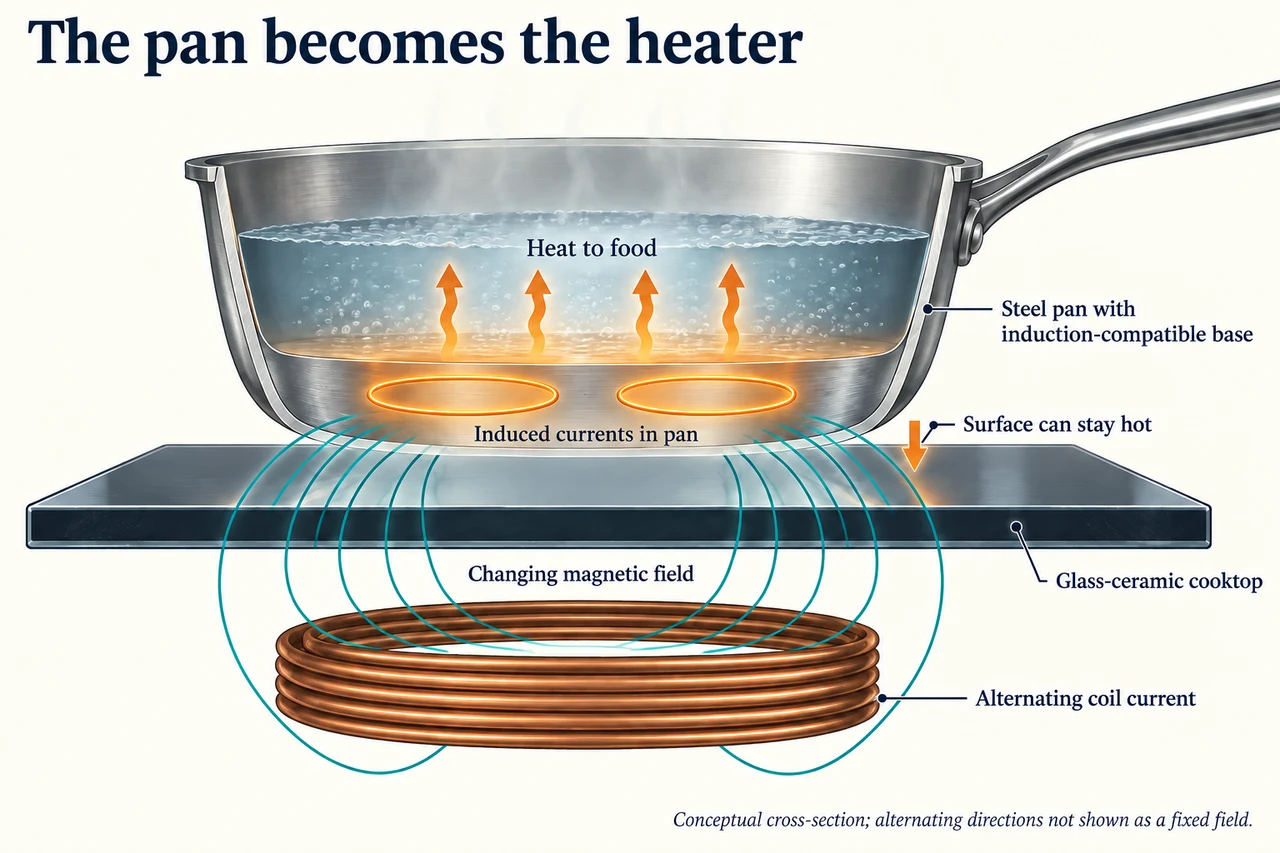
myAudience original rendered teaching illustration. Image: illustration, not a documentary photograph. · Operator-authored generated illustration; scientific model reviewed separately.
The pan becomes the heater
An induction cooktop transfers energy to compatible cookware through a changing magnetic field. Alternating current in a coil beneath the cooking surface produces changing magnetic flux through the metal pan base. This induces circulating currents in the conducting material. Electrical resistance dissipates energy there as heat. Heat then moves through the pan into its contents; magnetic materials can also have other loss mechanisms. The explanatory model focuses on induced-current heating rather than treating every material or appliance as identical.
The glass-ceramic layer separates the coil electrically and mechanically from the pan; it is not a wire carrying the induced pan currents. In the illustration the current loops lie in the metal pan base, while field lines cross the separator. The two are different representations: field lines are not pipes carrying electrons. The field lines and current loops deliberately omit instantaneous directions. Their changing behaviour is the mechanism; their shapes are not a calibrated field map or a fixed north/south configuration.
The source of energy remains the electrical supply. Induction is not heat without an input, and heating a pan still takes time. Not all cookware couples suitably to an ordinary appliance. Compatibility depends on material and design rather than the everyday word metal. DOE’s 2023 consumer explanation is useful for the general mechanism but its broad compatibility and safety statements are not a universal guarantee. Check the actual appliance instructions and cookware requirements rather than treating a magnet test or attractive diagram as a complete engineering evaluation.
For a bounded heating model, energy to raise the temperature of a material is mass × specific heat capacity × temperature increase. This assumes no phase change and a constant specific heat over the range. Water-only useful efficiency compares heat gained by the water to electrical input. A different boundary including the pan changes the numerator. Heating time requires a net heat-transfer rate, not merely the appliance’s label power. In an invented constant-rate model, 1.5 kg water heated from 20°C to 80°C with specific heat 4180 J/(kg·K) gains 376, 200 J. At 1500 W input with 80% water-only useful efficiency, the water gains 1200 J each second and reaches the target in 313.5 seconds.
Removing a compatible pan may stop the intended induction coupling, but it does not immediately remove heat already stored in the pan or cooking surface. The small arrow from the hot pan towards the surface shows why that surface can stay hot. This teaching plate gives no live electrical test or burn-safety permission. Qualifying installation, repair and appliance-specific precautions remain outside a reading lesson.
Compare alternatives using the same meal, starting temperatures, vessels and measurement boundary. Faster heating in one trial does not independently establish lower lifecycle emissions or lower household bills. Electricity source, ventilation, affordability, replacement cookware, repair and access to safe cooking all matter. A defensible recommendation states whose costs and risks are counted and what evidence could overturn the choice. Original theoretical examples teach accounting; measured performance should be dated and specific to tested conditions.
Image: illustration, not a documentary photograph.
Worked example: A fictional 1500 W cooktop transfers 80% of its input to 1.5 kg water, with constant specific heat 4180 J/(kg·K). Find energy gained, time to heat 20°C → 80°C and electrical energy; ignore phase changes and assume constant net rate.
Temperature increase is 60 K. Water heat gain = 1.5 × 4180 × 60 = 376, 200 J.
Net water-heating rate = 0.80 × 1500 = 1200 W. Time = 376, 200/1200 = 313.5 s.
Input energy = 1500 × 313.5 = 470, 250 J = 0.130625 kWh. Difference 94, 050 J reaches other outputs under this boundary.
Answer: 376.2 kJ to water; 313.5 s; 470.25 kJ electrical input, approximately 0.131 kWh.
Check your understanding: A different model heats the same water plus a 0.5 kg pan with specific heat 500 J/(kg·K), both through 60 K. Input is 1800 W and 75% reaches the combined pan-and-water boundary. Find heat gain/time/input energy and explain why this does not directly compare with the first 80% water-only efficiency. What would steady unchanging coil flux predict after switching transients?
Answer: Pan gain = 0.5 × 500 × 60 = 15, 000 J. Combined gain = 391, 200 J. Net rate = 0.75 × 1800 = 1350 W, so time ≈ 289.78 s. Input ≈ 521, 600 J, or 0.14489 kWh. The numerator now includes pan heating, so the two percentages use different useful-output boundaries. For a stationary pan and genuinely steady unchanging flux, the induction model predicts no continuing emf from flux change after transients; coil resistance heating is a separate loss, not this mechanism.
Why: State the boundary before comparing efficiencies; distinguish power from energy and field change from field existence. Numerical values are deliberately fictional, not appliance ratings.