LED light: recombination, colour and the complete lamp
By How things work · myAudience
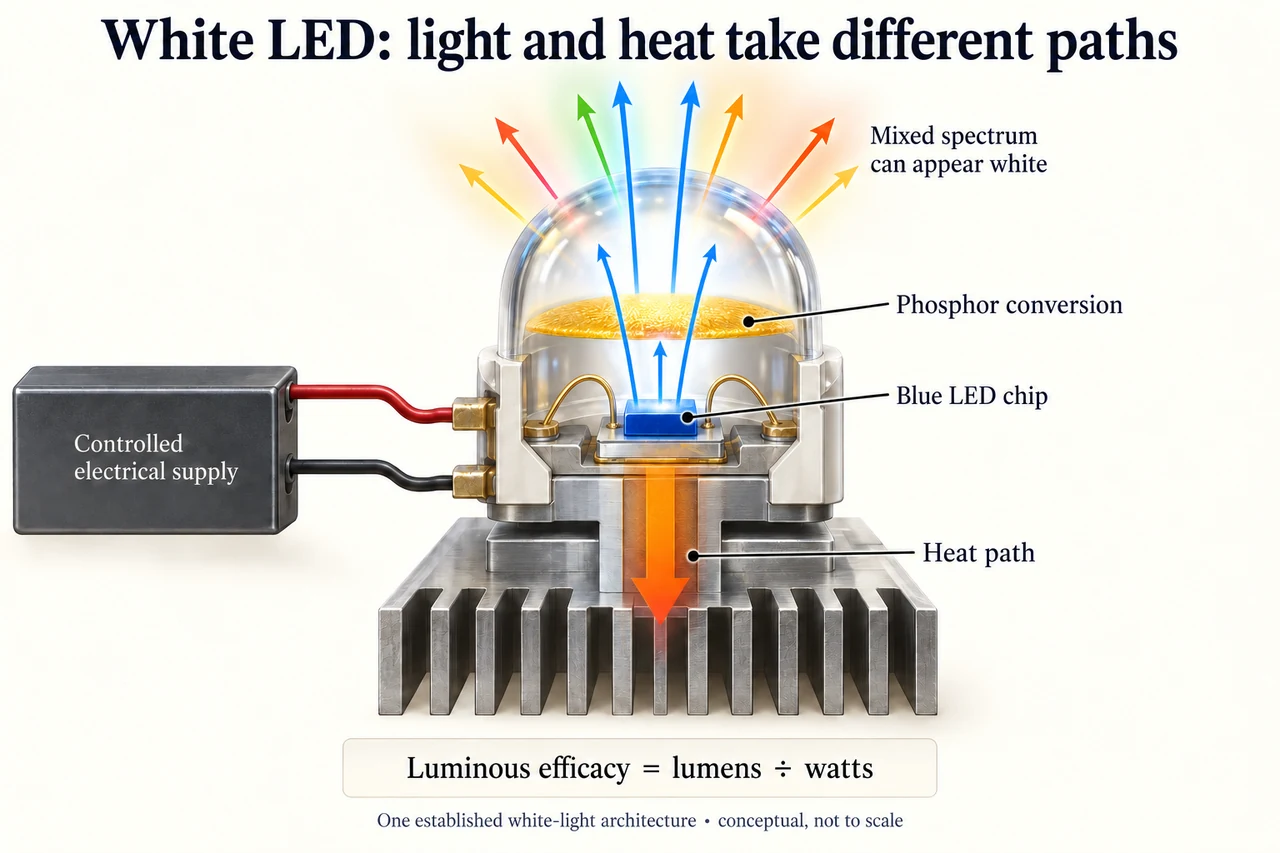
myAudience original rendered teaching illustration. Image: illustration, not a documentary photograph. · Operator-authored generated illustration; scientific model reviewed separately.
LED light: recombination, colour and the complete lamp
A light-emitting diode uses a semiconductor structure in which injected electrons and holes can recombine and release energy as photons. A hole represents an unoccupied electron state behaving as a positive charge carrier; it is not a little physical tunnel. Not every recombination event yields useful light outside the device. Electrical and thermal design influence whether a complete lamp gives useful illumination over its service life.
The plate follows an established white-light approach: a blue-emitting LED excites a phosphor layer, which converts part of the blue light into longer-wavelength light. The combined spectrum can appear white. The blue chip, phosphor, lens and heat path serve different jobs; white is not a single extra wavelength emitted by a magic white semiconductor. Other systems mix several coloured LEDs, so this cutaway is one architecture rather than a universal lamp.
At device level, forward bias supplies charge carriers into the active region; their recombination can produce light. The heat sink carries unwanted thermal energy away, while the driver controls electrical supply to the LED. Light-output efficiency and electrical-to-light energy efficiency must be distinguished from luminous efficacy in lumens per watt: the lumen weights spectral output according to human visual sensitivity. A lumen value is not a direct fraction of all input joules turned into radiation.
Use an invented complete-lamp comparison: 900 lumens from 9 W gives 100 lm/W. A 12 W lamp giving 1,200 lumens also gives 100 lm/W, although it consumes more power and produces more light. Choosing the lower-watt lamp without checking required light can leave a task poorly lit. At five hours per day for 30 days, the 9 W lamp consumes 1.35 kWh and the 12 W lamp 1.80 kWh. These are original arithmetic models, not claims about products.
Distinguish package and luminaire boundaries. If an invented emitter gives 1,000 lumens while its device uses 8 W, package efficacy is 125 lm/W. If the complete lamp loses 10% of that light in optics and takes 10 W at the mains after driver losses, luminaire efficacy is 900/10 = 90 lm/W. Dividing emitted package lumens by complete-system power would mix boundaries. A useful task also depends on light distribution, glare and colour rendering, not just this ratio.
Discuss a street-light upgrade that reduces electrical demand but increases glare into homes or light reaching wildlife habitat. Evaluate shielding, timing, task requirements, repairability and affected people’s views. Established LED devices do not guarantee any particular product lifetime, flicker behaviour or healthy-lighting claim; new materials and controls need measured evidence in context. The lesson teaches mechanisms and comparison, not a mains-wiring activity.
Image: illustration, not a documentary photograph.
Worked example: Two fictional complete lamps provide 800 lm at 8 W and 1,200 lm at 15 W. Calculate efficacy, then energy for 100 h. Which is better per watt, and what cannot yet be decided?
First efficacy = 800/8 = 100 lm/W; second = 1,200/15 = 80 lm/W.
First energy = 8 W × 100 h = 0.8 kWh; second = 1.5 kWh.
The first has better luminous efficacy; required light distribution and quantity are not given.
Answer: 100 versus 80 lm/W; 0.8 versus 1.5 kWh. Efficacy alone does not decide task suitability.
Check your understanding: An emitter makes 1,500 lm; optics transmit 80%. Complete input is 12 W. What complete-lamp efficacy follows, and why is 125 lm/W wrong?
Answer: Delivered light = 1,500 × 0.80 = 1,200 lm; efficacy = 1,200/12 = 100 lm/W. 125 lm/W incorrectly uses emitter output before optical loss with complete-system input.
Why: Declare the system boundary and assumptions before applying conservation. Invented values test reasoning, not a real installation.