Washing machines: cleaning motion, spin and the next appliance
By How things work · myAudience
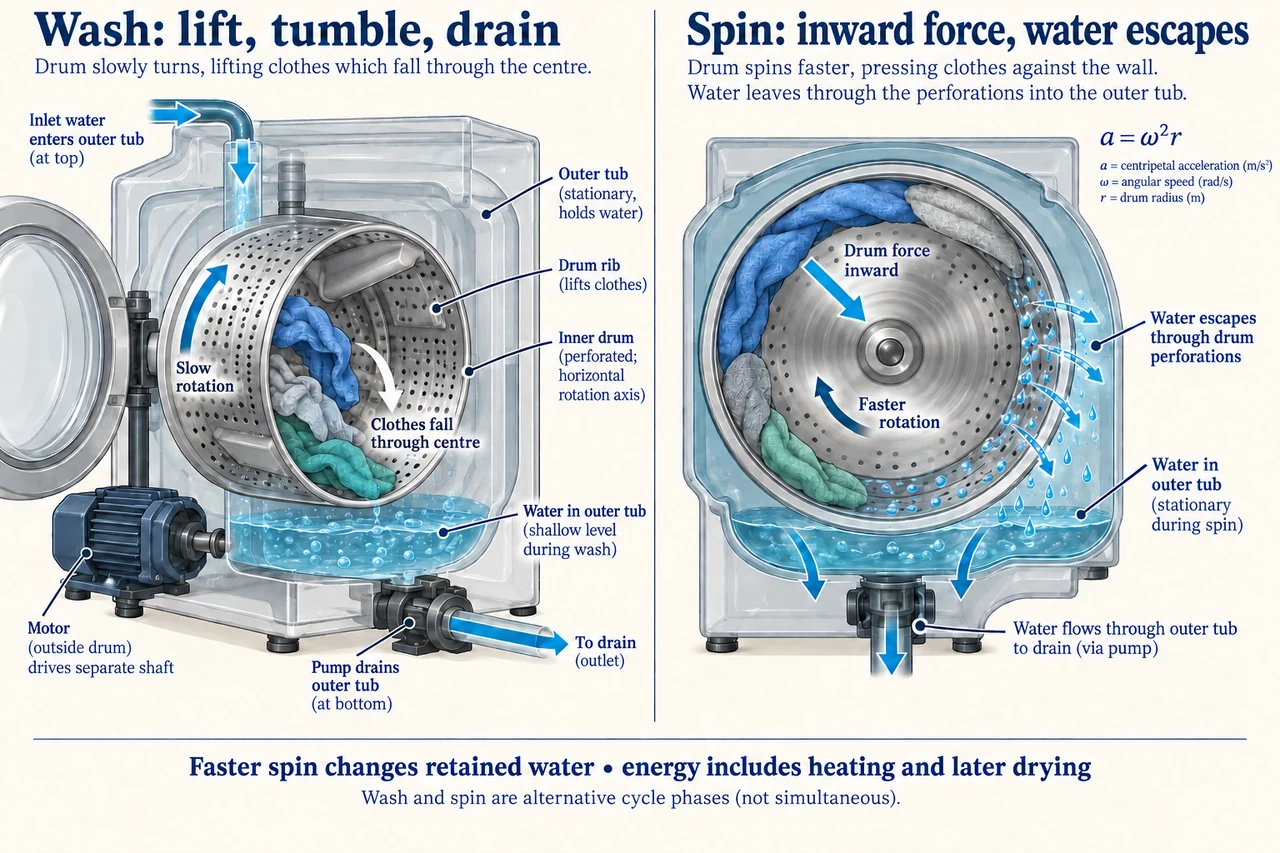
myAudience original rendered teaching illustration. Image: illustration, not a documentary photograph. · Operator-authored generated illustration; scientific model reviewed separately.
Washing machines: cleaning motion, spin and the next appliance
A washing machine combines water, detergent, motion and time. A front-loading drum can lift fabric and allow it to fall through a shallow wash volume; other architectures use different agitation. Rinsing removes suspended material and detergent, and draining transfers used water out. Mechanical motion alone does not establish stain removal or hygiene: textile, detergent, temperature and programme conditions matter. The picture separates a wash phase from a spin phase rather than showing every action occurring together.
In the left panel, follow lifting and tumbling inside the perforated drum; the stationary outer tub collects water and a drain pump removes it. In the spin panel, fabric follows a curved path because contact with the drum provides inward acceleration. Water that is not constrained in the same way can pass through perforations into the tub. An outward path for released droplets is not an extra outward contact force on the fabric. The image is conceptual, so arrows identify different quantities rather than precise trajectories.
Use centripetal acceleration a = ω²r, with angular speed ω in radians per second. At a fictional 600 revolutions per minute, ω = 600 × 2π/60 = 20π rad/s. At radius 0.20 m, acceleration is about 790 m/s². Doubling speed to 1,200 rpm multiplies this modelled acceleration by four, not two. That calculation does not tell you the retained-water fraction, bearing load, permissible speed or whether a textile can safely use that programme.
Heating water is a separate energy account. For an invented 10 kg water quantity heated through 20 K with effective specific heat 4,200 J/(kg K), the ideal energy is 840 kJ, about 0.233 kWh. Heating 20 kg through the same rise doubles it to 0.467 kWh before losses. A cold programme is not automatically equally effective for every purpose, and a machine label’s energy metric need not mean only drum-motor consumption.
Extend the boundary to drying. Suppose a fictional extra spin uses 0.020 kWh and removes enough water to reduce later drying input by 0.15 kWh. Combined laundry input falls by 0.13 kWh for that assumed case. If later drying is not required, the avoided dryer input is zero and this particular energy argument disappears. ENERGY STAR’s described IMEF boundary includes washing, water heating, standby and subsequent drying, illustrating why whole-service accounting can differ from one phase.
Discuss providing reliable laundry in shared housing where purchase price, repair access, water availability and users’ time all matter. Evaluate cleaning outcomes alongside energy rather than ranking solely by spin speed or advertised watts. Do not adopt dated savings comparisons as universal measured results. The concepts do not authorise changing interlocks, working on mains wiring or selecting unsafe programmes; appliance and textile instructions control real operation.
Image: illustration, not a documentary photograph.
Worked example: At radius 0.25 m, compare ideal inward acceleration at 400 and 800 rpm. Then account for a fictional extra spin using 0.03 kWh while saving 0.12 kWh in later drying.
ω₁ = 400 × 2π/60 ≈ 41.89 rad/s; a₁ = ω₁² × 0.25 ≈ 438.65 m/s².
ω₂ is twice ω₁, so a₂ ≈ 1,754.60 m/s², four times a₁.
Combined energy change = 0.03 − 0.12 = −0.09 kWh: a saving of 0.09 kWh under this assumption.
Answer: Approximately 439 and 1,755 m/s²; 0.09 kWh combined saving.
Check your understanding: Why does doubling rpm not prove half the drying time, and why must the energy boundary include drying?
Answer: Acceleration scales with speed squared, but retained water and drying time depend on fabric, loading and process data not supplied. Additional spin electricity can be outweighed by avoided dryer input; ignoring either term misstates the combined service.
Why: Declare boundaries, keep units consistent and distinguish an invented explanatory model from measured installation performance.