Microwave heating: absorption is not inside-out cooking
By How things work · myAudience
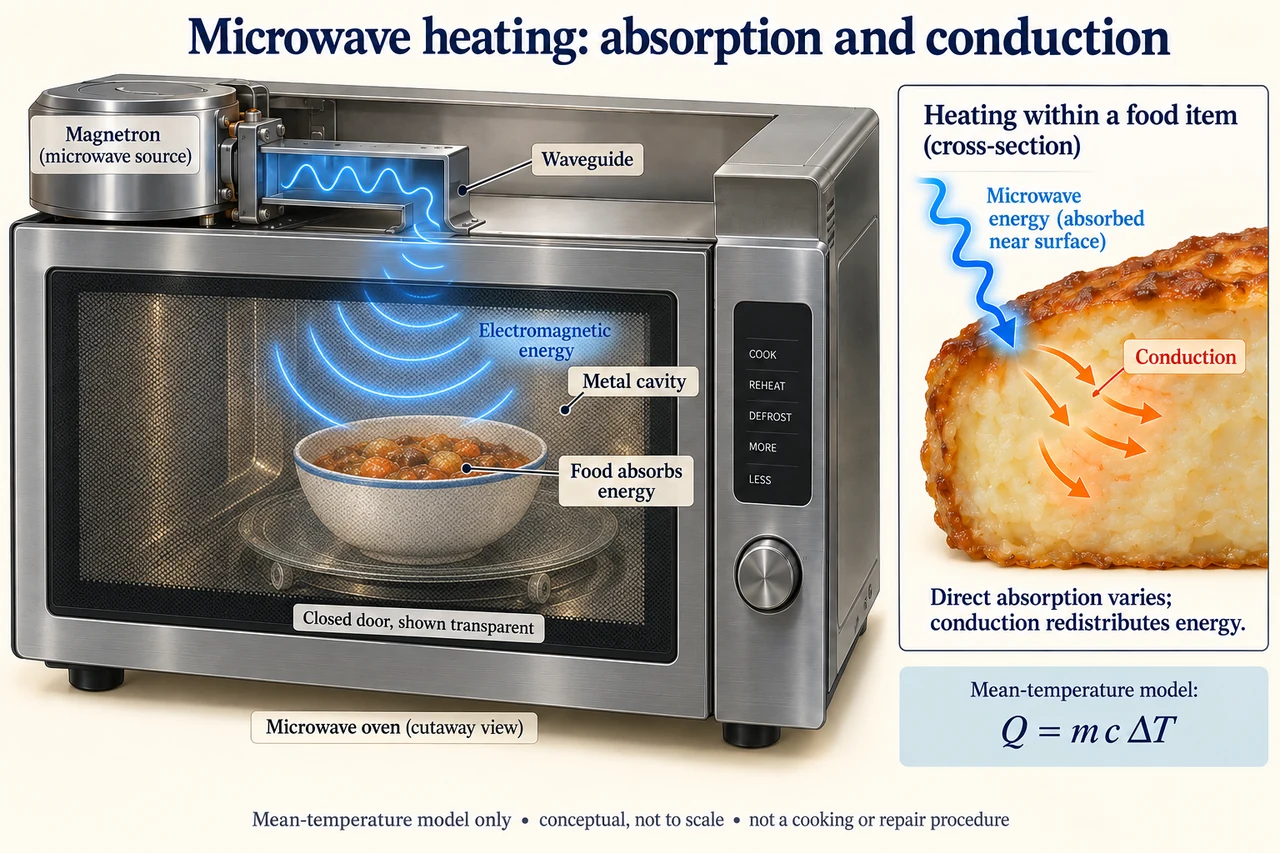
myAudience original rendered teaching illustration. Image: illustration, not a documentary photograph. · Operator-authored generated illustration; scientific model reviewed separately.
Microwave heating: absorption is not inside-out cooking
A microwave oven transfers electrical energy into electromagnetic radiation and then into the food through absorption. Its source commonly uses a magnetron; radiation travels into a metal cooking cavity. The field varies with time and interacts with the food’s electrical properties. Water content is important, but a picture of water molecules alone does not describe every contribution from ions or all food compositions.
The plate is a conceptual cutaway showing the source outside the food cavity, a waveguide carrying energy into the cavity, and food on a turntable. Coloured waves represent energy propagation, not visible light or a map of the real standing-wave pattern. A second inset contrasts direct microwave absorption with conduction into regions less directly heated. It must not suggest radiation only heats the exact centre or travels without attenuation through arbitrarily thick food.
Microwaves used for heating are non-ionising: the mechanism is not the same as an X-ray breaking chemical bonds by ionisation. Absorbed electromagnetic energy becomes thermal energy, and food is not made radioactive by the cooking mechanism. Non-ionising does not mean incapable of injury; sufficiently intense exposure and hot food or containers can harm. The complete enclosure and interlocks are part of the engineered appliance, not optional accessories to bypass.
Energy accounting gives a useful but limited numerical model. If a fictional food sample absorbs 600 W for 120 s, absorbed energy is 72,000 J. For a 0.50 kg uniform sample with effective specific heat 4,000 J/(kg K), no phase change and negligible outward transfer, temperature rise is Q/(mc) = 36 K. This is an average, not proof that every point rises 36 K. Density, composition, evaporation and spatial absorption invalidate a single-temperature shortcut in many real foods.
Test an original transfer: the same 72 kJ reaches a 1.0 kg sample with the same effective heat capacity, so the ideal mean rise halves to 18 K. Doubling food mass does not simply promise twice the heating time to achieve a safe outcome because geometry and absorption patterns change. Stirring or movement and subsequent conduction can redistribute energy, but a neat energy total cannot establish microbiological safety or remove uneven heating. Follow the appliance and food instructions for actual use.
Discuss whether a community kitchen should evaluate an appliance by heating speed, total electricity consumption, food access, maintainability or several criteria. Rated wall input and useful absorbed power have different boundaries; a high quoted output is not 100% efficiency. The teaching example is not a cooking prescription, especially for liquids that can superheat. This established appliance mechanism leaves field modelling, leakage testing and repair to appropriately qualified procedures.
Image: illustration, not a documentary photograph.
Worked example: An invented sample absorbs 500 W for 90 s. Mass 0.75 kg and effective specific heat 3,000 J/(kg K) are assumed constant, with no phase change/loss. Find ideal mean rise.
Absorbed energy = 500 × 90 = 45,000 J.
Heat capacity of sample = 0.75 × 3,000 = 2,250 J/K.
Mean rise = 45,000/2,250 = 20 K.
Answer: 20 K mean rise in the specified ideal model; local temperatures need not equal the mean.
Check your understanding: If wall input is 1,000 W but useful food absorption is 600 W, what useful fraction follows? Does it prove uniform food temperature?
Answer: Useful fraction = 600/1,000 = 60%. It says nothing about spatial temperature uniformity; absorption, conduction and geometry govern that separately.
Why: Declare the system boundary and assumptions before applying conservation. Invented values test reasoning, not a real installation.