Vacuum cleaners: pressure, flow and particle capture
By How things work · myAudience
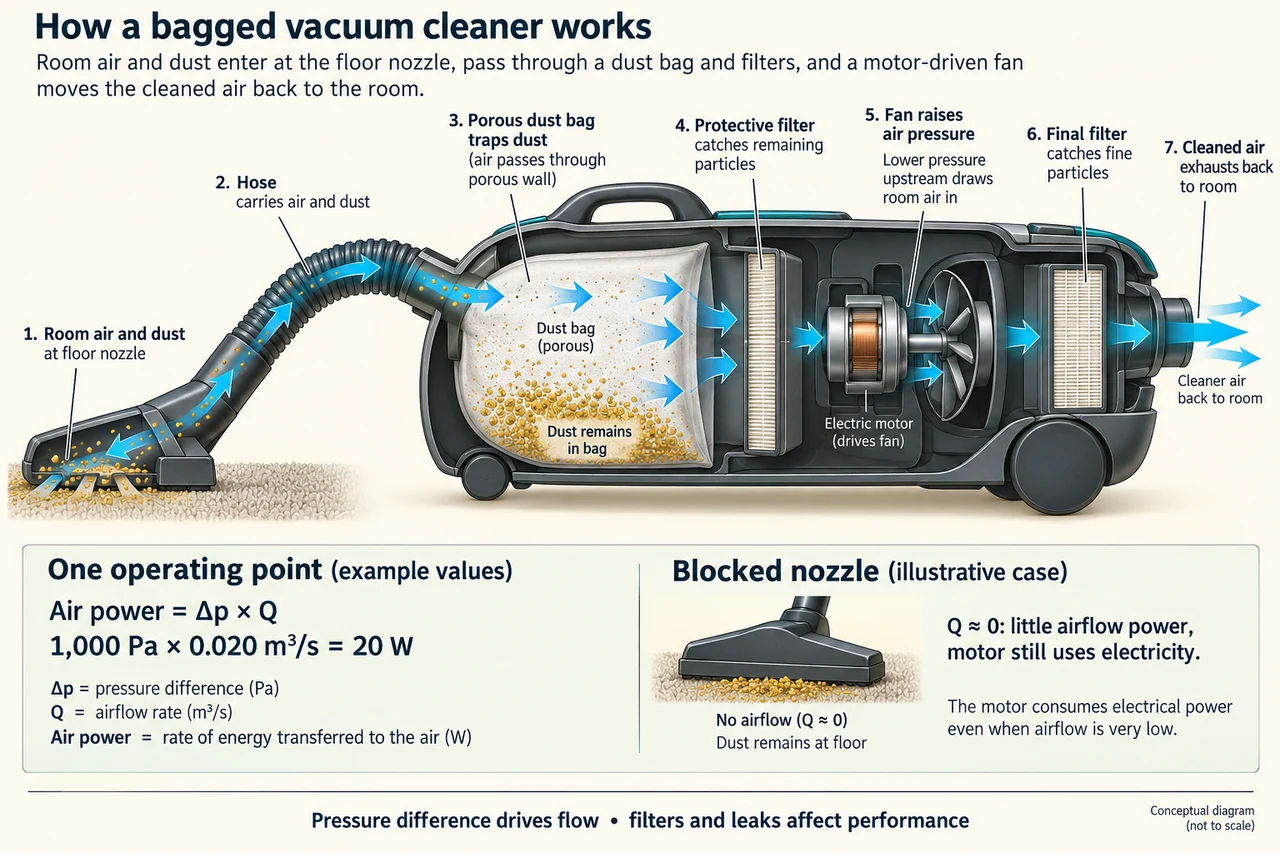
myAudience original rendered teaching illustration. Image: illustration, not a documentary photograph. · Operator-authored generated illustration; scientific model reviewed separately.
Vacuum cleaners: pressure, flow and particle capture
A motor-driven fan establishes a pressure difference that moves air through a vacuum cleaner. Room air flows into a lower-pressure inlet, carrying loosened particles along the hose. This is not a complete absence of air or an invisible pulling substance. In a bagged design the porous bag captures particles while air passes through; a cyclonic design separates particles using curved airflow and still needs suitable downstream filtration. Those architectures should not be drawn as interchangeable components without explanation.
The plate follows one generic bagged route: nozzle, hose, porous bag, protective filter, fan, final filter and exhaust back to the room. Trace blue arrows through the bag wall while gold particles remain collected. The motor transfers work to the fan through a shaft; it is not another route for dusty air. Serial arrows describe a conceptual flow path, not dimensions, an exact fan curve, or certification of whole-machine filtration.
Pressure is force per area; moving a small volume against a pressure difference requires pressure difference times volume as an ideal pressure-work account. Dividing by time gives airflow power P_air = Δp × Q, where Q is volume per second. This low-speed, approximately constant-density account differs from electrical input and from total fan shaft power. If pressure difference is 1,000 Pa and flow is 0.020 m³/s at the same operating point, airflow power is 20 W.
Compare invented operating points rather than multiplying unrelated catalogue peaks. At 2,000 Pa and 0.010 m³/s, airflow power is also 20 W. A blocked nozzle can approach zero flow even while pressure difference is substantial, so the product can approach zero despite electrical consumption and heating. Maximum static pressure and maximum free-air flow usually refer to different conditions; multiplying them together does not yield an actual measured operating power.
Filters, seals and restrictions interact with the fan. Capturing more particles can add resistance, and bypass leakage can undermine whole-machine capture even when a filter tested alone performs well. Turbulent flow and irregular geometry mean a simple laminar-tube formula is not a universal cleaner model. An invented change from 1,200 Pa at 0.018 m³/s to 1,600 Pa at 0.012 m³/s changes airflow power from 21.6 to 19.2 W; the pressure rise alone is not evidence of improvement.
Discuss choosing equipment for a shared building using cleaning outcome, noise, filtration evidence, repairability and workers’ exposure. Particle capture is not automatically proof of sterilisation or protection against a specific illness. Manufacturer descriptions are used here for architecture, not comparative marketing claims. New sensors or robotic navigation add functions but do not replace the pressure-flow and capture mechanisms; measured whole-device data and maintainable consumables still matter.
Image: illustration, not a documentary photograph.
Worked example: At one fictional operating point, Δp is 1,500 Pa and Q is 0.016 m³/s; electrical input is 120 W. Find airflow power and its ratio to electrical input. A restriction changes the point to 2,000 Pa and 0.008 m³/s with the same input.
Initial airflow power = 1,500 × 0.016 = 24 W; ratio = 24/120 = 20%.
Restricted airflow power = 2,000 × 0.008 = 16 W; ratio = 16/120 ≈ 13.33%.
Higher pressure came with lower airflow power. Neither ratio alone measures dust removal.
Answer: 24 W and 20%, then 16 W and about 13.33%; cleaning quality remains unmeasured.
Check your understanding: A catalogue separately lists maximum static pressure 4,000 Pa and free-air flow 0.030 m³/s. Is 120 W necessarily available at a real operating point?
Answer: No. Each maximum may occur under a different restriction. A joint pressure-flow curve or a simultaneous measurement is needed before applying their product as operating airflow power.
Why: Declare boundaries, keep units consistent and distinguish an invented explanatory model from measured installation performance.