Why the same steel can behave differently
By How things work · myAudience
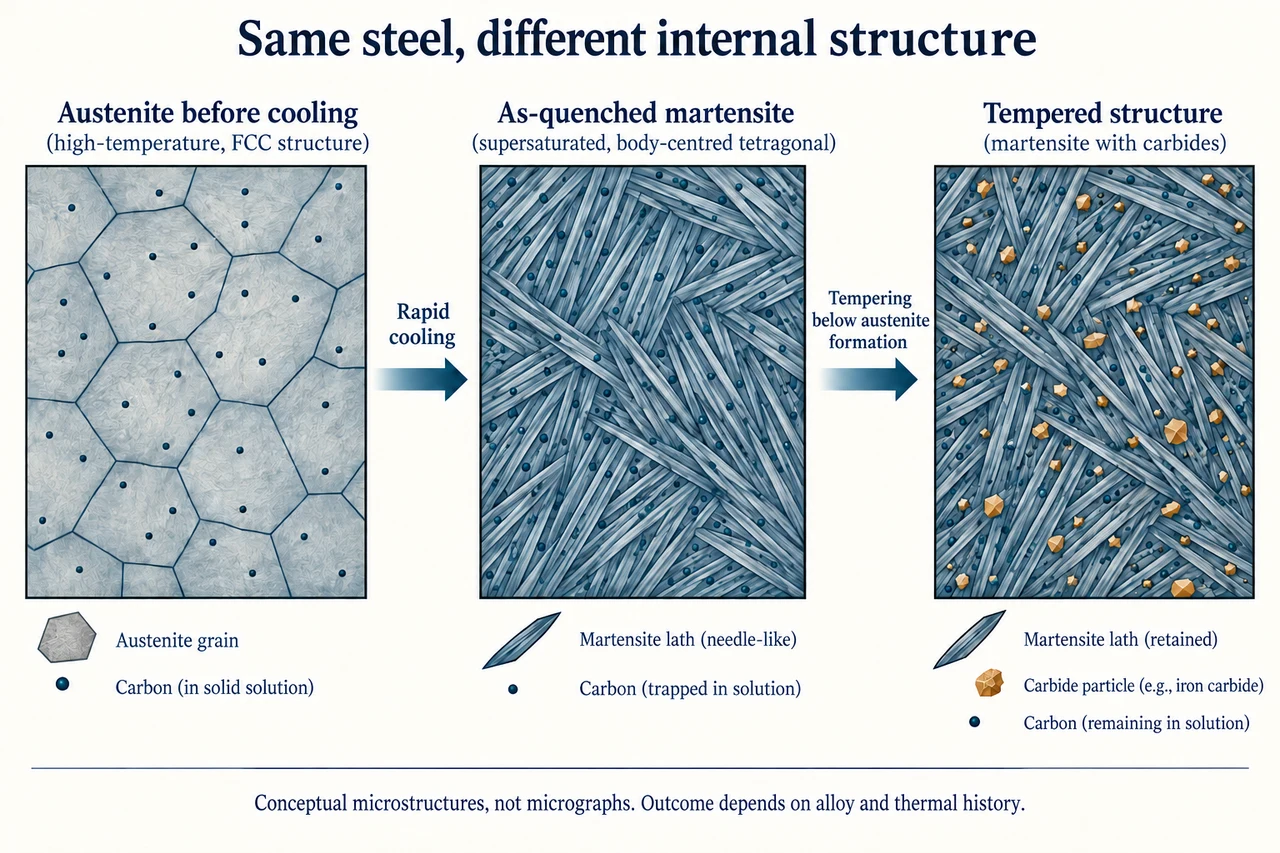
myAudience original rendered teaching illustration. Image: illustration, not a documentary photograph. · Operator-authored generated illustration; scientific model reviewed separately.
Why the same steel can behave differently
Changing an alloy’s composition and changing its microstructure are different operations. Alloying changes which elements are present and their amounts; heat treatment can rearrange phases and internal structures without adding new elements. A closed accounting model therefore conserves total carbon even when carbon moves between a matrix and carbide particles. Real surfaces can exchange material with their surroundings, so that closed-system assumption must be stated rather than silently imposed on every industrial process.
The left panel represents austenite grains. In the chosen steel model, sufficiently rapid cooling permits a diffusionless transformation to martensite: coordinated atomic displacements change the crystal structure without the long-range redistribution needed for an equilibrium carbon arrangement. Carbon is initially trapped in a supersaturated structure. The central panel shows lath-like martensite, with a body-centred tetragonal description appropriate to the simplified carbon-containing model. It is not a universal micrograph: different carbon contents and histories can yield other morphologies, and some austenite can remain untransformed. Cooling does not melt the steel or create additional carbon.
Tempering heats the martensitic steel within a regime where austenite is not being formed. Carbon can redistribute and carbide precipitation can occur; changes to defects and recovery also influence properties. The right panel retains a lath-like background while distinct amber particles indicate carbide formation. The blue dots are qualitative carbon symbols, not a count from which to infer chemical composition, phase fraction or a reaction stoichiometry. The illustration compares conceptual structures, not measured images of three identical specimens.
Hardness, strength and toughness answer different questions. Resistance to indentation or wear does not directly measure resistance to crack growth or the ability to absorb energy before failure. For many plain-carbon-steel tempering conditions, reduced hardness can accompany a useful property balance, but alloy carbides can produce secondary hardening in suitable steels. “More tempering always means softer” is therefore an unsafe universal rule. Choice of alloy, starting structure, heating history and intended service must be part of any justified comparison; this lesson supplies no temperatures, durations or quenching procedure.
An original mass-balance model makes the conservation principle testable. Suppose a fictional closed 1 kg sample has 0.4% carbon by mass. Assume the final matrix has 0.1% carbon and a carbide-rich phase has 6.7% carbon, with exactly those two phases and no loss. These deliberately specified compositions define an accounting exercise; they do not predict a real steel’s phases at a particular temperature. If x is the mass fraction of the carbide-rich phase, the carbon balance is 0.004 = 0.067x + 0.001(1 − x). Solving gives x = 1/22, about 4.545%. The phase contains roughly 3.045 g of carbon and the remaining matrix roughly 0.955 g: their sum is the original 4 g.
Test engineering claims against both material evidence and responsibility. A wear-resistant part can still fail through brittle fracture, fatigue or unsuitable service conditions. Extending service life may save material and energy, while an inadequately qualified process can transfer risk to workers and the public. A responsible comparison asks for verified properties, traceable treatment history, loading and environment, not just a photograph or a hardness number. Reading this explanation develops material literacy; it does not qualify a learner to heat-treat a safety-critical component.
Image: illustration, not a documentary photograph.
Worked example: Use the fictional closed two-phase model: 1 kg total, bulk carbon 0.4% by mass, matrix carbon 0.1%, carbide-rich phase carbon 6.7%. Calculate each phase mass and check total carbon.
Write all percentages as fractions: 0.004 = 0.067x + 0.001(1 − x). Thus 0.003 = 0.066x, so x = 0.0454545….
Carbide-rich phase mass = 1000x ≈ 45.455 g; matrix mass ≈ 954.545 g.
Carbon in those phases is 45.455 × 0.067 ≈ 3.045 g and 954.545 × 0.001 ≈ 0.955 g. Their sum is 4.000 g, equal to 1000 × 0.004.
Answer: Approximately 45.455 g carbide-rich phase and 954.545 g matrix; the total carbon remains 4 g.
Check your understanding: A report proposes 8% carbide-rich phase using the same compositions and closed 0.4% bulk-carbon model. Is it consistent? What changes if the sample mass halves? Why can neither the picture nor this calculation prove that every tempering treatment improves toughness?
Answer: The proposed fraction gives 0.08 × 0.067 + 0.92 × 0.001 = 0.00628, or 0.628% carbon, so it contradicts the stated 0.4% inventory. At least one assumption or reported composition/fraction would have to change. Halving sample mass leaves the phase fractions unchanged, halves both phase masses and leaves 2 g total carbon. The picture is qualitative; the calculation constrains mass balance, not morphology, defect populations or measured mechanical properties. Alloy-specific precipitation, recovery, loading and environment must be investigated; a universal toughness claim does not follow.
Why: Transfer the conservation equation while identifying what it cannot determine. Correct carbon accounting is necessary for this closed model, but it is not sufficient evidence of a real microstructure, process feasibility or safe performance.