Copper moves through a different form
By How things work · myAudience
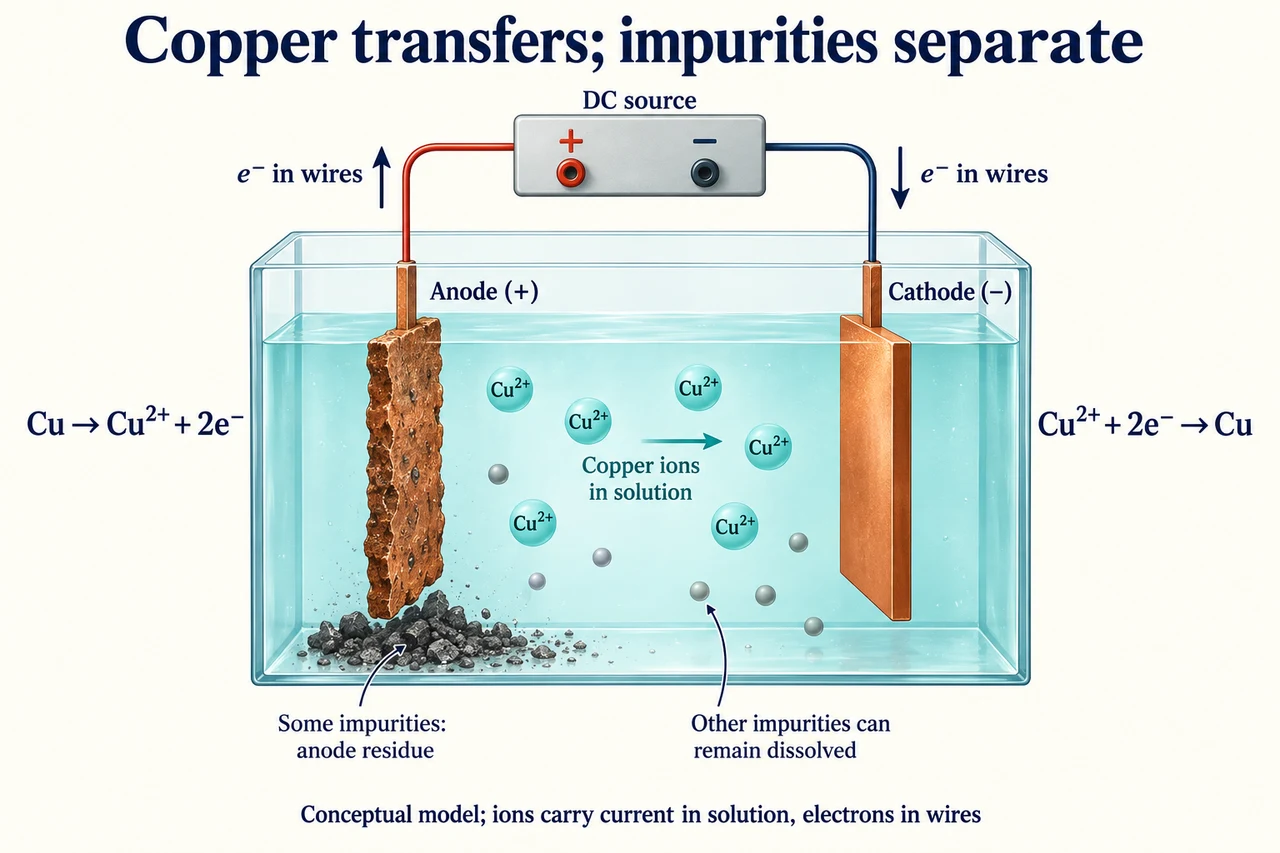
myAudience original rendered teaching illustration. Image: illustration, not a documentary photograph. · Operator-authored generated illustration; scientific model reviewed separately.
Copper moves through a different form
Electrorefining begins with impure metal, not directly with a lump of ore. A controlled electrical process transfers copper from an impure anode into solution and deposits copper at a cathode. Extraction, electrorefining and remelting are distinct jobs. The objective here is separation through electrochemical behaviour, not destroying impurities or simply filtering all unwanted atoms out of a liquid.
The left anode is connected to the positive side of the external supply. Its ideal copper half-reaction is Cu → Cu²⁺ + 2 e−: oxidation releases electrons to the external circuit. The right cathode receives electrons from the negative side; Cu²⁺ + 2 e− → Cu describes reduction and metal deposition. In both relations atom count and electrical charge balance. The electrons travel through the metallic connections; ions carry current in the electrolyte. An arrow carrying electrons across the liquid would teach the wrong charge-transport model.
Impurities do not all behave alike. Some become anode residues; others can remain dissolved and need controlled solution management. Actual selectivity depends on chemistry and operating conditions, and defects or contamination can affect the cathode. The drawing therefore marks some residue and some dissolved impurities rather than claiming that every impurity falls to the floor. The source text describes industrial electrolyte and operating details, but this lesson intentionally supplies no chemical recipe, live-current procedure or instructions for handling hazardous process liquids.
The ideal copper transfer requires two moles of electrons per mole of copper. Charge equals current multiplied by elapsed time for constant current. With Faraday constant approximately 96, 485 C per mole of electrons and copper molar mass 63.546 g per mole, ideal deposited mass is Q × 63.546/(2 × 96, 485) grams. This assumes every cathodic electron contributes to the stated copper reaction. A stated current efficiency reduces that ideal deposit. It is not the same as energy efficiency or the percentage of copper in a sample.
In an original fictional model, 100 A flows for one hour. Charge is 360, 000 C; ideal copper deposit is approximately 118.550 g. At a stated 95% copper-deposition current efficiency, the deposit is approximately 112.622 g. If the terminal voltage is held at 0.4 V, electrical input is 40 W for an hour, or 0.04 kWh. These are bounded accounting values, not a tankhouse design. A small ideal net reaction voltage does not establish zero real input: resistance, interfaces and other process requirements still matter.
Interpret useful yield alongside waste management, power sources, maintenance and affected people. Anode residue may contain valuable or hazardous constituents, so higher copper purity does not remove responsibility for other streams. Electrical conductivity can be important to a product, but a purer sample is not automatically the lowest-impact choice for every use. Compare repair, recovery, service quality and community burdens using verified evidence. This reading supports scientific literacy, not professional competence in industrial electrochemical operations.
Image: illustration, not a documentary photograph.
Worked example: A fictional process runs 100 A for 3600 s. Use Faraday constant 96, 485 C/mol electrons and copper molar mass 63.546 g/mol. Find ideal deposited copper and deposit at 95% copper current efficiency; find input energy at 0.4 V.
Q = It = 100 × 3600 = 360, 000 C. Moles electrons = 360, 000/96, 485; copper moles are half that.
Ideal copper mass = 360, 000 × 63.546/(2 × 96, 485) ≈ 118.550 g. At 95% copper current efficiency multiply by 0.95: ≈ 112.622 g.
Input power = VI = 0.4 × 100 = 40 W. For one hour, input energy = 40 Wh = 0.04 kWh = 144, 000 J.
Answer: Ideal ≈ 118.550 g; at 95% current efficiency ≈ 112.622 g; terminal input 0.04 kWh.
Check your understanding: Current is halved and duration doubled, while voltage and copper current efficiency stay fixed. What changes in deposit, power and energy? A report calls 95% current efficiency 95% energy efficiency and says every impurity must settle as residue; identify both errors. Verify each half-reaction conserves charge.
Answer: Charge remains the same because 50 A × 7200 s = 360, 000 C, so deposit remains ≈ 112.622 g at 95% current efficiency. Power halves to 20 W but elapsed time doubles to two hours, so electrical energy stays 0.04 kWh. Current efficiency concerns the share of charge making copper, not all useful energy input/output; impurities can follow different routes, including remaining dissolved. Anode charge 0 → ( + 2) + 2(−1) = 0; cathode charge( + 2) + 2(−1) = 0 → 0. Atoms are also conserved.
Why: Track charge, mass, power and time separately. Equal deposited mass does not prove equal operating feasibility; chemistry, transport, quality and safety are excluded from this simplified comparison.