Concrete hardens through a chemical reaction
By How things work · myAudience
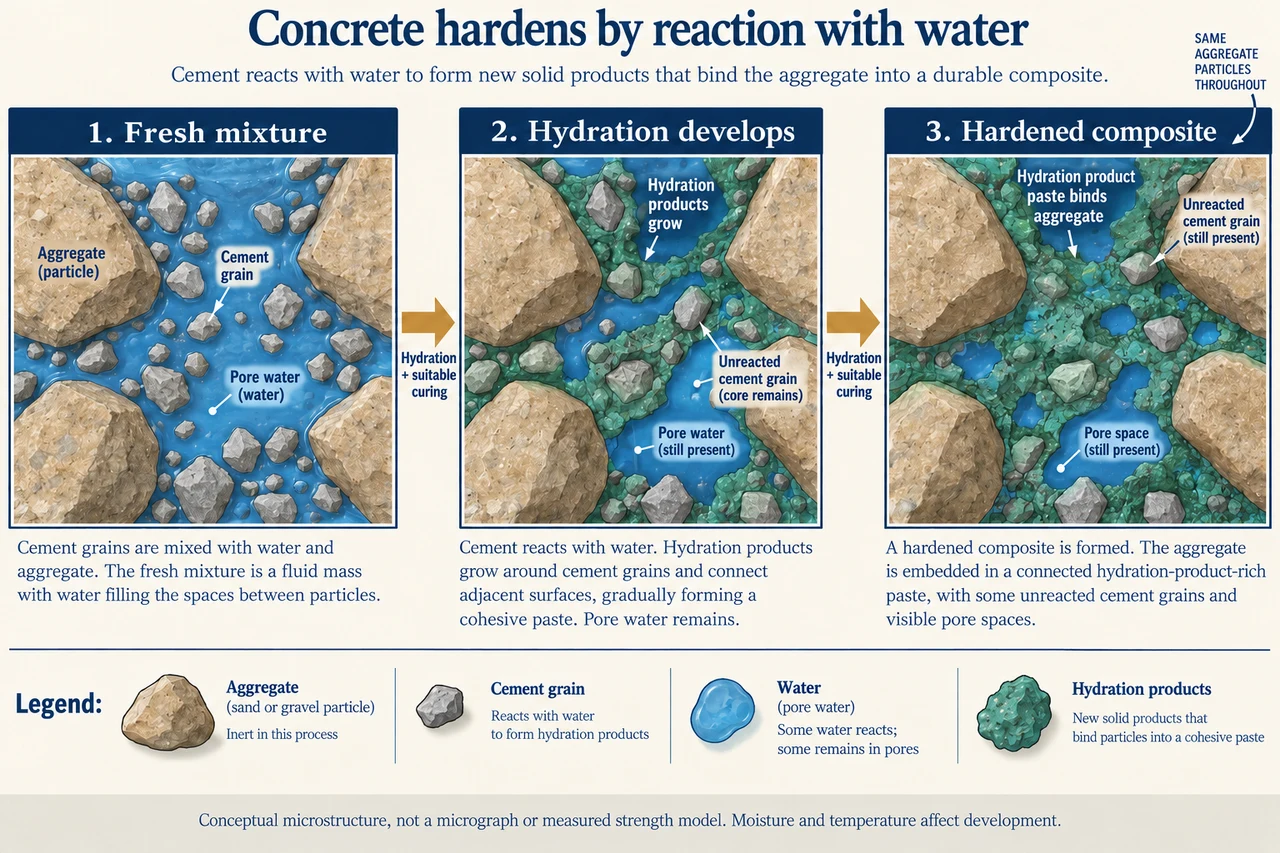
myAudience original rendered teaching illustration. Image: illustration, not a documentary photograph. · Operator-authored generated illustration; scientific model reviewed separately.
Concrete hardens through a chemical reaction
Cement and concrete are different things. Cement is a binder; concrete combines a cementitious paste with aggregate and may include additional constituents. In the selected hydraulic-cement model, water participates in chemical reactions that develop the binder structure. Hardening is therefore not simply a wet mixture drying until it becomes solid. The distinction matters: allowing excessive early moisture loss can obstruct useful development and contribute to damage rather than accelerate a desirable cure.
Trace the three conceptual panels. Fresh paste surrounds the larger aggregate pieces; smaller cement grains are drawn in the water-filled space. Hydration produces new material around reacting grains and develops a connected paste that binds aggregate into a composite. The final panel deliberately retains pores and some unreacted grain cores. It does not claim that every grain disappears or that a useful concrete must become perfectly dense. Particle shapes, relative sizes and phase quantities are illustrative, not a microscopic measurement.
Cement hydration involves dissolution, chemical reaction and the formation of several product phases. Calcium-silicate-hydrate is an important part of ordinary portland-cement paste, but the green region in the plate represents hydration products collectively, not one pure crystal species with a fixed chemical formula. Different cements and supplementary constituents can follow different developments. NIST’s virtual laboratory models these changes using several phases and explicit microstructure assumptions; a qualitative rendered illustration is not a validated simulation of a particular mix.
Curing manages conditions needed for continuing development, including moisture and temperature. Supplying or retaining appropriate water is conceptually different from adding more mixing water to make fresh concrete easier to place. Too little available moisture can limit hydration; inappropriate extra mixing water can change the paste structure and subsequent performance. Lowering a water-to-cement ratio is not an unlimited improvement if the mixture cannot be placed and consolidated properly. A specified ratio alone cannot predict strength, durability or a suitable curing period.
Water-to-cement ratio is a mass ratio, not a ratio of bucket volumes. In an original accounting model, 300 kg of cement and 150 kg of available mixing water give w/c = 0.50. If 1,000 kg of dry aggregate also brings 20 kg of explicitly stated free surface water, ignoring that contribution makes the calculated numerator wrong: total available water is 170 kg and w/c is approximately 0.567. To retain the original accounting target, batch water would be 130 kg when that same 20 kg contribution is present. These are hypothetical mass inputs, not a construction mix design; absorbed water and other constituents require their own defined accounting.
An extra 50 kg of water added to the original 150 kg model changes w/c to 200/300, about 0.667. It does not double the amount of cement or prove a proportional strength change. Actual properties require appropriate testing, material identity, placement and curing history. The archived FHWA2006 source teaches the need to control moisture and thermal development, but its older thresholds and references are not supplied as current construction instructions. Responsible choices weigh service life, embodied impacts, worker protection and the burden of repairs on communities; a cheaper unverified material is not automatically a fairer infrastructure choice.
Image: illustration, not a documentary photograph.
Worked example: Use a hypothetical accounting target w/c = 0.50 with 300 kg cement. Dry aggregate mass is 1,000 kg and its stated free surface water is 2% of that dry mass. How much batch water gives the target? What ratio results if an operator adds 150 kg and ignores the surface water?
Target available water = 0.50 × 300 = 150 kg. Free surface water = 0.02 × 1000 = 20 kg.
Batch water = 150 − 20 = 130 kg under the stated available-water definition.
Adding 150 kg instead gives total water 150 + 20 = 170 kg and w/c = 170/300 ≈ 0.567.
Answer: 130 kg batch water matches the fictional mass-accounting target; ignoring the 20 kg contribution gives w/c ≈ 0.567, without establishing a real mix specification.
Check your understanding: A new report describes aggregate water as 2% of the wet aggregate mass rather than dry mass. Can the same 20 kg be assumed for 1,000 kg dry aggregate? Solve the water mass under the new definition. Explain why drying faster and achieving the same ratio do not independently prove good curing or equal strength.
Answer: No. If W is water mass, W/(1000 + W) = 0.02, so 0.98W = 20 and W ≈ 20.408 kg. The target batch-water adjustment would then be about 129.592 kg under the same model. The denominator definition matters. Hydration is a reaction involving water, while moisture loss can impede development; equal w/c also leaves material identity, workability, porosity, placement, temperature and curing history unresolved. Neither statement certifies strength or durability.
Why: Transfer requires defining the mass basis before calculating, then separating bookkeeping from the reaction and performance mechanisms. This is literacy and mathematical reasoning, not qualified structural-material selection.