Radio communication: symbols, carriers and a shared channel
By How things work · myAudience
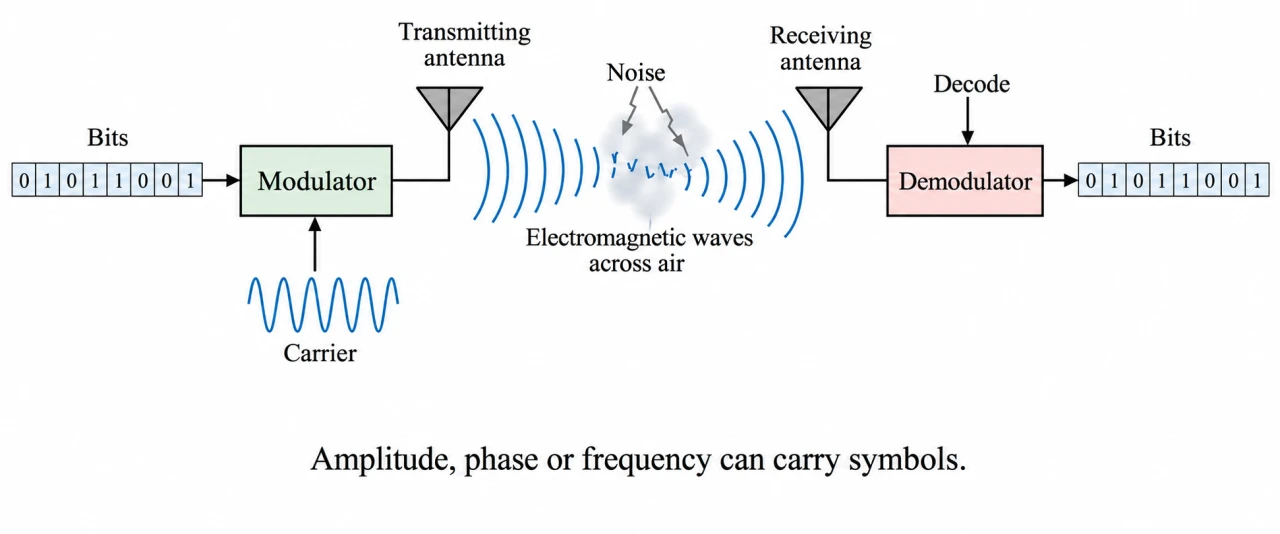
myAudience original imagegen teaching illustration; illustration, not a documentary photograph. · Original generated illustration; scientific and publication acceptance pending independent review.
Radio communication: symbols, carriers and a shared channel
A cellular radio transmitter maps information to symbols and uses them to vary a carrier’s amplitude, phase or frequency. Its antenna couples electrical energy into electromagnetic waves. The receiver selects a band, detects the waveform and estimates the symbols. An unchanging carrier alone does not specify an arbitrary message.
Modulation shifts information into a usable frequency band; demodulation reverses that mapping with synchronization. Carrier frequency and symbol rate are different quantities. In a toy four-symbol alphabet, each symbol represents two bits because four = 2². Coding and protocol overhead reduce the user data rate below raw mapped bits per second.
Radio propagation, interference and noise perturb the received signal. Base stations coordinate scarce channel resources and hand over users as conditions change; merely increasing a device’s transmit power cannot eliminate shared-channel contention. We model only an idealized isolated symbol stream, not a cellular standard or coverage guarantee.
For unchanged antennas and unobstructed far-field free-space propagation, received power scales with 1/r² at fixed transmitted power. This conditional model does not describe indoor walls, multipath fading or terrain. A doubled distance costs a factor of four in power, while better coding or lower data rate can alter reliability without changing the path geometry. The inverse-square reasoning spreads fixed radiated power over an area proportional to r² while keeping direction, frequency and receiving aperture fixed; it is not a claim about every radio environment.
Read the plate left to right: bits enter the modulator together with a carrier, antennas couple the channel to the equipment, noise perturbs the transmitted wave and demodulation recovers an illustrative bit sequence. The matching shown bits represent successful decoding in this example, not a guarantee of error-free reception. The plate does not specify a cellular standard or spectrum allocation.
For discussion, shared spectrum serves competing users and accessibility needs. How should operators balance coverage, interference, cost and resilient service? Higher nominal payload rate is not automatically fairer access, and location or traffic data require privacy safeguards outside this signal model.
Image: illustration, not a documentary photograph.
Worked example: A fictional four-symbol radio sends 100,000 symbols/s. Code rate is 3/4 and payload fraction after protocol overhead is 0.80. Find payload rate and time for 120,000 payload bits, ignoring setup and retransmissions.
Four symbols carry log2(4) = 2 mapped bits/symbol. Raw rate = 200,000 bit/s.
Information rate after coding = 200,000 × 0.75 = 150,000 bit/s; payload rate = 150,000 × 0.80 = 120,000 bit/s.
Transmission time = 120,000/120,000 = 1.0 s. Propagation, queuing and retries would add delay.
Answer: 120 kbit/s payload and 1.0 s transmission time under the stated ideal mapping and overhead.
Check your understanding: 1: Use eight symbols at the same symbol rate and overhead: find payload rate. 2: Does this guarantee improved delivery at twice the distance?
Answer: Eight symbols encode three bits, giving 180 kbit/s payload. No: free-space received power is quartered at twice the distance, and fitting more symbols into a constrained noisy signal can make decisions harder. Error probability and channel conditions are missing.
Why: Credit requires counting bits per symbol separately from symbol rate, applying both overheads, and refusing to equate higher nominal mapping rate with reliable coverage.