Biogas: microbes change material, equipment captures useful energy
By How things work · myAudience
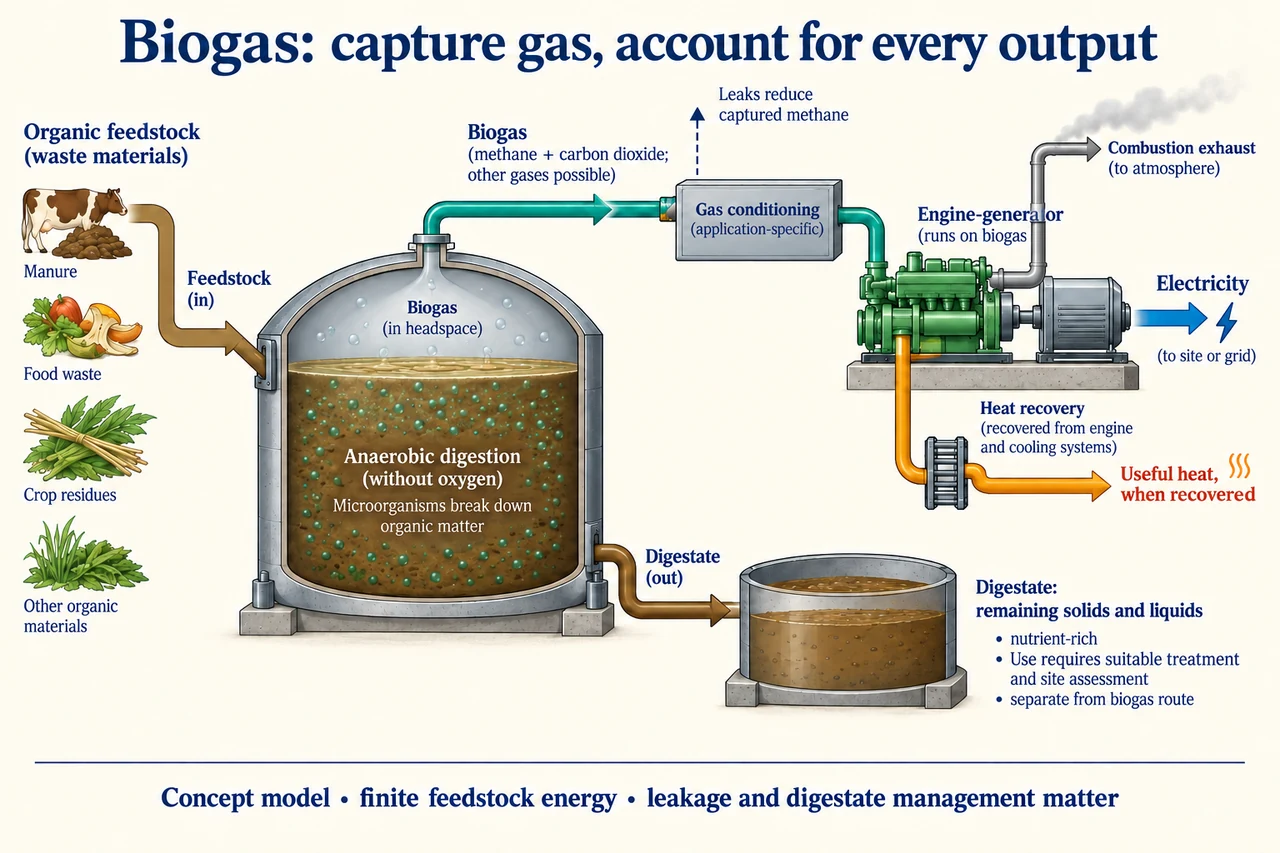
myAudience original rendered teaching illustration. Image: illustration, not a documentary photograph. · Operator-authored generated illustration; scientific model reviewed separately.
Biogas: microbes change material, equipment captures useful energy
Anaerobic digestion uses microbial communities to transform suitable organic material without oxygen. A sealed digester keeps the selected reaction environment distinct from the oxygen-consuming combustion that may occur later in an engine. The microbes do not create energy: chemical energy in the incoming material is redistributed among products and other transfers. Biogas and digestate are distinct outputs, and not every incoming material becomes gas. Established digesters differ with feedstock, site and intended service; a generic diagram cannot specify a viable plant.
Follow the plate’s two routes. Gas leaves the headspace through conditioning equipment toward an engine-generator, while the remaining solid/liquid digestate follows a separate low-level outlet. The generator receives mechanical shaft work, not a stream of waste slurry. Useful heat can be recovered when equipment and demand permit; combustion exhaust is another output. The dashed leak arrow marks an unwanted diversion from captured gas, not an intended process step. Microbial dots and liquid levels are qualitative; the plate gives neither reaction rates nor operating conditions.
Biogas commonly contains methane and carbon dioxide, with water vapour and other constituents possible. Its volume is therefore not automatically a volume of usable methane. Conditioning requirements depend on whether the destination is an engine, a pipeline or another process; purification is not the same operation as generation. Digestate still needs appropriate management and may require treatment before beneficial use. Calling it a valuable product cannot establish its quality, suitability or absence of environmental risk.
Use an original declared boundary to distinguish capture from conversion. Suppose produced methane has 100 kWh chemical energy on one consistent basis over a fictional interval, with 8% lost before engine use. Delivered chemical energy is 92 kWh. At stipulated gross electrical and recovered-heat fractions of 35% and 40% of delivered energy, outputs are 32.2 kWh electricity and 36.8 kWh recovered heat; the other 23 kWh reaches unrecovered thermal outputs. If site electrical auxiliaries use 4 kWh, electrical export is 28.2 kWh. If 10 kWh recovered heat serves the digester internally, only 26.8 kWh remains for an external heat demand.
External useful output in that model is 28.2 + 26.8 = 55 kWh, not the 75% component figure quoted on the delivered-gas boundary. The original 100 kWh is partitioned into 55 external useful, 14 internal electrical/heat service, 23 unrecovered thermal and 8 uncaptured chemical energy. Internal services are accounted transfers, not extra exported benefits. At 20% loss with the same fictional fractions and fixed internal demands, export becomes 24 kWh electrical and 22 kWh heat, or 46 kWh total. Actual auxiliaries and conversion fractions can change; these are conditional accounts, not measured plant efficiencies.
An environmental comparison needs the alternative waste-management pathway, leakage measurements, combustion emissions, transport, digestate handling and who bears odour or water-quality impacts. Avoided methane is not established merely by installing a tank, and using recovered gas does not establish zero emissions. Food-waste prevention and other management options should remain visible rather than treating more feedstock as an automatic benefit. Compare independently verified service, costs and community effects; hazardous gas handling and facility operation require qualified systems, not a home recipe.
Image: illustration, not a documentary photograph.
Worked example: A fictional interval produces methane containing 200 kWh chemical energy. Capture delivers 90% to an engine. Gross electricity is 30% and recovered heat 45% of delivered energy; site auxiliaries use 6 kWh electricity and 20 kWh heat. Calculate external outputs and account for the remaining energy.
Delivered energy = 200 × 0.90 = 180 kWh; uncaptured chemical energy = 20 kWh.
Gross electricity = 54 kWh and recovered heat = 81 kWh; unrecovered thermal output = 180 − 54 − 81 = 45 kWh.
External electricity = 54 − 6 = 48 kWh; external heat = 81 − 20 = 61 kWh. External useful total = 109 kWh; 109 + 26 internal + 45 unrecovered + 20 uncaptured = 200 kWh.
Answer: 48 kWh external electricity and 61 kWh external heat, with all 200 kWh accounted under the fictional boundaries.
Check your understanding: A report applies the same example but adds 54 kWh gross electricity to 61 kWh external heat and calls that site export. Identify the double counting. Does an accurate energy account alone establish avoided climate emissions?
Answer: Gross electricity includes the 6 kWh used internally, so the external electrical output is 48 kWh and useful external total is 109 kWh. Accurate bookkeeping does not establish a climate comparison: alternative treatment, leakage, combustion and other lifecycle effects still need measured inputs and a defined comparison. Chemical energy lost as methane is not equivalent to its climate effect.
Why: Declare boundaries, keep units consistent and distinguish an invented explanatory model from measured installation performance.