Distillation separates through contact and return
By How things work · myAudience
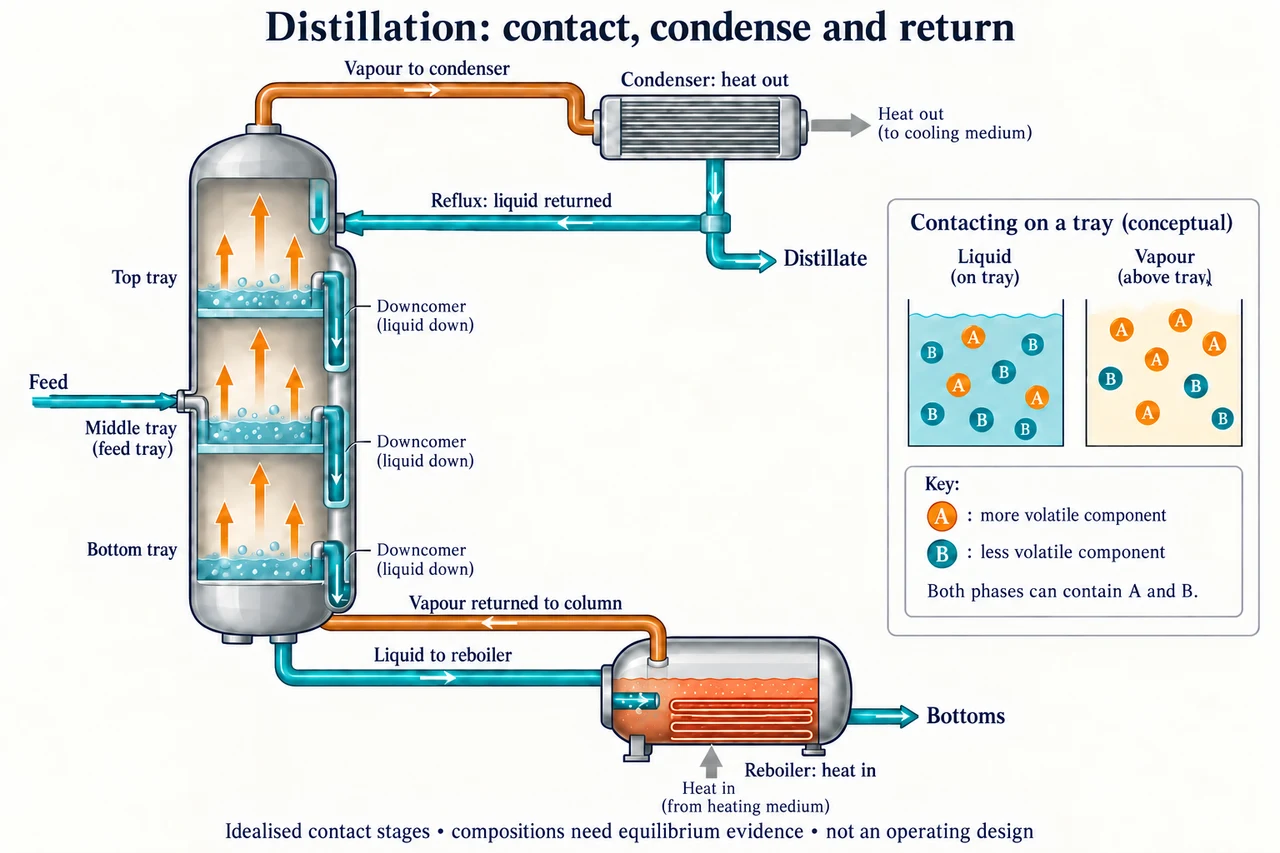
myAudience original rendered teaching illustration. Image: illustration, not a documentary photograph. · Operator-authored generated illustration; scientific model reviewed separately.
Distillation separates through contact and return
Distillation uses differences in vapour–liquid behaviour to change mixture composition. For a selected binary mixture under appropriate equilibrium conditions, the vapour can be richer in the more volatile component than the contacting liquid. This does not mean that the vapour is pure or that the less volatile component cannot evaporate. Both phases can contain both components. Actual equilibrium evidence depends on the mixture and conditions; an azeotrope can limit what ordinary distillation achieves. Our diagram is a conceptual staged column, not a design for a named chemical, pressure, temperature or promised purity.
Trace the material routes separately from heat. Feed enters the middle of the three illustrative trays. Vapour rises and liquid moves downward through downcomers, allowing repeated contact. At the top, vapour goes to a condenser that transfers heat out. Some resulting liquid leaves as distillate; some returns to the column as reflux. At the bottom, liquid goes to a reboiler, heat enters, and generated vapour returns upward into the column; a liquid bottoms stream leaves. These return routes sustain internal contact rather than merely pouring all condensed liquid into a collection bottle. The A/B symbols only show qualitative enrichment and coexistence: their counts are not measured compositions, and three drawn trays are not a purity claim.
An equilibrium stage is a model for contacting streams, not a guarantee that every physical tray reaches equilibrium. LearnChemE’s educational summary distinguishes this stage assumption and constant molar overflow from real equipment. More contact stages or greater reflux can help a separation within an appropriate model, but they do not supply unlimited separation for free. Reflux adds internal circulation and associated heat duties; real performance also depends on contact effectiveness, hydraulics, available capacity and mixture behaviour. The top condenser removes heat while the reboiler supplies it. Heating and cooling arrows represent energy transfer, not a second chemical stream secretly changing the component balance.
Use a separate original steady-state mole budget with no accumulation or reaction. Let feed F = 100 kmol/h contain mole fraction zA = 0.50 of component A. Suppose distillate D = 40 kmol/h has xDA = 0.80, while bottoms B = 60 kmol/h has xBA = 0.30. Total flow balances because 100 = 40 + 60. A balances because 100 × 0.50 = 40 × 0.80 + 60 × 0.30 = 32 + 18 = 50 kmol/h. The distillate is 80% A by mole, but it recovers only 32/50 = 64% of feed A. Purity and recovery answer different questions. Using mass fractions with these molar flows would mix incompatible quantities unless the necessary conversion were performed.
Try a demanding change of boundary rather than assuming a bigger purity number is automatically better. At the same feed, if D = 50 kmol/h and xDA = 0.80, total balance requires B = 50 kmol/h and the remaining 10 kmol/h of A gives xBA = 0.20. A recovery is 40/50 = 80%. These balances are internally possible; they do not prove the same column can achieve that split at unchanged conditions or cost. Conversely, a proposal D = 80 kmol/h at xDA = 0.80 would remove 64 kmol/h of A from a feed containing only 50. The negative A remaining in bottoms exposes an impossible steady-state proposal under this boundary before any equipment calculation is attempted.
For an idealised total condenser with no accumulation, incoming vapour flow V equals reflux L plus distillate D. At D = 40 kmol/h and reflux ratio R = L/D = 1, L = 40 and V = 80 kmol/h. If R becomes 2 at the same D, L = 80 and V = 120 kmol/h. This is 50% more vapour reaching that condenser, not automatically 50% more product, purity or energy consumption; actual heat duties require enthalpy data and a full energy balance. Efficiency comparisons should count heat supply, cooling, internal circulation, losses and the useful recovered product. Material and energy burdens can fall on different communities. This lesson offers no hazardous purification procedure, plant operating settings or certification of process safety.
Image: illustration, not a documentary photograph.
Worked example: A fictional steady binary column has no accumulation or reaction. Feed is 100 kmol/h at A mole fraction 0.50; distillate is 40 kmol/h at 0.80 A, and bottoms is 60 kmol/h at 0.30 A. Check total and A balances, then distinguish distillate purity from A recovery.
Total molar flow: F = D + B; 100 = 40 + 60 kmol/h.
Component A: F zA = D xDA + B xBA; 100 × 0.50 = 40 × 0.80 + 60 × 0.30 = 32 + 18 = 50 kmol/h.
Distillate purity is xDA = 0.80 = 80% A by mole. Recovery of feed A in distillate is (D xDA)/(F zA) = 32/50 = 0.64 = 64%.
Answer: The stated flows satisfy both balances. Distillate purity is 80% by mole; A recovery into distillate is 64%. Neither balance establishes equilibrium feasibility or the required energy and equipment.
Check your understanding: Keep the feed fixed. First propose D = 50 kmol/h at 0.80 A: find B, its A fraction and A recovery. Then test D = 80 kmol/h at 0.80 A. Finally, with D = 40 kmol/h compare total-condenser incoming vapour at reflux ratios 1 and 2. Which feasibility and energy claims remain unproven?
Answer: The first proposal gives B = 50 kmol/h; A remaining is 50 − 40 = 10 kmol/h, so xBA = 10/50 = 0.20 and A recovery is 40/50 = 80%. The second proposal would demand 64 kmol/h A in distillate from only 50 entering, leaving −14 kmol/h A: impossible under the stated steady, nonreacting boundary. For the idealised total condenser at D = 40, R = 1 gives L = 40 and V = 80; R = 2 gives L = 80 and V = 120 kmol/h. Vapour flow rises by 50% while D stays fixed. A feasible mole balance is necessary but not sufficient for equilibrium or equipment feasibility. No actual energy ratio follows without enthalpy and energy-balance evidence.
Why: Conserve total moles and each component within the same stated boundary. Separate purity, recovery, equilibrium attainability and energy requirements, and do not mistake internal reflux for extra net production.