A synthesis loop makes more than one pass count
By How things work · myAudience
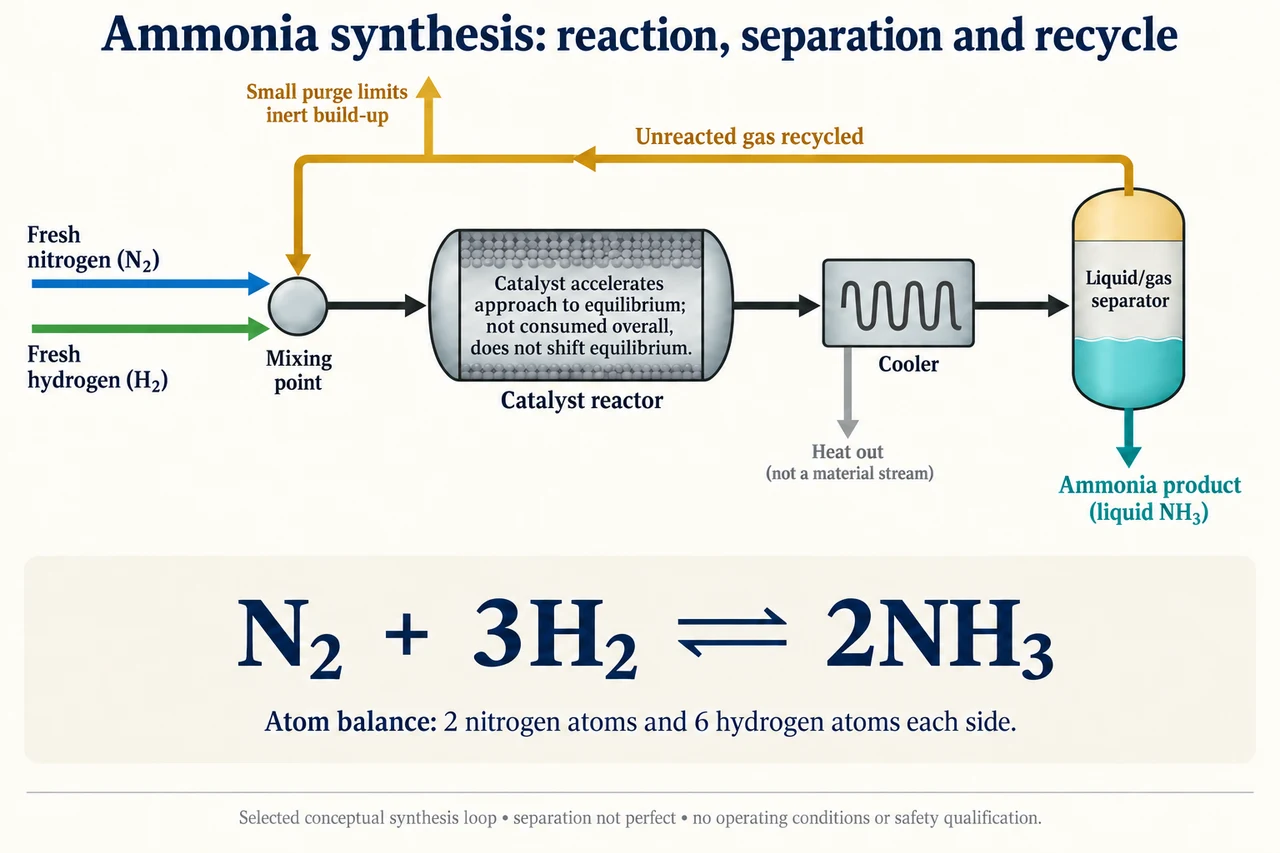
myAudience original rendered teaching illustration. Image: illustration, not a documentary photograph. · Operator-authored generated illustration; scientific model reviewed separately.
A synthesis loop makes more than one pass count
Ammonia synthesis combines nitrogen and hydrogen according to N₂ + 3H₂ ⇌ 2NH₃. Each reaction amount consumes one mole of nitrogen molecules and three moles of hydrogen molecules to produce two moles of ammonia molecules. Atoms remain conserved: two nitrogen atoms and six hydrogen atoms appear on each side. Total molecule count can change during a reaction, so equal total molar flows entering and leaving a reacting unit are not required. This lesson selects a conceptual catalytic synthesis loop, not an actual plant specification or an instruction to manufacture, handle or store ammonia.
Follow the plate’s material route: fresh nitrogen and hydrogen mix with returned gas before entering the catalyst reactor. Reactor effluent is cooled, then a separator removes an ammonia-rich liquid product while gas returns upstream. The small purge branch prevents an unwanted circulating inventory from growing without limit. Heat leaving the cooler is a separate energy transfer, not lost nitrogen or hydrogen. The diagram intentionally omits the detailed feed preparation, compression, heat recovery and protection systems a real plant needs. Separation is not perfect; some ammonia can remain in gas. Its symbolic catalyst granules and equation are not a model of a particular active surface or proof that the loop reaches complete conversion.
A catalyst can accelerate approach to equilibrium by offering an alternative reaction pathway. It does not change the equilibrium constant at unchanged temperature, and it is not a consumed feed in the overall balanced reaction. Catalyst condition can nevertheless deteriorate, so “not consumed overall” does not mean an indestructible industrial material. Rate and equilibrium are different limits: waiting time, temperature history, composition and equipment constraints still matter. The synthesis reaction is exothermic. A temperature change can therefore affect both the rate and equilibrium in different ways; no single setting or preferred operating condition follows from this drawing. The process is a managed compromise, not an arrow that turns every entering molecule into product.
Use a deliberately fictional single-pass budget. Reactor inlet contains 100 kmol/h N₂ and 300 kmol/h H₂, no ammonia or inert material. Stipulate that 20% of entering N₂ reacts and that only the stated reaction occurs. Then 20 kmol/h N₂ consumes 60 kmol/h H₂ and forms 40 kmol/h NH₃. Outlet amounts are 80 N₂, 240 H₂ and 40 NH₃: 360 kmol/h altogether, compared with 400 entering. The missing 40 kmol/h of molecular count is not leaked mass. Using stipulated approximate molar masses 28, 2 and 17 kg/kmol, inlet mass is 3,400 kg/h and outlet mass is 2,240 + 480 + 680 = 3,400 kg/h. This conversion is chosen for learning, not measured plant performance or a claimed equilibrium value.
Now impose a second, explicitly idealised steady boundary: all 80 N₂ and 240 H₂ leaving that reactor are separated and returned, all 40 NH₃ becomes product, and there are no inerts, purge or losses. To keep the same reactor inlet, fresh feed supplies only 20 N₂ and 60 H₂ kmol/h. Net fresh input is therefore 80 kmol/h, while internal reactor input is 400 kmol/h. Counting the recycled 320 kmol/h as new purchased feed would count the same material repeatedly. External mass balance is 20 × 28 + 60 × 2 = 680 kg/h of fresh reactants, matching 40 × 17 = 680 kg/h product. Perfect separation is a calculation assumption, not a claim about the real loop drawn in the image.
Real feed may introduce constituents that do not leave with the desired product. In an ideal illustration of an inert inventory, let each circulation step add one unit of inert and retain 95% of the previous inventory. If I is the just-before-removal inventory, steady bookkeeping gives I = 1 + 0.95 I, or I = 20 units; removal is one unit per step. With no removal and continuing input there is no finite steady inventory in this model. This is not a recommended purge rate: real removal also carries reactants and requires a proper multi-component balance. Responsible comparison counts hydrogen production, energy, separation, losses and fertilizer use beyond the synthesis loop. DOE summaries from 2018 and 2021 describe research directions; they do not establish that a novel catalyst has replaced commercial practice today.
Image: illustration, not a documentary photograph.
Worked example: A fictional reactor receives 100 kmol/h N₂ and 300 kmol/h H₂. Exactly 20% of N₂ reacts through N₂ + 3H₂ → 2NH₃; no other reaction occurs. Find outlet component flows and check mass using stipulated approximate molar masses N₂ = 28, H₂ = 2, NH₃ = 17 kg/kmol.
Reaction amount is 0.20 × 100 = 20 kmol/h N₂. H₂ consumed is 3 × 20 = 60; NH₃ formed is 2 × 20 = 40 kmol/h.
Outlet: N₂ = 100 − 20 = 80; H₂ = 300 − 60 = 240; NH₃ = 40 kmol/h. Total molecular molar flow is 360, not 400 kmol/h.
Mass in = 100 × 28 + 300 × 2 = 3,400 kg/h. Mass out = 80 × 28 + 240 × 2 + 40 × 17 = 3,400 kg/h. Atoms and mass balance despite fewer molecules.
Answer: 80 kmol/h N₂, 240 kmol/h H₂ and 40 kmol/h NH₃ leave; mass is conserved at 3,400 kg/h under the stipulated approximate molar masses.
Check your understanding: Under perfect product separation and full unreacted-gas recycle with no purge/inerts/losses, what fresh feed maintains the same reactor inlet? If a separate inert model adds one unit each step and retains 95% of the previous just-before-removal inventory, find its steady inventory. Does a faster catalyst alone imply a new equilibrium constant?
Answer: Fresh feed replaces only reaction consumption: 20 kmol/h N₂ and 60 kmol/h H₂. Its 680 kg/h equals the 40 kmol/h ammonia product’s 680 kg/h; internal recycled gas is not net new feed. In the separate inventory model, I = 1 + 0.95 I gives I = 20 units, with removal 0.05 × 20 = 1 unit each step. Without removal there is no finite steady inventory while input continues. These idealisations do not set a real purge rate or guarantee perfect separation. A catalyst changes the pathway and rates, not the equilibrium constant at the same temperature.
Why: Distinguish conserved atoms/mass from changing molecule count; distinguish external fresh feed from internal circulation. Keep perfect separation and the discrete inert budget explicit rather than pretending they describe a qualified real plant.