A paper machine removes water without losing the sheet
By How things work · myAudience
myAudience original rendered teaching illustration. Image: illustration, not a documentary photograph. · Operator-authored generated illustration; scientific model reviewed separately.
A paper machine removes water without losing the sheet
Papermaking transforms a dilute fibre suspension into a coherent sheet by forming, pressing and drying. This lesson starts with prepared papermaking stock; it does not represent the earlier production of pulp from wood or the full processing of recovered paper. Stock can contain fibres, fine material and additives chosen for a purpose. The challenge is to distribute material, retain useful constituents and remove water while preserving a sheet that meets the required properties. “Drier” and “stronger” are not synonyms, and a smooth picture cannot establish a paper grade, barrier performance or tested strength.
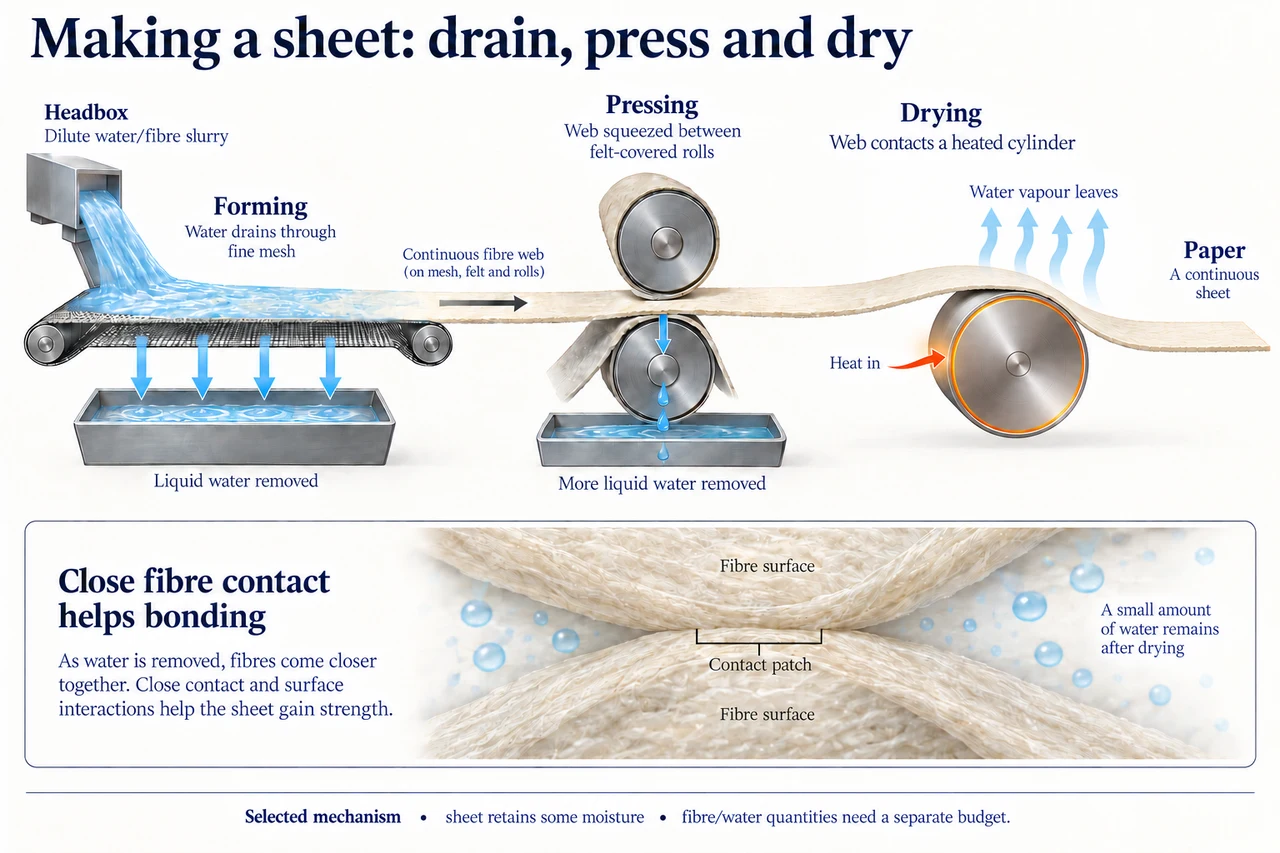
Trace the image’s continuous sheet route. A headbox places dilute furnish onto a moving forming fabric. Water drains downward while a fibre network develops; the web then moves through pressing before reaching a heated drying section. Pressing removes more liquid water and consolidates the wet sheet. Drying transfers heat and removes water as vapour. The downward blue liquid arrows and upward pale vapour arrows therefore describe different stages and phases, not fibres disappearing. The contact inset highlights close fibre surfaces, not a counted set of atoms or newly created covalent crosslinks. The drawn cylinder count is illustrative and cannot specify a drying duty. Some moisture remains in the finished sheet.
As water leaves, fibre surfaces can approach closely enough for interactions that help the dry sheet cohere. NC State’s introductory account identifies hydrogen bonding involving hydroxyl-rich cellulosic surfaces as an important contribution. Contact, fibre properties, network arrangement and additives also matter; no single dashed bond or dry appearance explains all paper strength. Formation describes how uniformly the sheet’s material is distributed over a relevant scale. Fine material is not necessarily retained merely because long fibres remain on the forming fabric. The developing mat and interactions among particles can change retention. A mechanism picture should help you ask where solids and water go rather than assume the machine keeps every useful particle.
Consider a fictional ideal solids budget in which 100 kg of oven-dry fibre is retained, with no filler, additive or fibre loss. A starting stock at 1% dry fibre by total wet mass contains 10,000 kg altogether, so water is 9,900 kg. At 20% solids after forming, total mass is 100/0.20 = 500 kg and water is 400 kg. At 50% solids after pressing, total is 200 kg and water is 100 kg. A final sheet at 95% solids has total mass 100/0.95 ≈ 105.263 kg and retains about 5.263 kg water. Removed water is therefore 9,500 kg during forming, 300 kg during pressing and about 94.737 kg during drying. These invented fractions teach a boundary; they are not a recommended machine target or asserted standard performance.
Change the pressing result to 40% solids while keeping the same retained dry fibre and final sheet. Water entering drying becomes 100/0.40 − 100 = 150 kg. About 144.737 kg must then leave in drying, 50 kg more than in the 50%-solids case. That extra water-removal requirement follows from the mass budget; an exact fuel or electricity penalty still requires temperatures, enthalpy, heat recovery, air and equipment data. It is equally misleading to call all 9,900 kg initial water “consumed freshwater”: internal collection and reuse can return part of the water. A mill-wide water balance must distinguish internal circulation from fresh input, effluent, vapour leaving and water retained in products.
Water can weaken many dry paper networks, and rewetting can help separate fibres for repulping, but that is not proof of unlimited recycling or identical properties after every cycle. Scallan and Laivins’ 1993 research abstract describes reduced swelling after drying and rewetting for selected pulps, often called hornification; this is a dated, bounded scientific observation, not a universal rejection of recovered fibre. Contaminants, coatings, fibres and the required product need their own assessment. Useful resource comparisons count retained material, rejects, energy, water treatment, sourcing and service function rather than a single recycled-content percentage. Safe industrial operation and product testing remain outside this conceptual lesson.
Image: illustration, not a documentary photograph.
Worked example: A fictional no-loss process retains 100 kg dry fibre throughout. Stock starts at 1% solids by total wet mass; after forming it is 20%, after pressing 50%, and the final sheet is 95%. Find water removed in each stage and final retained water. No filler or additive is counted.
For any stated solids fraction s, total wet mass = 100/s and water = 100/s − 100 kg. Initially: total 10,000 kg, water 9,900 kg.
After forming: total 500 kg, water 400 kg; forming removes 9,900 − 400 = 9,500 kg water. After pressing: total 200 kg, water 100 kg; pressing removes 400 − 100 = 300 kg.
Final: total 100/0.95 ≈ 105.263 kg and water ≈ 5.263 kg. Drying removes 100 − 5.263 ≈ 94.737 kg. Removed water plus retained water is 9,500 + 300 + 94.737 + 5.263 = 9,900 kg, allowing rounding.
Answer: Forming removes 9,500 kg water; pressing 300 kg; drying about 94.737 kg. The final sheet retains about 5.263 kg water with its 100 kg dry fibre.
Check your understanding: If pressing reaches only 40% solids, how much water must drying remove to reach the same 95% final solids? Does the difference determine exact energy use? If 5 kg fibre is instead lost before forming, may you continue using 100 kg retained solids in every stage? Does initial circulating water equal consumed freshwater?
Answer: At 40% solids the wet sheet contains 150 kg water, so drying removes about 150 − 5.263 = 144.737 kg: 50 kg more than before. Exact energy does not follow from water mass alone without the required thermal/system evidence. If 5 kg fibre is lost, only 95 kg is retained; all downstream totals must use that new dry-solids amount and separately account for the lost fibre stream. Initial stock water can include reused internal water, so it is not automatically net freshwater consumption. A whole-mill boundary must count actual fresh input and external outputs.
Why: Keep a consistent dry-solids basis, use percentages of total wet mass, and distinguish stage water removal, phase change and external resource consumption. A sheet can be dry without proving the required strength, uniformity or recycling performance.