Microgrid: an island needs a balanced local system
By How things work · myAudience
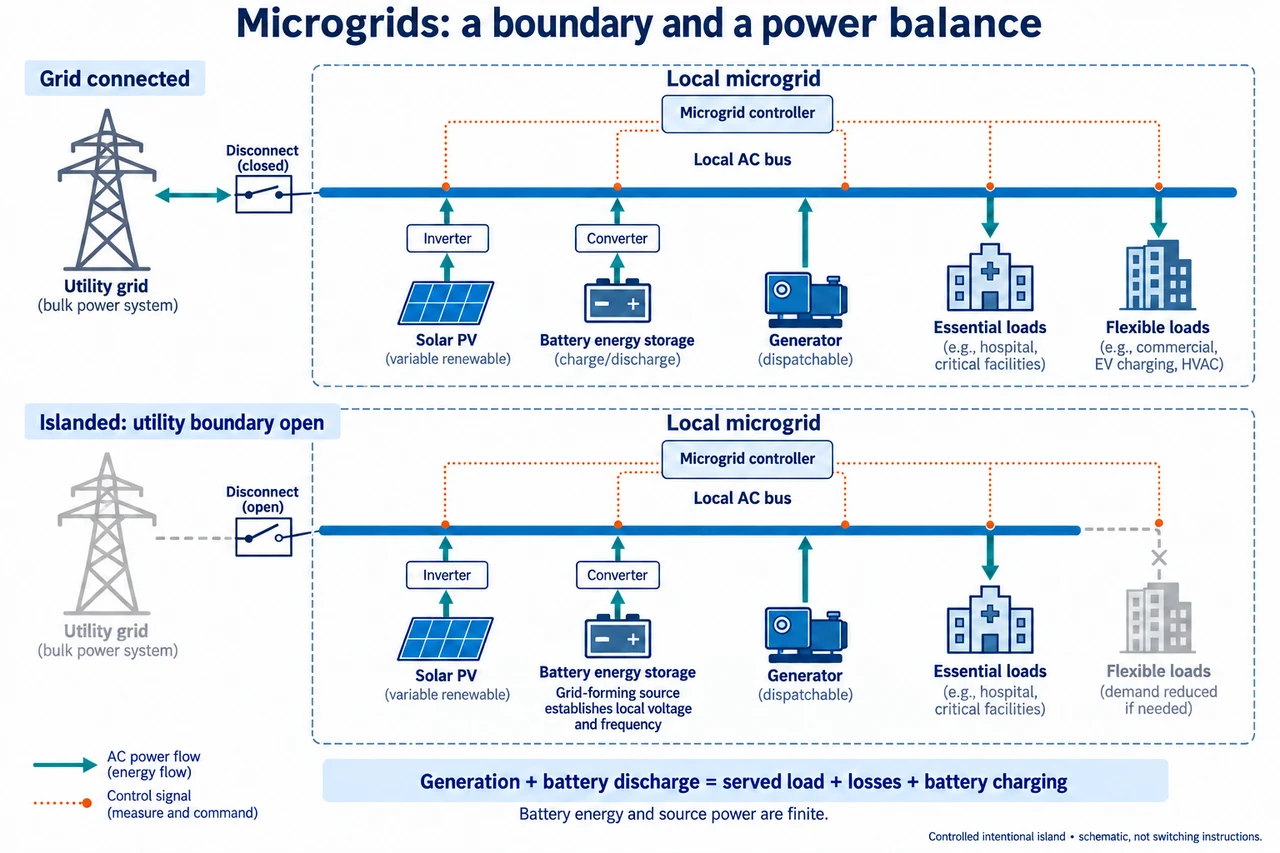
myAudience original rendered teaching illustration. Image: illustration, not a documentary photograph. · Operator-authored generated illustration; scientific model reviewed separately.
Microgrid: an island needs a balanced local system
A microgrid is a local grouping of electricity sources and loads that can be controlled together, with a defined connection to the wider grid. Distributed generation alone is not sufficient: the local system needs compatible equipment, protection, controls and an intentional operating boundary. A grid-connected local network can import or export power; an islanded one must serve its demand from resources within its boundary. The same equipment can therefore face different constraints in each state.
The plate places the utility tower outside the local boundary. In the upper state a closed connection permits import, while local solar, battery and generator resources can contribute to the bus. In the lower state the open gap has no crossing energy arrow: local resources supply essential demand and flexible demand is reduced if necessary. The battery converter is the selected grid-forming source, which establishes the local voltage and frequency reference. The solar inverter is not drawn as an independent voltage reference. Some solar equipment follows an existing grid and disconnects when that reference is lost; engineered intentional islands require suitable control and protection, not simply a rooftop panel during an outage.
Power balance is instantaneous, while stored energy is accumulated over time. In an original island model, essential demand is 18 kW, flexible demand 12 kW and local electrical losses 2 kW. Solar supplies 10 kW and a generator supplies 15 kW. Demand plus losses totals 32 kW, so the battery must discharge 32 − 25 = 7 kW. If battery AC-output capability is only 6 kW, the schedule is infeasible despite sufficient stored energy. Reducing flexible demand by at least 1 kW resolves this particular power deficit. It does not prove voltage stability, fault protection or adequate reserve.
Now examine a sustained energy constraint rather than a single instant. Suppose the battery has an explicitly stated 24 kWh allowance deliverable at its AC boundary, avoiding double-counting conversion efficiency. At a steady 7 kW discharge this would last 24/7 h, about 3.43 h, if the power-capability condition were satisfied. If the generator later supplies 20 kW, solar supplies 10 kW and served demand plus losses is 25 kW, the 5 kW surplus can charge the battery only within its charge-power and remaining-capacity limits. Excess supply is not automatically useful storage; it may need curtailment or a permitted alternative destination.
Use a two-interval budget to expose a hidden assumption. With 24 kWh initially deliverable, the first two hours at 7 kW spend 14 kWh, leaving 10 kWh. During the next hour, solar falls to 4 kW while the generator remains at 15 kW and demand plus losses remains 32 kW. The required battery discharge rises to 13 kW. That hour needs 13 kWh, exceeding the 10 kWh remaining even before any tighter power limit. Reducing demand plus losses to at most 29 kW makes this last-hour energy account possible with 10 kW discharge. A 6 kW battery limit instead requires demand plus losses at most 25 kW. Energy adequacy and power adequacy must both hold.
An algebraically balanced schedule is not a complete microgrid design. Frequency and voltage must remain controlled during disturbances; reconnecting to the utility requires authorised compatible protection and synchronisation. The DOE example explains deliberate isolation to prevent back-feeding the utility and reducing noncritical demand during extended outages; it is not a sequence to copy from a drawing. Fair resilience planning asks who loses flexible service, which vulnerable groups need essential support, and how costs and emissions are distributed. Fuelled generation, batteries and solar have different constraints and environmental burdens. A microgrid can improve resilience without guaranteeing uninterrupted service under all weather, fuel or equipment conditions.
Image: illustration, not a documentary photograph. The plate is a functional concept model, not physical wiring, switching instructions or a performance guarantee.
Worked example: In a fictional island, solar supplies 6 kW and a generator 12 kW. Served load is 22 kW and losses 1 kW. A battery has 15 kWh deliverable AC energy and a 4 kW output limit. Find the required discharge, feasibility, and minimum reduction in served load.
Required discharge is 22 + 1 − 6 − 12 = 5 kW. The 4 kW output limit is exceeded, so the schedule is infeasible. Reducing served load by at least 1 kW gives 21 + 1 − 18 = 4 kW, with an energy-only constant runtime of 15/4 = 3.75 h. This does not establish stable operation or reserves.
Answer: Required discharge is 22 + 1 − 6 − 12 = 5 kW. The 4 kW output limit is exceeded, so the schedule is infeasible. Reducing served load by at least 1 kW gives 21 + 1 − 18 = 4 kW, with an energy-only constant runtime of 15/4 = 3.75 h. This does not establish stable operation or reserves.
Check your understanding: Start with 18 kWh deliverable AC battery energy. For one hour, total served load plus losses is 26 kW and other sources supply 20 kW. For the next two hours other sources supply 17 kW, with unchanged demand. Can energy suffice? A 7 kW output limit also applies; distinguish the two failures and find the maximum constant demand-plus-losses during the last interval.
Answer: First hour uses 6 kWh, leaving 12 kWh. Next interval requires 9 kW × 2 h = 18 kWh, so energy is insufficient; 9 kW also exceeds the separate 7 kW power limit. Remaining energy permits at most 12/2 = 6 kW discharge over those two hours, tighter than 7 kW. Demand plus losses must therefore be at most 17 + 6 = 23 kW under the stated constant model. Source variability, conversion boundary and reserves could require further reduction.
Why: Apply declared energy boundaries, units and separate power constraints; original fictional models do not certify installation operation.