Sorting materials means measuring more than appearance
By How things work · myAudience
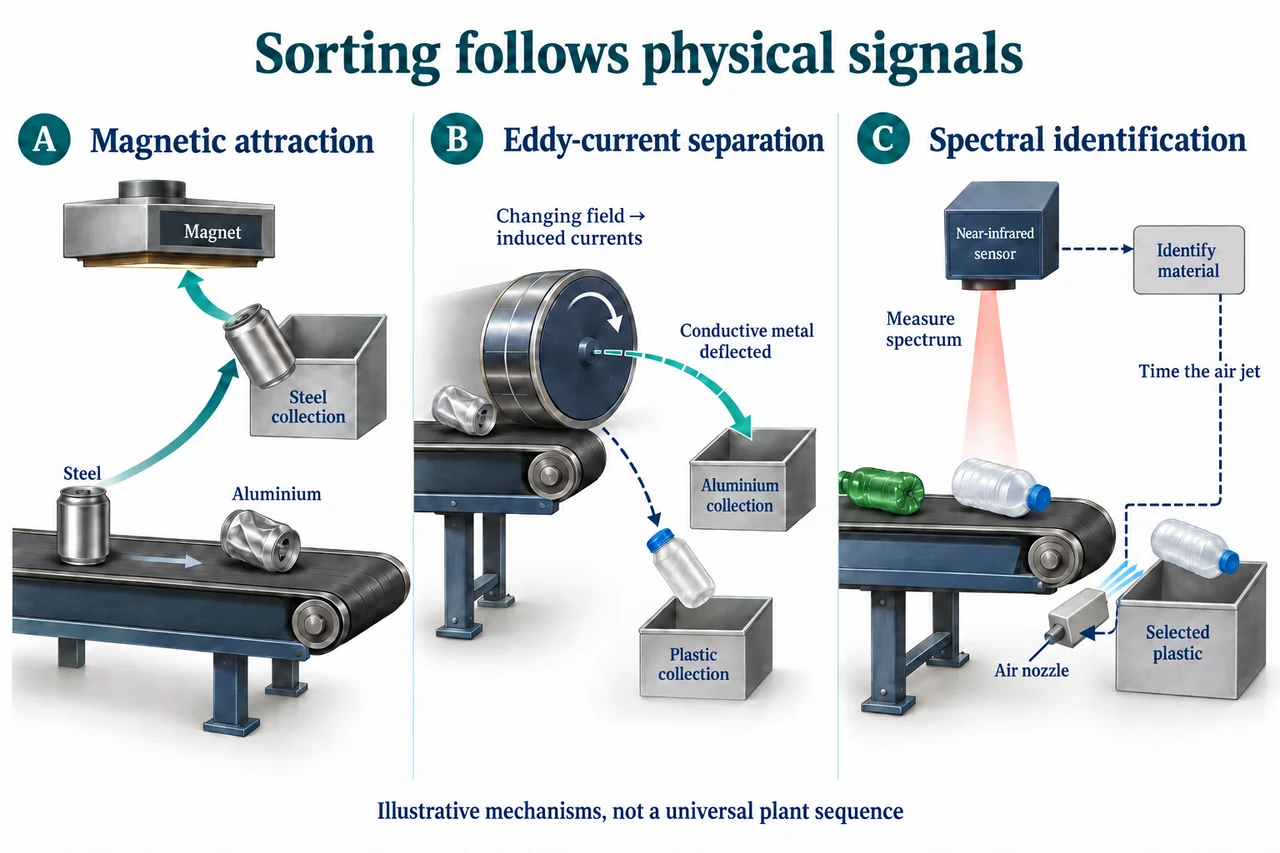
myAudience original rendered teaching illustration. Image: illustration, not a documentary photograph. · Operator-authored generated illustration; scientific model reviewed separately.
Sorting materials means measuring more than appearance
A recycling line must turn a mixed stream into outputs that someone can actually use. Sorting asks a narrower question than recycling: which pieces should leave through each outlet? Reprocessing, product quality and an available receiving market are further requirements. A material is not automatically recyclable in a particular collection system because one machine could separate it. This lesson selects three physical sorting mechanisms and an invented mass budget; it does not prescribe the equipment order of every facility or certify a recovered material. Objects with similar visible colours can have different compositions, while useful material may remain hidden in a composite or contaminated object.
The plate separates three examples rather than drawing a universal plant sequence. In the magnetic panel, a steel item is attracted towards the overhead magnet while the illustrated aluminium item continues. Magnetic attraction does not mean that every metal follows the steel path. In the eddy-current panel, a changing magnetic field induces circulating currents in a conducting object; their electromagnetic interaction can deflect that object from the trajectory of a nonconducting piece. This is not the same mechanism as ferromagnetic attraction. The optical panel measures returned light, classifies a selected piece and times a downstream air jet. The arrows distinguish a measurement signal from a material trajectory. An actual separator needs reliable presentation and timing; a correct decision that fires at the wrong piece is still a sorting failure.
Physical properties supply different kinds of evidence. A screen separates by relevant size and geometry, not by a universal polymer identity. Near-infrared measurements can help identify polymer types through characteristic spectral responses rather than visible colour alone. Overlapping objects, coatings and surface contamination can interfere with the evidence or the separation action. A 2017 Fraunhofer-authored research abstract identifies carbon-black absorption as a limitation for conventional near-infrared identification of black plastics and investigates a mid-infrared alternative. That dated study does not imply that every black item is unrecyclable, or that every present-day separator has the same limitation. Its useful lesson is to ask whether the chosen signal can distinguish the actual materials, not to treat a confident-looking machine label as ground truth.
Purity and recovery answer different questions. Define target recovery as target material in the selected output divided by target material entering. Define product purity as target material in that output divided by all material in that output. Suppose an invented 1,000 kg feed contains 600 kg target and 400 kg other material. A chosen setting captures 90% of the target and incorrectly captures 5% of the other material. The output contains 540 kg target plus 20 kg other: 560 kg altogether. Recovery is 540/600 = 90%; purity is 540/560 ≈ 96.43%. The residue contains 60 kg target and 380 kg other, or 440 kg. Both material categories balance separately, and 560 + 440 = 1,000 kg. These figures are stipulated learning data, not measured equipment performance.
A stricter fictional decision captures only 80% of target and incorrectly captures 2% of other material. The selected output becomes 480 + 8 = 488 kg; purity rises to 480/488 ≈ 98.36%, while target recovery falls to 80%. A cleaner-looking output has lost another 60 kg of potentially useful target into the residue. Deciding which setting is preferable requires a stated product specification and a defensible account of material value, downstream treatment, rejects, resource use and uncertainty. Purity alone cannot supply that decision. Even a perfect mass balance cannot prove that the material is chemically safe, uncontaminated, compatible with a product or accepted by the receiving operation.
A useful investigation tracks the entire chain from physical signal to classification, timed separation and output verification. Inspect representative samples of both output and residue using a justified method; do not assess success only by looking at the attractive selected pile. Presentation changes can change performance even when the algorithm is unchanged. A batch with less target also changes purity at the same capture rates: with 200 kg target and 800 kg other, the first fictional setting gives 180 + 40 = 220 kg product, only about 81.82% pure although target recovery remains 90%. Ethical evaluation includes the workers handling hazardous or sharp rejects, the communities receiving residues, and the resources actually saved after reprocessing. This conceptual lesson supplies no instructions for bypassing guards, handling hazardous waste or operating a separator.
Image: illustration, not a documentary photograph.
Worked example: A fictional 1,000 kg feed contains 600 kg target and 400 kg other material. A separator selects 90% of the target and 5% of the other material. Find product mass, purity, target recovery and residue composition.
Selected target = 0.90 × 600 = 540 kg. Selected other = 0.05 × 400 = 20 kg; product mass = 560 kg.
Purity = 540/560 ≈ 96.43%. Recovery = 540/600 = 90%; the denominators answer different questions.
Residue target = 60 kg and residue other = 380 kg. Product 560 + residue 440 = 1,000 kg, with target 540 + 60 = 600 and other 20 + 380 = 400 kg.
Answer: Product is 560 kg at approximately 96.43% target purity and 90% target recovery. Residue is 440 kg: 60 kg target and 380 kg other.
Check your understanding: A stricter setting captures 80% of target and 2% of other material in the same feed. Compare it with the first setting. Then keep the first capture rates but change the feed to 200 kg target and 800 kg other. Does the same recovery guarantee the same purity, and can the highest purity alone identify the best process?
Answer: The stricter setting selects 480 kg target and 8 kg other, giving 488 kg product at about 98.36% purity and 80% recovery. It loses 120 kg target rather than 60 kg. With the changed feed and the original rates, product is 180 + 40 = 220 kg; purity is 180/220 ≈ 81.82% and recovery remains 90%. Purity depends on feed composition as well as capture rates. No single winner follows without the receiving specification and the consequences of lower recovery, treatment, rejects and resource use. Sorting a product does not establish its safe use or local acceptance.
Why: Balance each material category independently; distinguish product contamination from lost target. A signal, a decision and a timed physical action are separate failure points. Reject universal claims from a dated study or an invented performance budget.