Humidity control: temperature is not water content
By How things work · myAudience
myAudience original generated educational illustration · Original commissioned illustration
Humidity control: temperature is not water content
A room can reach its temperature set point while still having an excessive moisture load. Sensible cooling changes temperature; dehumidification removes water vapour from the air. These demands need not rise and fall together. Water can enter from outdoor air, people and activities, and can be stored or released by building materials. The Department of Energy discusses this mismatch in both its dated 2012 residential engineering presentation and a newer hot-humid-climate project. The underlying mechanism is established; neither source makes a particular thermostat setting or equipment choice universally suitable.
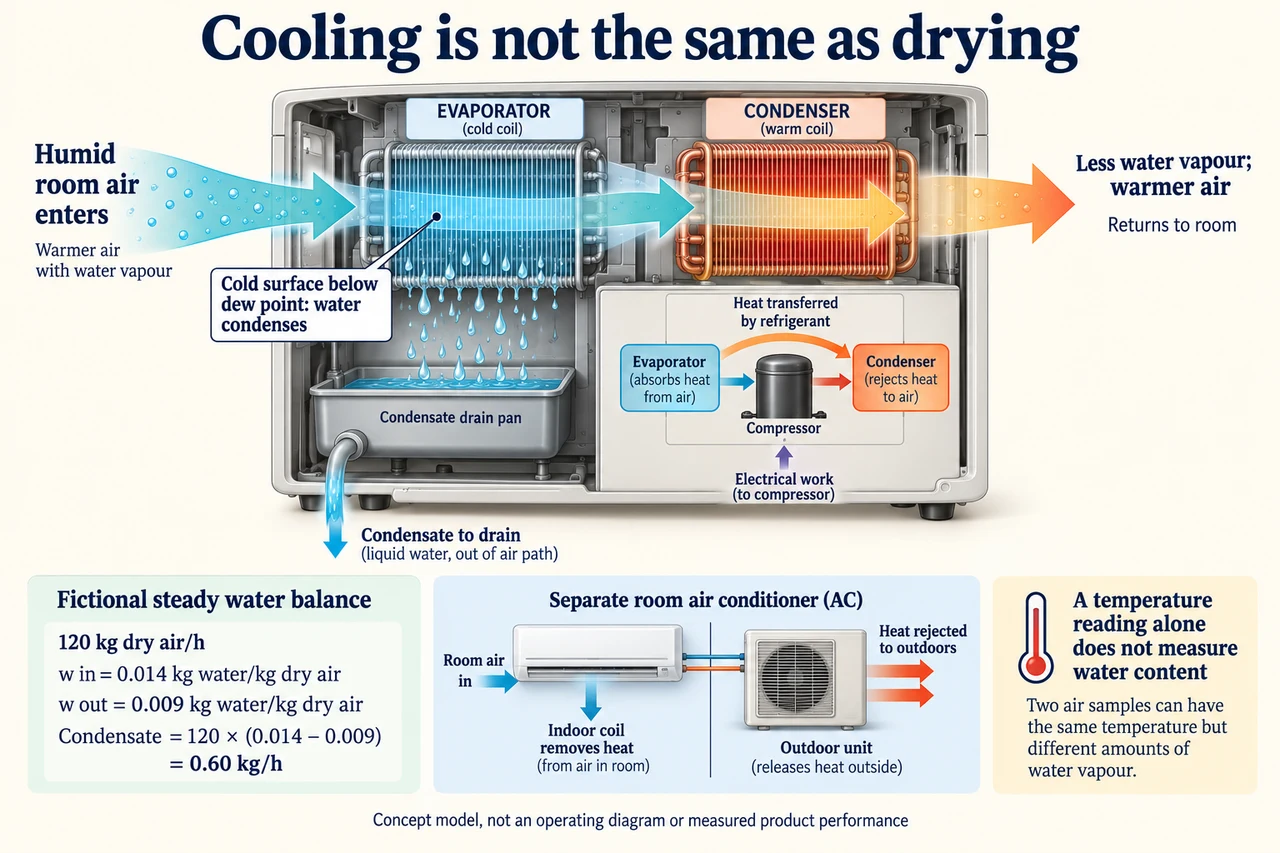
Read the illustrated stand-alone dehumidifier from left to right. Room air passes the cold evaporator, where heat is transferred out of the air and water can condense on a surface below the incoming air’s dew point. Droplets collect in a separate pan and drain, not in the refrigerant circuit. The air then passes the warm condenser and returns to the room with less water vapour and a higher temperature than immediately after the cold coil. The water symbols in the arrows stand for vapour content; they are not a claim that ordinary room vapour is visible liquid droplets. The small compressor inset distinguishes electrical work and transferred heat from the separate air and liquid-water paths.
Dew point concerns saturation at the stated pressure and water content. Cooling an initially unsaturated sample at approximately constant pressure without first changing its vapour content raises relative humidity until saturation is reached; continued cooling with condensation reduces vapour content. Relative humidity is a ratio involving saturation at the current temperature, so a fall in relative humidity caused only by heating is not proof that water was removed. Humidity ratio w means kilograms of water vapour per kilogram of dry air. It provides a mass-accounting reference that does not change merely because the same air becomes warmer. Pressure, condensation, air mixing and changing moisture sources must be considered when comparing actual readings.
Construct an original steady control-volume balance around the selected air path. Assume dry air is neither added nor removed there, the dry-air throughput is 120 kg/h, all separated condensate drains away, and there is no accumulating water inside the device. The incoming water rate is 120 × 0.014 = 1.68 kg/h; outgoing vapour is 120 × 0.009 = 1.08 kg/h. Their difference is 0.60 kg/h of liquid condensate. Thus incoming water equals outgoing vapour plus drain water. The rate refers to dry-air mass, not room volume or fresh-air supply. The same room air may circulate repeatedly, and 120 kg/h does not mean 120 kg/h of new outdoor air.
This simple balance does not establish the energy consumption or the time to dry an actual room. A colder coil transfers both sensible heat and energy associated with condensation, and the refrigeration cycle requires electrical work. In a stand-alone unit the condenser returns heat to indoor air, unlike the separate room-air-conditioner inset whose outdoor unit rejects heat outside. A warming room is therefore compatible with moisture removal. An efficiency comparison needs water-removal rate and electrical input under matched conditions; drainage mass alone cannot reveal coefficient of performance or whole-building comfort. Refrigerant servicing, drainage and electrical safety need qualified product-specific procedures, not the conceptual cutaway.
Extend the balance to the room rather than assuming the inlet condition remains constant forever. If a fictional room receives 0.72 kg/h of additional water vapour while the unit drains 0.60 kg/h and there is no other removal or storage change, the room’s water inventory increases at 0.12 kg/h. If the room instead has no incoming moisture, its humidity ratio will generally fall during drying, changing the unit’s removal rate; multiplying a one-hour figure by 24 then assuming an unchanged room would be unjustified. Moisture stored in walls or textiles can also delay the response. Measure the relevant quantities over time and state the boundary of the estimate.
An ethical design question is who receives a healthy, comfortable and affordable indoor environment and who pays for electricity or maintenance. A larger compressor is not automatically a better answer when a leak, uncontrolled source or poorly managed ventilation is the dominant moisture input. Dehumidification does not replace source repair, nor does tightening a building prove that ventilation can be omitted. Compare moisture management, thermal comfort, noise, energy use and maintenance access as separate outcomes. Avoid blaming occupants for every high reading when the building and climate constrain their choices.
Image: illustration, not a documentary photograph. The cutaway is a bounded functional model, not physical construction instructions or measured product performance.
Worked example: In a fictional steady air path, dry-air throughput is 150 kg/h and humidity ratio falls from 0.012 to 0.008 kg/kg. Find incoming vapour, outgoing vapour and drain rate. A room receives 0.90 kg/h of vapour; assume this drain is its only removal and no material storage change. Find inventory change.
Incoming vapour = 150 × 0.012 = 1.80 kg/h; outgoing vapour = 150 × 0.008 = 1.20 kg/h.
Condensate = 1.80 − 1.20 = 0.60 kg/h, under the steady device assumptions.
Room accumulation = 0.90 − 0.60 = 0.30 kg/h; device and room are different control volumes.
Answer: 0.60 kg/h drains while room water inventory increases by 0.30 kg/h in the declared model; no energy or comfort guarantee follows.
Check your understanding: A colleague heats room air and observes lower relative humidity, then claims 0.60 kg/h of water has been removed. Explain what evidence is missing. If the original 120 kg/h device inlet falls to w= 0.012 and outlet remains 0.009, compute the new drain rate and the accumulation with a 0.72 kg/h room source.
Answer: Heating can lower relative humidity without removing vapour; mass accounting needs humidity ratio/flow or actual separated-water measurement and relevant storage/source boundaries. New drain = 120 ×(0.012 − 0.009) = 0.36 kg/h. With 0.72 kg/h added, room inventory rises 0.36 kg/h under the stated assumptions; the old 0.60 kg/h rate cannot be reused blindly.
Why: Trace the mechanism with defined system boundaries, distinguish original model calculations from measured performance, and justify the limits of a transferred conclusion.