Ventilation and filtration: a clean-air mass balance
By How things work · myAudience
myAudience original generated educational illustration · Original commissioned illustration
Ventilation and filtration: a clean-air mass balance
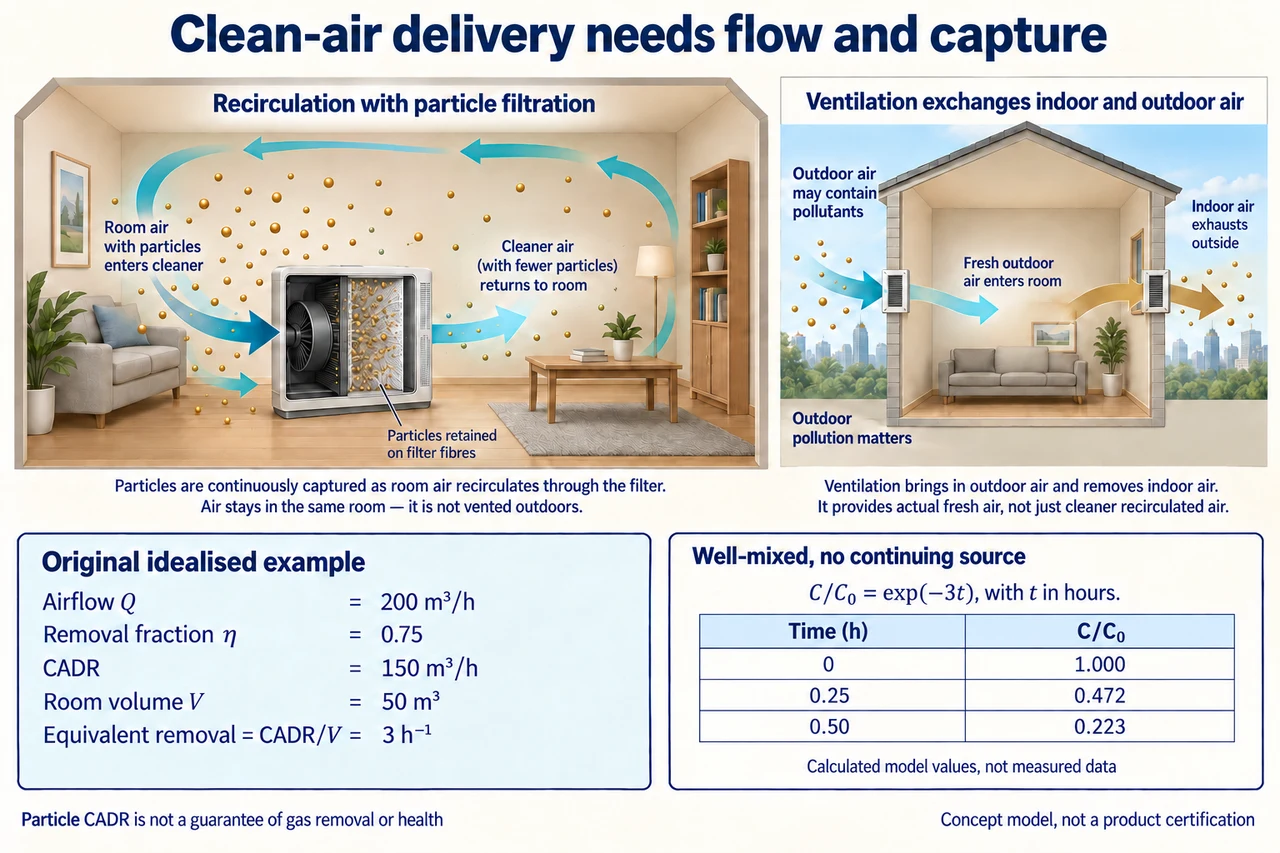
Ventilation and filtration act through different paths. Ventilation replaces indoor air with outdoor air; a recirculating cleaner sends room air through a device and returns it to the same room. The illustrated filter retains selected particles on fibres, while the right-hand inlet and exhaust cross the building boundary. Cleaner recirculated air is not new outdoor air, and outdoor air can itself contain pollutants. Source control, suitable ventilation and appropriate filtration are complementary decisions, not interchangeable labels or guarantees of healthy air.
The useful quantity for a selected pollutant is clean-air delivery, not filter efficiency in isolation. Let Q be airflow through the cleaner in m³/h and η its fractional removal for the pollutant under the assumed conditions. The equivalent clean-air delivery is K=ηQ. In the fictional plate Q= 200 m³/h and η= 0.75, so K= 150 m³/h. A 95%-efficient device passing only 100 m³/h gives 95 m³/h under the same ideal calculation and therefore less equivalent particle removal than the 75%-efficient 200 m³/h example. EPA’s technical summary defines this combination of flow and removal; actual certified CADR depends on pollutant and test conditions, so do not turn these invented inputs into a product certification.
Derive a room model rather than assuming every particle gets removed on its first circulation. Let C be concentration in µg/m³ and V a constant well-mixed room volume in m³. Pollutant mass is VC. In a short interval Δt, the cleaner removes approximately KCΔt, because air reaching it has the stipulated room concentration. With no continuing source or other gains or losses, V dC/dt =−KC. Separating variables and integrating gives ln(C/C₀)=−Kt/V and C=C₀ exp(−Kt/V). If hours are used for t, K/V must be in h⁻¹. Poor mixing, a nearby source or a changing filter/flow can invalidate the single-concentration model.
For the illustrated 50 m³ room, K/V= 150/50= 3 h⁻¹. After 0.25 h the calculated concentration fraction is exp(− 0.75)≈0.472; after 0.50 h it is exp(− 1.5)≈0.223. The table shows rounded computed model values, not measurements. Starting from a fictional 80 µg/m³ gives about 17.85 µg/m³ after half an hour. One equivalent air change does not mean zero concentration: at t= 1/3 h the fraction is exp(− 1)≈0.368. Each pass removes a fraction of the particles presented to the filter while cleaner air mixes with air still in the room.
A continuing source changes the conclusion. With a constant pollutant input G in µg/h and the same ideal removal, V dC/dt =G−KC. The equilibrium concentration is C∞=G/K, and the transient is C(t)=C∞ +(C₀−C∞) exp(−Kt/V). In an original example G= 300 µg/h and K= 150 m³/h gives 2 µg/m³ at equilibrium, not zero. Halving the source to 150 µg/h halves that equilibrium even if the filter is unchanged. This distinction shows why reducing generation at its source matters and why an empty-room decay test cannot by itself predict exposure beside a continuously emitting source.
Add clean outdoor-air exchange only with its assumptions stated. If 50 m³/h of pollutant-free outdoor air replaces an equal exhaust flow and mixes ideally, removal for this model becomes 150 + 50 = 200 m³/h. With the same 300 µg/h source, C∞= 1.5 µg/m³. If outdoor concentration is C_out rather than zero, the ventilation term is Q_v(C_out−C); the outside air can add as well as remove the selected pollutant. Particle filters do not automatically remove gases such as carbon monoxide, and an assumed particle CADR must not be applied to every substance. EPA also warns that some cleaning technologies can create harmful byproducts; this lesson makes no ozone-cleaning or clinical claim.
Flow carries an energy and maintenance cost. An original ideal fan account assumes 200 m³/h = 1/18 m³/s, a 150 Pa pressure rise and a constant 50% fan-plus-drive efficiency. Airflow power ΔpQ is 150/18≈8.33 W and electrical input is 8.33/0.50≈16.67 W. These stipulated values do not describe a real fan curve. A clogged or more restrictive filter can change flow, pressure and power together, so a nameplate η value alone does not establish continued CADR. Quiet low-speed operation may also change delivered flow. Evaluate measured performance, noise, upkeep, energy and accessibility under actual operating conditions rather than using the illustration to select equipment.
Who bears the cost of cleaning shared air? An ethical proposal should distinguish a landlord’s duty to address pollution sources from an occupant’s ability to buy a portable device. A reassuring percentage on packaging can obscure low flow, gas limitations or uncertain mixing. Transparent communication reports the pollutant, assumptions, maintenance and measurements, while respecting privacy if indoor sensors are used. Image: illustration, not a documentary photograph. The room and equipment are bounded functional models, not product certification or a building operating plan.
Worked example: An original well-mixed 60 m³ room has no continuing source. A cleaner passes 240 m³/h with stipulated particle removal fraction 0.75. Initial concentration is 50 µg/m³. Find equivalent removal and concentration after 20 minutes.
K= 240 × 0.75 = 180 m³/h; K/V= 180/60 = 3 h⁻¹.
20 minutes = 1/3 h; exponent − 3 × 1/3 =− 1.
C= 50 exp(− 1)≈18.39 µg/m³; the remaining fraction is about 0.368, not zero.
Answer: 180 m³/h equivalent clean-air removal and approximately 18.39 µg/m³ after 20 minutes, only under the stated original ideal model.
Check your understanding: A colleague claims three equivalent air changes eliminate all particles and that the same filter removes carbon monoxide. Explain both errors. With a continuing 600 µg/h source and 180 m³/h effective removal, find equilibrium concentration; then derive the term added by outdoor-air exchange when outside concentration is nonzero.
Answer: Exponential removal leaves exp(− 3)≈0.0498 of the initial concentration after three equivalent changes with no source, not zero; gas removal cannot be inferred from particle capture. Equilibrium is 600/180 = 10/3≈3.33 µg/m³. Outdoor exchange contributes Q_v(C_out−C), so clean-air dilution is the special case C_out= 0; polluted outdoor air may add the selected pollutant.
Why: Trace the mechanism with defined system boundaries, distinguish original model calculations from measured performance, and justify the limits of a transferred conclusion.