Wi-Fi: useful data depends on shared airtime
By How things work · myAudience
myAudience original generated educational illustration · Original commissioned illustration
Wi-Fi: useful data depends on shared airtime
A strong received radio signal does not give a device sole ownership of the channel. In a simplified contention-based Wi-Fi exchange, stations sense whether the medium is busy, wait the required idle interval and count a randomly chosen number of idle slots before transmitting. A station pauses its countdown when another exchange occupies the medium and resumes after the applicable idle interval. This is a mechanism for sharing opportunities, not a guarantee that every user obtains equal throughput or that hidden transmitters cannot interfere. The UCSB lecture explains this foundational DCF model; its particular historic timing examples are not universal constants for every current Wi-Fi mode.
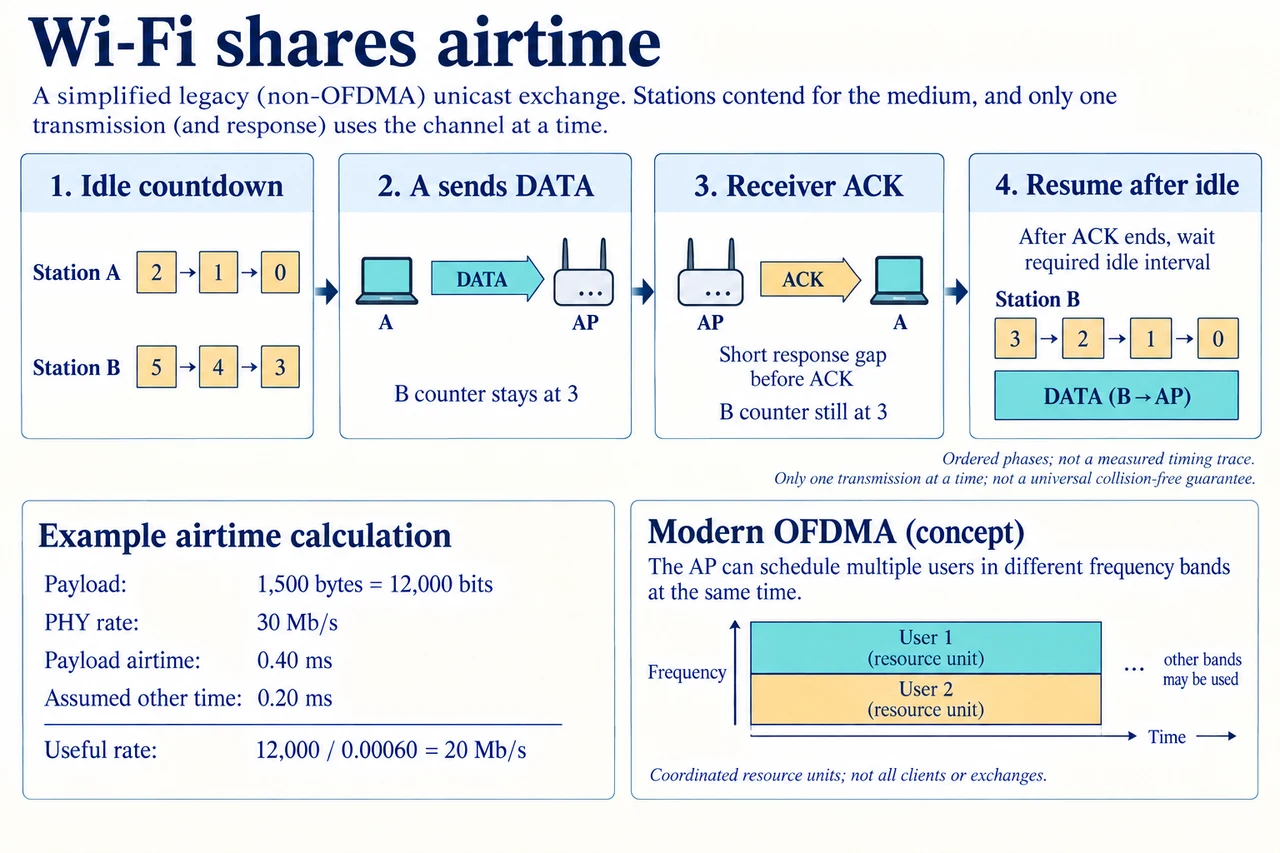
Read the four upper cards as ordered phases, not intervals drawn to scale. A begins with two illustrative countdown slots while B begins with five. When A starts its DATA frame, B still has three slots to wait; its counter is frozen rather than reset. The receiver returns an acknowledgement after a shorter response gap, before a new ordinary contention attempt is allowed. B remains frozen during that acknowledgement and resumes only after the required idle interval following it. The selected counts are fictional and the drawing deliberately supplies no fixed microsecond values. Remaining backoff state is preserved, although real implementations also have retry limits, access categories and other details outside these cards.
An acknowledgement provides feedback about reception of a particular unicast exchange. A missing acknowledgement does not uniquely diagnose a collision: interference, a weak link or a lost acknowledgement can give the sender the same symptom. A retry consumes channel time without delivering an additional copy of useful application information. Carrier sensing is local; a transmitter hidden from one station may still disturb that station’s receiver. Optional reservation mechanisms and newer coordination can mitigate particular problems, but they do not turn a radio environment into a universally collision-free cable.
The calculation card separates a physical-layer bit rate from useful delivered payload. Choose an original hypothetical frame with 1,500 payload bytes, so its payload is 12,000 bits. At a declared payload transmission rate of 30 Mb/s, those bits occupy 12,000 / 30,000,000 = 0.00040 s. Suppose all other time attributed to this exchange, including headers, waiting and acknowledgement, is 0.00020 s. Total attributed time is 0.00060 s and useful payload rate is 20 Mb/s. These invented aggregate timings are not parameters of a named standard or a measured network. If another bottleneck sits at the internet connection or server, improving this link need not improve the complete request.
To reason about retransmission, stipulate five attempts each taking 0.00060 s, of which four deliver a distinct successful payload. Useful bits total 48,000 while time totals 0.0030 s, giving 16 Mb/s. This deliberately assigns the same duration to failed and successful attempts; actual failed exchanges can have different timeouts and backoff. The lesson is the accounting boundary: count unique delivered payload in the numerator and all attributed busy and waiting time in the denominator. Counting five copies of the same data as five deliveries would reward waste rather than service.
The separate lower-right inset shows a different mode of coordination. Wi-Fi 6 can let an access point schedule resource units for multiple users within an OFDMA exchange. Two users can therefore occupy different allocated frequency resources in a coordinated interval, rather than independently contending for identical resources at that moment. Cisco Meraki explains these resource units and triggered exchanges. This does not mean every client supports the feature, every exchange uses it or unrelated networks cooperate with that access point. Keep the historical upper contention model and the modern scheduled inset distinct; neither is a complete current Wi-Fi specification.
A fairness problem appears when one client uses much more airtime per delivered byte than another. Under a simplified equal-payload comparison, 12,000 bits taking 1.2 ms occupy three times the time of 12,000 bits taking 0.4 ms. Signal quality, selected rates and retries can change that cost. Prioritising an essential low-bandwidth service may be justified, while permanently denying a slow user access may deepen exclusion. Explain the trade-off between airtime efficiency, latency and access rather than equating a speed headline with fairness. Troubleshooting should use consent-based aggregate measurements, not inspection of someone else’s communications.
Image: illustration, not a documentary photograph. The phase sequence, aggregate timings and two-user allocation are bounded teaching models, not captured traffic or a claim about a particular router. Protocol mechanisms are established; advertised peak rates and implementation-specific scheduling performance are outside this lesson.
Worked example: A fictional exchange carries 2,000 useful bytes at 40 Mb/s and attributes 0.30 ms of other time to each attempt. Compute the useful rate without retries. Of ten equal-duration attempts, only eight deliver unique successful payloads; find the revised rate.
Payload = 2,000 × 8 = 16,000 bits; payload time = 16,000 / 40,000,000 = 0.00040 s.
Attempt time = 0.40 + 0.30 = 0.70 ms = 0.00070 s; useful rate = 16,000 / 0.00070 = 22.857 million bits/s.
Eight unique successes provide 128,000 bits in ten × 0.00070 = 0.0070 s, giving 18.286 Mb/s. Equal failure duration is stipulated, not inferred.
Answer: Approximately 22.9 Mb/s without retries and 18.3 Mb/s with the specified failed attempts; neither equals the 40 Mb/s PHY rate.
Check your understanding: A user claims that a missing ACK proves another user collided, and that OFDMA means all nearby networks can transmit together without interference. Correct both claims. Explain why doubling the PHY rate in the 1,500-byte model does not double useful throughput.
Answer: Missing ACK has several possible causes, so it does not prove a collision. OFDMA assigns resources within a coordinated exchange and does not guarantee cooperation from all neighbours. At 60 Mb/s the payload takes 0.20 ms; with the unchanged assumed 0.20 ms other time, total is 0.40 ms. Useful rate = 12,000 / 0.00040 = 30 Mb/s, only 1.5 times the original 20 Mb/s because the stipulated overhead did not halve.
Why: Use the declared model and explain which physical or protocol assumptions prevent an unrestricted real-device prediction.