Wastewater: follow the water, solids and oxygen demand
By How things work · myAudience
myAudience original generated educational illustration · Original commissioned illustration
Wastewater: follow the water, solids and oxygen demand
Wastewater treatment combines different mechanisms because no single separator removes every kind of contamination. Screens catch larger debris; settling separates material that falls out under the chosen conditions; a biological stage transforms part of the organic load; disinfection addresses pathogens. A clearer-looking outlet is not proof that all dissolved contaminants or disease risks have disappeared. EPA’s historical 1998 overview explains these established process distinctions, not current permit limits or a guaranteed removal percentage for every plant. The lesson follows one conventional activated-sludge route; other treatment configurations exist.
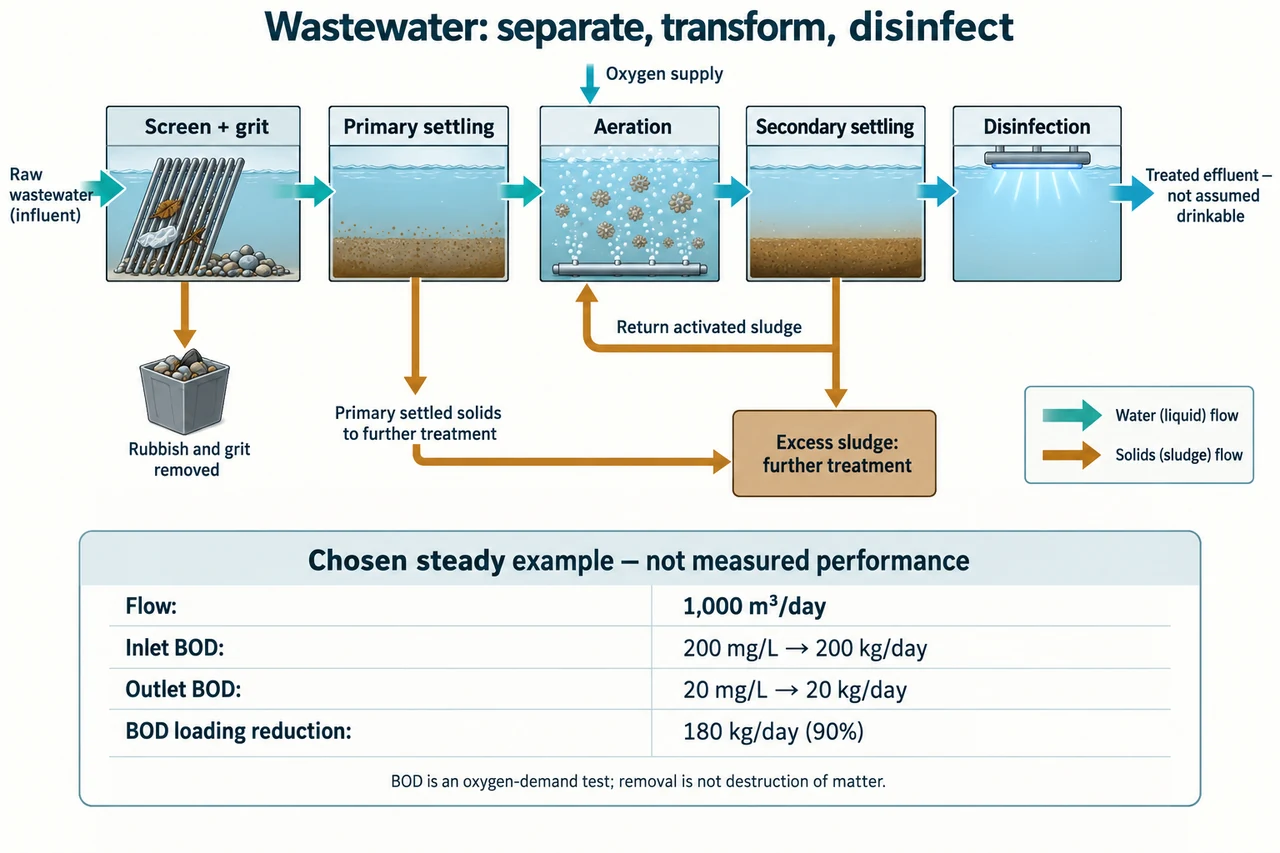
Read the plate’s upper water route from screen and grit removal through primary settling, aeration, secondary settling and disinfection. The separate lower arrows matter: secondary sludge partly returns to aeration to retain an active microbial population, while excess sludge and primary settled solids go to further treatment. Those routes must not be confused with treated effluent. Oxygen supplied to the aeration tank supports aerobic activity; bubbles are not a magical filter. The diagram is a functional map with separate water and solids paths, not a plumbing drawing, complete works specification or claim that the outlet is drinking water.
A biological reactor does not destroy matter. Microorganisms use suitable organic material, and carbon can move into biomass, dissolved products and gases as reactions proceed. Subsequent settling separates some biomass from the water. To judge performance, choose a measurable quantity and its boundary. Biochemical oxygen demand, or BOD, is a test of oxygen demand under a specified method; it is not a direct measurement of every pollutant or the mass of every living organism. Comparing inlet and outlet BOD can describe that particular tested demand, while nutrient, pathogen and chemical measurements answer different questions.
Construct a chosen steady daily loading example, with equal inlet and outlet water flows and comparable BOD tests. A flow of 1,000 m³/day is 1,000,000 L/day. At 200 mg/L the incoming BOD loading is 200,000,000 mg/day, or 200 kg/day; at 20 mg/L the outlet is 20 kg/day. The reduction is 180 kg/day, or 90% of the incoming loading. These are original illustrative numbers on the plate, not empirical results from EPA or a performance promise. They describe an oxygen-demand reduction; they do not show where every atom went or how much sludge was produced.
A concentration decrease alone can mislead. Suppose an outlet concentration halves from 20 to 10 mg/L while the outlet flow doubles from 1,000 to 2,000 m³/day: the calculated loading stays 20 kg/day. Dilution changed the concentration without reducing that outgoing mass-based demand. Conversely, equal removal percentages at different inlet loads can leave very different outlet loads. Evaluate flow and concentration together, use time-matched representative measurements, and distinguish an average from short-lived peaks. A storm can change flow, dilution, residence time and equipment loading simultaneously; one daily mean cannot certify every hour.
Residence time is another distinct quantity. In a hypothetical ideally mixed aeration volume of 500 m³ with throughflow 1,000 m³/day, V/Q gives 0.5 day, or 12 hours, as a nominal hydraulic residence time. Real residence-time distributions may differ because of mixing and flow paths. Returning and wasting solids means biomass retention is not simply that same 12-hour number. Predicting treatment from V/Q alone would omit microbial kinetics, oxygen availability, temperature, solids management and the wastewater composition. The calculation is useful for checking units and boundaries, not for operating a reactor.
Now consider the receiving community and ecosystem. Removing contamination upstream can protect people who never used the service directly, but reliable treatment also needs accessible sanitation, maintenance, power and accountable monitoring. Sludge is a managed output with its own treatment and disposal decisions, not waste made harmless by renaming it. A proposal that cuts electricity while increasing untreated discharge has moved the cost to downstream users. Compare resource recovery and reduced pollution with labour safety, chemical exposure, energy use and who can afford connection; do not equate an attractive plant photograph with evidence of compliance.
Image: illustration, not a documentary photograph. The selected paths and chosen arithmetic explain one bounded mechanism; they omit detailed nutrient removal, sludge processing, permit verification and product-specific operation.
Worked example: A fictional plant has equal inlet and outlet flow of 1,500 m³/day. Comparable inlet and outlet BOD measurements are 160 and 24 mg/L. Find both loadings, the reduction and its percentage. Then find nominal hydraulic residence time for a 750 m³ reactor.
Convert flow to 1,500,000 L/day; inlet = 1,500,000 × 160 / 1,000,000 = 240 kg/day.
Outlet = 1,500,000 × 24 / 1,000,000 = 36 kg/day. Reduction = 240 − 36 = 204 kg/day; 204 / 240 = 0.85, or 85%.
V/Q = 750 / 1,500 = 0.5 day = 12 hours. This hydraulic number is not the solids-retention time or a compliance test.
Answer: 240 kg/day enters and 36 kg/day leaves as tested BOD loading; the chosen reduction is 85%. Nominal hydraulic residence time is 12 hours.
Check your understanding: An operator reports an outlet drop from 30 to 15 mg/L, but flow rises from 800 to 1,600 m³/day. Has outgoing BOD loading fallen? Explain why a 90% BOD reduction does not establish drinking-water safety or zero material output.
Answer: Before: 800,000 × 30 / 1,000,000 = 24 kg/day. After: 1,600,000 × 15 / 1,000,000 = 24 kg/day. It has not fallen in this comparison. BOD is one specified oxygen-demand test, not comprehensive chemical or pathogen safety; matter can leave in sludge, dissolved products and gases, so reduced BOD does not mean matter has vanished.
Why: State the system boundary, trace the mechanism, use consistent units and justify what the simplified calculation cannot establish.