Steam power: a returning fluid still needs heat rejection
By How things work · myAudience
myAudience original generated educational illustration · Original commissioned illustration
Steam power: a returning fluid still needs heat rejection
A steam plant separates a heat source, a working-fluid cycle and the machine that converts shaft work into electricity. EIA describes steam turbines driven by heat from several sources; a steam turbine is therefore not itself synonymous with coal, nuclear energy or any one fuel. The established mechanism is heat addition to water, expansion through a turbine, condensation and pumping the liquid back. A generator then converts mechanical work into electrical output with its own losses. This lesson accounts for an illustrative cycle’s heat and shaft work before drawing conclusions about the whole plant.
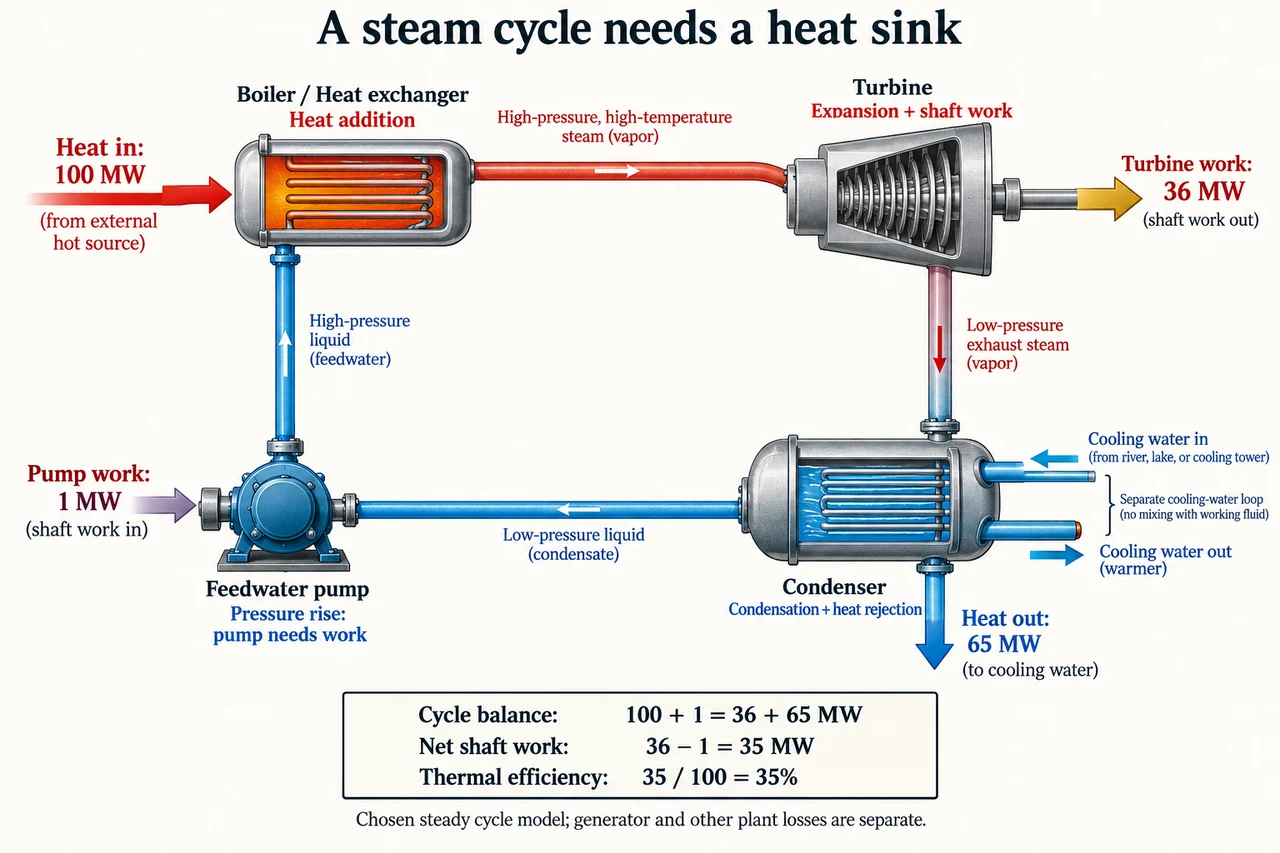
Follow the plate’s clockwise working-water route: heat addition at the upper-left exchanger, steam expansion through the turbine, exhaust into the condenser and liquid returning through the feedwater pump. The condenser’s cooling-water tubes are a separate stream that exchanges heat without intentionally mixing with the working water. The pump input arrow matters: a returning liquid does not lift itself back to the required pressure for free. A circulating loop conserves its working-fluid inventory in the idealised example, but it still receives and rejects energy. The picture omits real make-up water, leaks, detailed controls and multiple turbine stages.
Use a steady boundary around the entire working-fluid cycle. Neglect changes in stored, kinetic and potential energy across this chosen accounting interval. Heat input plus pump work input must equal turbine work output plus rejected heat. For the plate, 100 + 1 = 36 + 65 MW. Net shaft work is turbine output minus the pump input, 36 − 1 = 35 MW; dividing by the 100 MW heat input gives a thermal efficiency of 35%. Megawatts mean joules transferred per second, not a stored quantity. The four numbers are deliberately chosen to close the balance, not taken from a power-station rating.
Conservation alone does not say every mathematically balanced set of numbers is physically achievable. Turning all supplied heat into cyclic work while rejecting none would also conflict with the second-law restriction on a heat engine supplied by a single thermal reservoir. Real conversion depends on source and sink conditions and irreversible processes. Steam condensing in a heat exchanger lets heat pass to a cooler stream and returns water to a liquid state; it is not a device that makes unwanted energy disappear. The dated DOE steam guide explains that condenser conditions affect turbine performance within its operating range; this is a mechanism insight, not advice to alter pressure equipment.
Distinguish several efficiencies that a headline might combine. The plate’s 35% is net cycle shaft work divided by heat actually transferred into that cycle. It is not automatically electricity delivered to a customer divided by fuel energy. For a separate chosen whole-site example, fuel supplies 120 MW, heat transferred into the cycle is 100 MW, electrical export is 30 MW, and all remaining outputs together are 90 MW when storage change is zero. Fuel-to-export efficiency is 25%, whereas the already declared cycle figure remains 35%. The missing 5 MW between 35 MW cycle net work and 30 MW export can be accounted for in conversion and auxiliaries under the declared site boundary; it is not unexplained energy.
Heat recovery can change which outputs count as useful without turning heat into extra electricity. Suppose a fictional site exports 30 MW electrically and delivers 40 MW of useful heating from a 120 MW fuel input. The combined useful-output ratio is (30 + 40) / 120 = 58.3%, while its electrical ratio is still 25%. Useful heating needs a customer at a suitable temperature and time; an unused warm-water stream cannot simply be relabelled useful to improve a statistic. Electricity and low-temperature heat have different practical uses, so the combined ratio is not a proof that two installations provide the same service.
A steam cycle’s environmental and social effects depend on its source and surroundings as well as conversion efficiency. Heat rejection can affect cooling demand and receiving waters; fuel extraction, emissions or source-specific waste require separate evidence. Communities may value dependable supply while bearing different costs from air pollution, water use or maintenance outages. Compare electricity, genuinely usable recovered heat, lifecycle impacts, affordability and resilience rather than choosing a winner from one cycle percentage. Emerging alternative working fluids or advanced designs need their own evidence; this conventional water/steam lesson does not certify those claims.
Image: illustration, not a documentary photograph. The four-component water loop and chosen 100/ 1/ 36/ 65 MW values are a steady cycle model; generator, boiler-source and other whole-site losses are separate, and no operating or construction procedure is supplied.
Worked example: A chosen steady steam cycle receives 80 MW of heat and 0.8 MW of pump work, while the turbine produces 28.8 MW. Find rejected heat, net shaft work and thermal efficiency. A separate whole-site boundary receives 100 MW of fuel energy and exports 24 MW electricity plus 30 MW useful heat; find its electrical and combined useful-output ratios.
Cycle heat rejection = 80 + 0.8 − 28.8 = 52 MW.
Net cycle shaft work = 28.8 − 0.8 = 28 MW; thermal efficiency = 28 / 80 = 0.35, or 35%.
Whole-site electrical ratio = 24 / 100 = 24%; combined useful-output ratio = (24 + 30)/ 100 = 54%. The denominators and output categories differ.
Answer: The cycle rejects 52 MW, produces 28 MW net shaft work and has chosen 35% thermal efficiency. The separate site ratios are 24% electrical and 54% combined useful output.
Check your understanding: A fictional cycle receives 60 MW of heat, needs 1 MW pump input and rejects 42 MW. What turbine output and net work satisfy the balance? Someone calls all 42 MW useful district heating even though no customer takes it. Correct the calculation and the claim; does the balance alone certify equipment performance?
Answer: Turbine output is 60 + 1 − 42 = 19 MW; net shaft work is 19 − 1 = 18 MW and thermal efficiency 18/ 60 = 30%. Rejected heat is not automatically useful delivered heat: temperature, demand and actual delivery matter. Conservation is necessary but not sufficient for physical feasibility, practical operation or plant performance; source/sink conditions and irreversible losses need separate assessment.
Why: Trace forces or energy through a declared boundary, check units and assumptions, and justify why a chosen calculation is not a rated performance or safe operating prescription.