Traction lifts: counterweights reduce imbalance, not safety requirements
By How things work · myAudience
myAudience original generated educational illustration · Original commissioned illustration
Traction lifts: counterweights reduce imbalance, not safety requirements
A traction lift moves a car and a counterweight in opposite directions through suspension members passing around a driven traction sheave. A motor supplies or absorbs mechanical work, guide rails constrain motion and other systems protect passengers. Otis’s mechanism explanations distinguish this traction arrangement from hydraulic lifting, while its safety description treats brakes, door interlocks and overspeed protection separately. This lesson selects a simple one-to-one suspension model: car and counterweight move equal distances in opposite directions. It does not claim every lift has that geometry, these masses or the same energy performance.
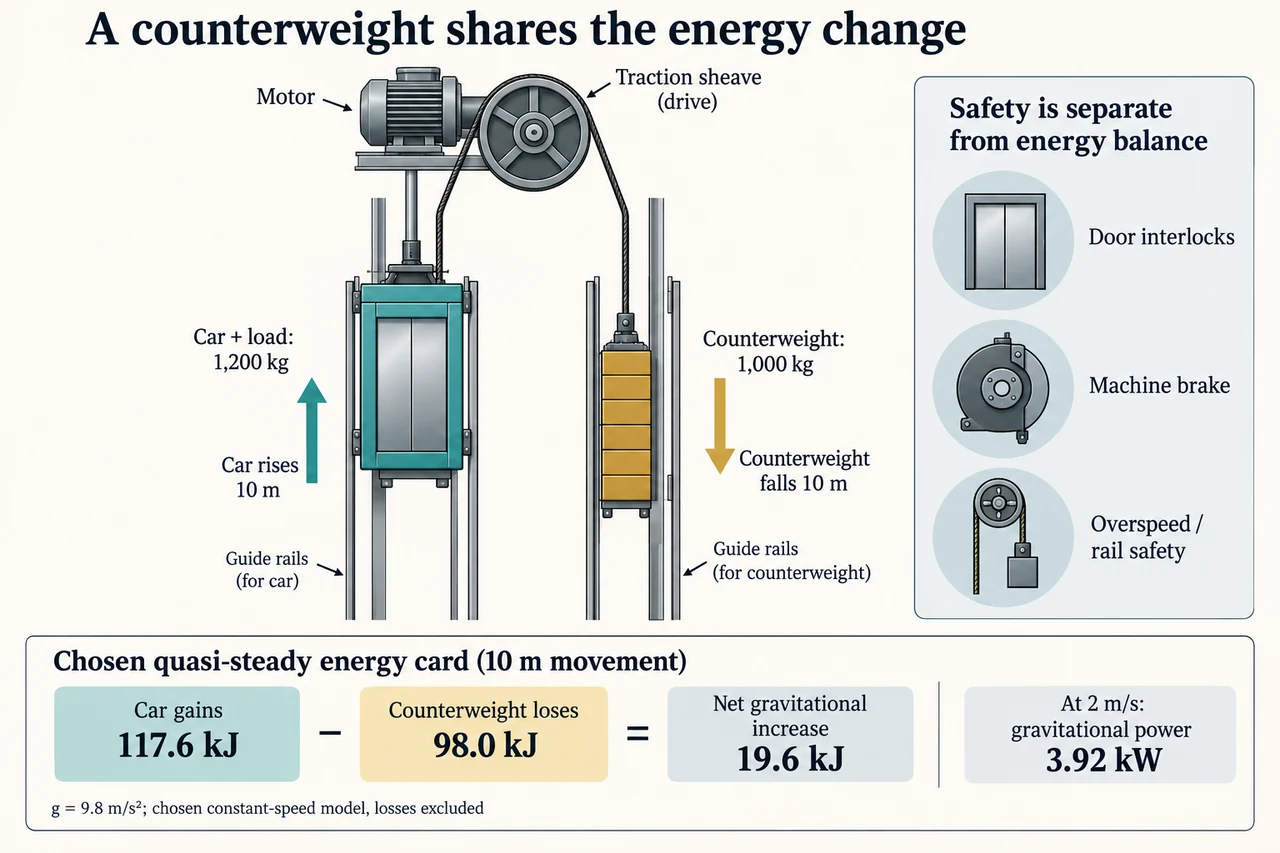
Follow the image’s rope route over the motor-driven sheave: the car rises on the left while the counterweight descends on the right. The arrows indicate the chosen motion, not extra upward support created by the counterweight. Gravitational potential energy increases for one mass and decreases for the other. The load includes the car and its contents, and the selected counterweight is a separate mass. Real suspension ropes, rotational inertia, friction and changing rope weight are omitted from the first energy card. The physical rope and traction system still must support and control the actual loads; a small energy difference is not a small structural load.
Use g = 9.8 m/s² and a car-plus-load mass of 1,200 kg, counterweight mass of 1,000 kg and a 10 m displacement. The car gains 1,200 × 9.8 × 10 = 117,600 J, or 117.6 kJ; the counterweight loses 98.0 kJ. Their combined gravitational energy therefore increases by 19.6 kJ. This accounting includes both bodies and their gravitational interaction with Earth, approximating g as constant over the chosen height change. Calculating only the car’s energy and calling it net drive demand ignores the counterweight. Calling the counterweight’s energy a new free supply ignores the earlier work and motion that positioned it.
At a chosen constant car speed of 2 m/s, the gravitational power associated with the imbalance is (1,200 − 1,000) × 9.8 × 2 = 3,920 W, or 3.92 kW, as shown. This is not automatically electrical input: losses and other services are separate. If an additional fictional mechanical loss is 0.50 kW, the motor must deliver 4.42 kW mechanically in that interval. With a stipulated drive efficiency of 0.80 in this motoring condition, electrical input is 4.42/ 0.80 = 5.525 kW. Efficiency, speed and friction are chosen values, not an Otis product rating or a universal modern lift benchmark.
The direction of the imbalance can reverse. If an 800 kg empty car rises while the same 1,000 kg counterweight falls 10 m, combined gravitational energy decreases by 19.6 kJ. Some drive systems can return part of released mechanical energy electrically, while other systems dissipate it; the negative sign alone does not prove regeneration. Even equal masses need power for friction and energy to accelerate. In an ideal one-to-one, massless-rope model with a 0.5 m/s² upward acceleration of the 1,200 kg car, the required drive-force difference is the static 1,960 N plus (1,200 + 1,000) × 0.5 = 1,100 N, totaling 3,060 N. Both bodies contribute inertia despite opposite velocities.
The safety panel is deliberately separate from the energy card. Door interlocks prevent incompatible door/motion states; machine braking and overspeed/rail safety functions address different hazards. A brake may hold a stationary car when the motor is not supplying lifting work; its existence does not make the energy calculation an acceptable safety design. The illustrated icons are functional reminders, not working mechanical layouts, inspection instructions or bypass procedures. Rope traction, stopping distance, control integrity, certification and maintained protective systems require specialised evidence. Counterbalancing never removes the need for load-bearing capacity and independent protection.
Access is a central engineering outcome. A lift outage can remove a person’s route to home, work, health care or education, so energy savings must be considered alongside reliability, accessible controls, clear fault communication and timely maintenance. Compare measured journeys and standby electricity as well as a favourable moving-load calculation. Regenerative claims should state the test boundary and duty cycle. This family also contains escalators, but their continuous moving steps and return route require a separate mechanism lesson; this traction-lift explanation does not close that assessed gap or certify a whole building’s accessibility.
Image: illustration, not a documentary photograph. The one-to-one route and selected masses give a net gravitational increase, with constant speed and losses excluded in the printed card. The separate safety icons show functions, not a fabrication drawing. Full suspension, electrical input and safe performance cannot be inferred from the 3.92 kW value.
Worked example: A fictional one-to-one lift has a 1,500 kg loaded car and a 1,100 kg counterweight. The car rises 8 m at a chosen constant speed of 1.5 m/s. Use g = 9.8 m/s² to find the combined gravitational increase and the associated gravitational power. Explain why neither result gives total electricity or rope strength.
Car gains 1,500 × 9.8 × 8 = 117,600 J; counterweight loses 1,100 × 9.8 × 8 = 86,240 J.
Combined increase = (1,500 − 1,100) × 9.8 × 8 = 31,360 J = 31.36 kJ.
Gravitational power = 400 × 9.8 × 1.5 = 5,880 W = 5.88 kW. Electrical and mechanical losses, auxiliaries, acceleration and load-bearing conditions are separate.
Answer: The chosen increase is 31.36 kJ and the constant-speed gravitational power is 5.88 kW. Both are narrow accounting quantities, not total electricity or safety ratings.
Check your understanding: Why is drive power not necessarily zero for equally massive car and counterweight? In the image’s 1,200/ 1,000 kg model, compute the ideal drive-force difference when the car accelerates upward at 0.5 m/s². Does this establish a safe drive?
Answer: Equal masses cancel the chosen gravitational imbalance but not friction or acceleration energy. The ideal difference is (1,200 − 1,000) × 9.8 + (1,200 + 1,000) × 0.5 = 3,060 N. This ignores rope mass, rotating inertia and losses and establishes no safe traction, stopping or structural capacity.
Why: Resolve the chosen force or energy boundary, state assumptions and distinguish a mathematical model from measured performance and safe operation.