Prosthetic mechanics: a spring returns energy; a powered actuator adds it
By How things work · myAudience
myAudience original generated educational illustration · Original commissioned illustration
Prosthetic mechanics: a spring returns energy; a powered actuator adds it
A prosthesis replaces a missing body part; an orthosis supports or modifies the function of an existing part. An assistive device can have a much broader role. These categories are not interchangeable, and a powered device is not automatically the right choice for every person or activity. This lesson studies three engineering ideas: how force creates a turning effect, how elastic parts store and return energy, and how a controller directs energy supplied to an actuator. It does not prescribe a fit, alignment or rehabilitation programme. A person's goals and experience remain central; a mechanical calculation cannot decide what someone ought to wear.
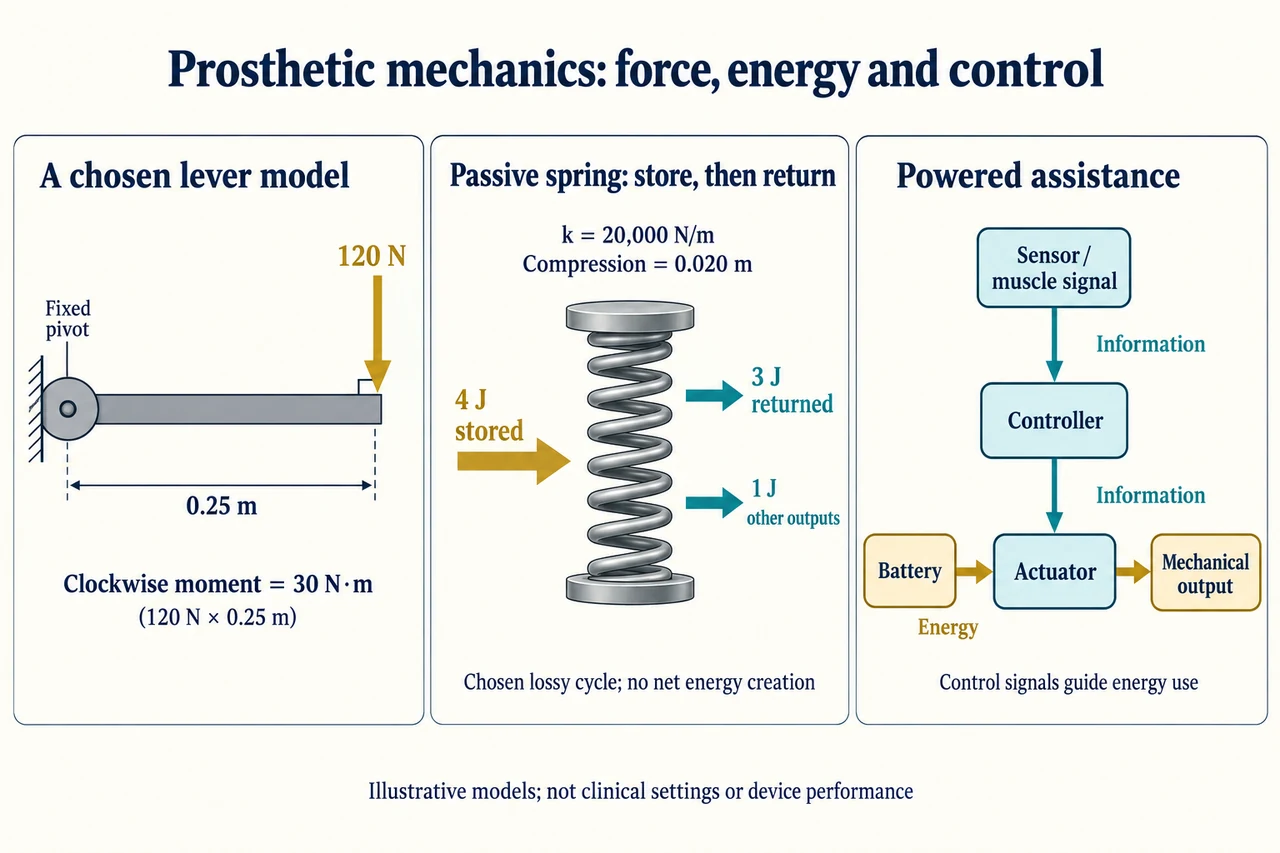
The left panel is deliberately an abstract lever, not a dimensioned artificial limb. Its force acts downward at the right-hand end, perpendicular to a horizontal bar. About the pivot, the chosen 120 N force with a 0.25 m perpendicular moment arm produces a clockwise moment of 30 N·m. In general, magnitude τ = rF sin θ, where θ is the angle between the pivot-to-application vector and the force. The line of action matters: applying the same force only 0.125 m away halves the moment to 15 N·m. Keeping the original radius but changing θ to 30° also gives 15 N·m. A large force can produce zero moment about this pivot if its line of action passes through the pivot; zero moment does not mean zero force or zero stress elsewhere.
The middle panel separates energy storage from energy creation. For the chosen ideal linear spring, F = kx and stored elastic energy U = ½kx². The factor one-half comes from integrating a force that increases from zero as the spring is compressed; multiplying the final force by the whole displacement would overestimate the work by a factor of two. With k = 20,000 N/m and x = 0.020 m, the final force is 400 N and the stored energy is 4 J. These are illustrative values, not measurements of a prosthetic foot. Real elastic structures may have nonlinear force curves, damping and hysteresis. Their recoverable energy depends on the loading history, not only one stiffness number.
The diagram's chosen lossy cycle takes 4 J of stored energy and returns 3 J mechanically, with 1 J transferred to other outputs such as thermal energy. The return fraction is 75%. The actual loading work of a real dissipative spring can exceed its recoverable stored energy; this simplified account fixes the energy available at the start of release. A passive spring can deliver positive instantaneous mechanical power while unloading, because power is energy transfer per unit time. It cannot supply positive net energy indefinitely over complete repeated cycles without energy being put back in. Describing all passive limbs as providing 'no power' would erase this distinction. Returning energy sooner or later also changes timing; identical returned joules need not produce identical movement or comfort.
A powered actuator has an additional energy supply. In a separate fictional account, 100 J taken from a battery becomes 70 J of mechanical output and 30 J of other outputs. The chosen 70% conversion fraction is not a product rating. A battery-powered motor and a compressed-air actuator obtain energy through different routes; the controller does not manufacture the work. The right panel therefore uses thin information arrows from sensor to controller to actuator, and a separate energy arrow from battery to actuator. An angle sensor or muscle electrical signal can inform control without supplying enough energy to drive the mechanism. Muscle electrical activity used for control is not an ECG, nor a direct reading of a person's thoughts or consent.
NIH describes sensors and processors in bionic limbs, while a VA account explains a powered ankle combining elastic elements with a motor. A separate NIH report from 2021 describes a neurally controlled ankle feasibility study with one participant. That case is a research example, not population-level proof that every person will obtain the same balance benefit or that this implementation is now generally available. A control system must cope with noisy signals and changing tasks; responsiveness, stability and a useful failure state matter alongside power. More aggressive assistance can be unhelpful if its timing or magnitude conflicts with the user's movement. No control settings or electrode placement instructions are supplied here.
A demanding design comparison must specify what is held constant. Doubling stiffness at fixed 0.020 m compression doubles force to 800 N and energy to 8 J. Doubling stiffness while holding force at 400 N instead halves compression to 0.010 m and halves stored energy to 2 J, because U = F²/(2k) in the linear model. Thus 'stiffer stores more energy' is incomplete unless the constraint is named. Fatigue, attachment loads, total mass and repairability can also change. Neither this calculation nor a single laboratory efficiency establishes lower metabolic effort, comfort or reduced injury for a particular user. Those outcomes need appropriate evidence and individual professional assessment.
An ethical evaluation should compare meaningful choices, not rank people by how closely a device imitates a stereotyped body. A technically sophisticated mechanism that cannot be repaired locally, charged reliably or supported affordably may reduce a user's independence. Conversely, powered assistance may enable activities that matter greatly to someone when suitable support is available. Ask who chooses the goals, who can refuse a device or data collection, and who bears maintenance costs. The illustration is an explanatory mechanism map: its lever is abstract, its spring figures are chosen, and its controller boxes omit a real implementation. It covers selected force, energy and control reasoning; sockets, clinical fitting, long-term trials and the full range of assistive technologies remain separate learning and professional work.
Worked example: In a new abstract lever, a 150 N force acts 0.20 m from a pivot at 30° to the radius. Find the moment magnitude. A separate ideal spring has k = 10,000 N/m and compression 0.030 m. Calculate force and energy. If a chosen release returns 3.6 J mechanically, find the return fraction and other-output energy. Then double stiffness first at fixed displacement and then at fixed original force; explain why the two energy results differ.
The moment magnitude is 0.20 × 150 × sin 30° = 15 N·m. The specified angle determines magnitude, but a clockwise or anticlockwise direction requires the actual force orientation; it cannot be inferred from these unsigned quantities alone.
The spring force is 10,000 × 0.030 = 300 N, and U = ½ × 10,000 × 0.030² = 4.5 J. Returning 3.6 J gives 3.6/4.5 = 80%, leaving 0.9 J for other outputs in this chosen release account.
At fixed 0.030 m displacement, k = 20,000 N/m gives F = 600 N and U = 9 J. At fixed original 300 N force, displacement is 0.015 m and U = 2.25 J. The constraint changes the work integral; these abstract results do not determine a user's preferred device.
Answer: The moment magnitude is 15 N·m; the original spring has 300 N final force and 4.5 J stored energy. The chosen release returns 80%, with 0.9 J elsewhere. Doubling stiffness gives 9 J at fixed displacement but 2.25 J at fixed force.
Check your understanding: A sensor correctly identifies a movement request. Does that guarantee safe assistance or provide the energy for it? Why can a passive spring deliver power but not create net cycle energy? If the plate's 4 J spring returns its chosen 3 J over 0.15 s, what is average output power, and what cannot that number establish?
Answer: A correct request is only one control input; actuator timing, limits, stability, user intent and failure response still matter. The energy supply is separate from the information signal. A passive spring can release stored energy, but repeated releases require renewed energy input and losses prevent self-powering. Average output power in the chosen interval is 3/0.15 = 20 W; this is not instantaneous peak power, continuous capability, patient benefit or a clinical rating.
Why: Explain the energy or contamination boundary, calculate the chosen model with units, justify transfer and distinguish illustrative reasoning from clinical validation.