Sterilisation: reducing survival and preventing recontamination are different jobs
By How things work · myAudience
myAudience original generated educational illustration · Original commissioned illustration
Sterilisation: reducing survival and preventing recontamination are different jobs
An item can look clean without being sterile. Cleaning removes material; disinfection and sterilisation have different microbial endpoints; a sterile barrier protects an item after the relevant validated process. Treating these words as synonyms hides where a system can fail. This lesson studies contact and heat transfer, a chosen microbial-survival model, and the difference between process evidence and a barrier. The illustration is not an operating procedure: it gives no clinical temperature, exposure time, pressure or chemical concentration. A real device's material compatibility, processing instructions and validated cycle are indispensable and cannot be reconstructed from this concept plate.
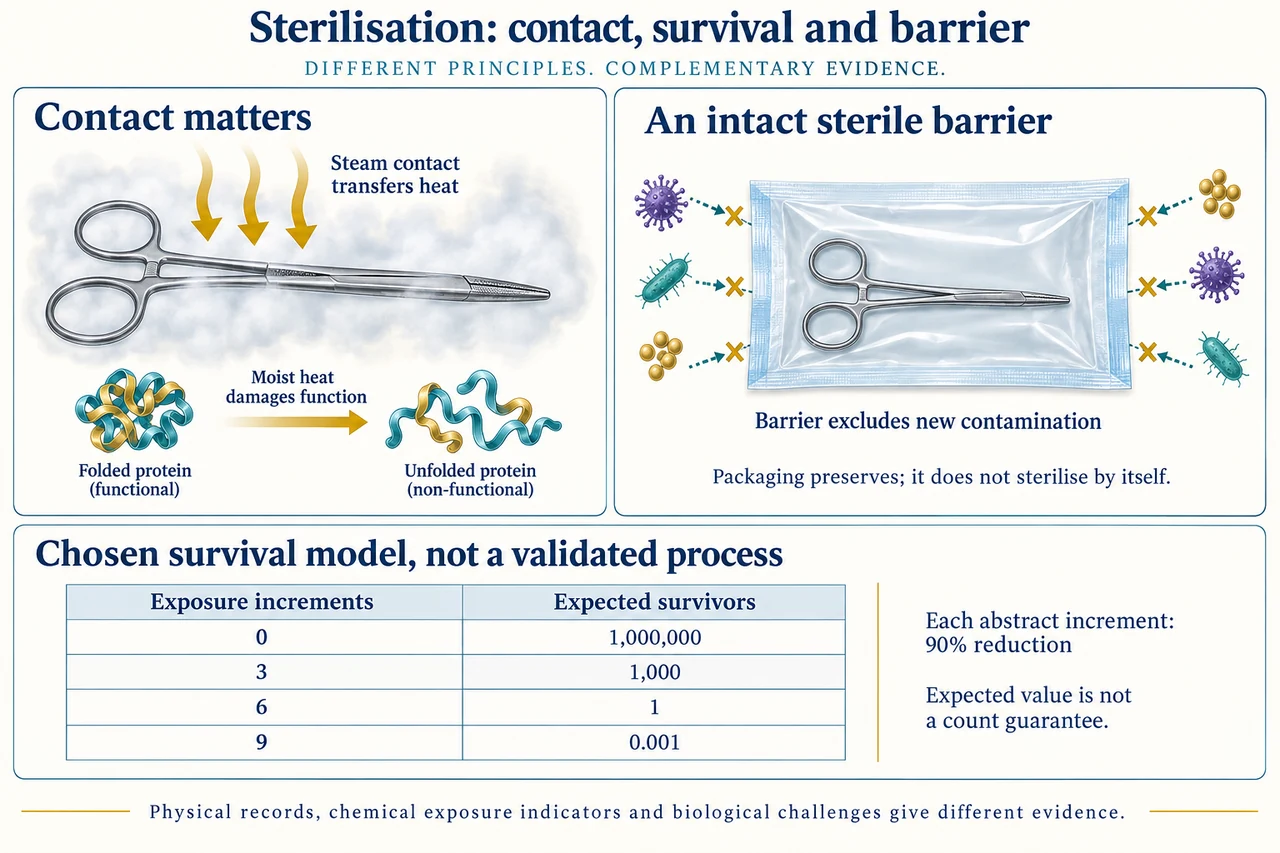
In steam processing, pressure is a means of reaching a higher steam temperature, rather than a substitute for contact and heat transfer. Condensation of steam on a cooler surface transfers energy; moist heat can damage biological structures and functions, including protein function. The left panel therefore ends its arrows at the instrument and illustrates a folded protein becoming disordered. It does not claim every microorganism has identical heat resistance or that any hot cloud makes an item sterile. Trapped air, sheltered contamination and complex internal spaces can prevent adequate exposure even when the chamber's indicated condition seems correct. A chamber measurement and the condition at the hardest-to-reach part of a load are different questions.
The table uses an explicitly chosen first-order survival model. Suppose an initial population of viable units has expected size N₀ = 1,000,000 and each abstract exposure increment leaves 10% surviving. After n increments, expected N = N₀ × 0.1ⁿ. The displayed n = 0, 3, 6 and 9 give 1,000,000, 1,000, 1 and 0.001. On a logarithmic scale, log₁₀N = 6 − n, which is a straight line; on an ordinary count scale the decline is exponential. A 90% reduction is one decimal-log reduction, not subtraction of 90% of the starting number every time. The increments here have no assigned duration or clinical setting. Actual resistance and exposure may be heterogeneous, and this equation cannot validate a real sterilisation cycle.
A fractional expected value is not a fragment of a viable organism. It summarises repeated outcomes under a probability model. An expected survivor count of 1 does not certify that every item has exactly one survivor, and it certainly does not mean none. To explore that distinction, additionally assume independent rare survivors with a Poisson count distribution: P(at least one) = 1 − exp(−λ), where λ is expected survivors. At λ = 1 this chosen probability is about 63.2%; at λ = 0.001 it is about 0.09995%. The Poisson assumption is an extra mathematical model, not evidence about a real packaged instrument or a certified sterility assurance level. Correlated shielding or incorrect starting assumptions can invalidate it.
Reducing contamination before the final process changes the model's starting point, but cleanliness alone does not replace that process. If the chosen starting count is 10,000 rather than 1,000,000, six of the same abstract increments give expected 0.01 rather than 1. This is a sensitivity calculation, not a promised clinical outcome. Removing interfering material also changes access to surfaces, which cannot be represented merely by lowering N₀. The distinction is important: a model that treats every organism as equally exposed can be mathematically consistent yet physically unsuitable. An error in the contact assumption cannot be repaired just by calculating an extra decimal place.
The sealed pouch in the right panel represents a sterile barrier, not a sterilising agent. The outside microbe arrows stop at the intact boundary to show exclusion of new contamination after processing. Actual packaging must be compatible with the intended process: when sterilisation happens through a permeable package, the sterilant must reach the item, and the package must subsequently maintain its barrier function. Different materials and methods need different validated arrangements. A seal failure, tear or other compromising event creates a new question that the original process record cannot answer. The generic closed pouch is not an instruction to improvise packaging, or a claim that every transparent bag is an effective sterile barrier.
Monitoring combines different types of evidence. A physical record describes measured process conditions; a chemical indicator responds to specified exposure; a biological challenge assesses an organism-based test under a defined arrangement. A colour change by itself does not prove an individual item sterile. Nor does a successful challenge justify ignoring a broken seal, inadequate contact or a material change. FDA describes multiple sterilisation methods and the need for validation and material suitability; alternatives are not freely interchangeable. The engineering task is to connect the evidence to the actual device, load and process, and to investigate failure rather than convert one convenient indicator into a universal guarantee.
A responsible comparison includes patient protection, worker exposure, reliable supply and environmental effects. Reusable systems can require water, energy, maintenance and trained personnel; disposable systems create material waste and also depend on a validated supply chain. A lower-resource option is not acceptable merely because a simplified survival calculation looks favourable. Conversely, waste reduction and safer agents can be legitimate goals when validation preserves protection. The plate's contact sketch, barrier and table explain different parts of the system without claiming a complete method. Full material compatibility, facility procedures, regulations, unusual biological agents and process validation remain outside this selected mechanism lesson.
Worked example: For a hypothetical count model, N₀ = 10,000 and each abstract exposure increment gives a two-log reduction. Find expected survivors after 1, 2 and 3 increments. Under an additional Poisson assumption, estimate the probability of at least one survivor after the third increment. Explain why one expected survivor does not mean a sterile item, and why neither calculation supplies a validated processing recipe.
A two-log reduction leaves a fraction 10⁻² = 0.01 each increment. N = 10,000 × 0.01ⁿ therefore gives 100, 1 and 0.01 after 1, 2 and 3 increments respectively.
With additional Poisson λ = 0.01, P(at least one) = 1 − exp(−0.01) ≈ 0.00995017, or 0.995%. At expected 1, the corresponding chosen probability is about 63.2%, not zero.
The starting population, equal resistance, exposure and independence assumptions require evidence. No time, temperature, contact test, material qualification or packaging validation follows from this illustrative table; real process assurance remains separate.
Answer: Expected counts are 100, 1 and 0.01; the additional chosen Poisson model gives about 0.995% probability of at least one after the third increment. These are illustrative mathematical results, not certified sterility assurance.
Check your understanding: A package has a changed chemical indicator colour but a damaged seal. Can the colour certify its current contents sterile? Why are negative expected counts impossible even though log₁₀N can become negative? In the plate's model, what happens to expected survivors if the initial number doubles at fixed nine increments?
Answer: The colour gives limited exposure evidence; a damaged barrier creates a recontamination concern that it cannot dismiss. Expected counts remain nonnegative; a negative base-ten logarithm represents a positive value below one, not negative organisms. Doubling N₀ doubles the plate's expected value from 0.001 to 0.002. None of these calculations overrides device-specific validation or qualified assessment.
Why: Explain the energy or contamination boundary, calculate the chosen model with units, justify transfer and distinguish illustrative reasoning from clinical validation.