Cold chains: the payload temperature matters more than a reassuring display
By How things work · myAudience
myAudience original generated educational illustration · Original commissioned illustration
Cold chains: the payload temperature matters more than a reassuring display
A cold chain is a sequence of temperature-controlled stages rather than a single refrigerator: initial cooling, storage, transport, transfer and display all affect a product's history. Refrigeration slows many microbial processes; it does not automatically sterilise food. FDA notes that some organisms, including Listeria, can grow at refrigerated temperatures, and that appearance or smell cannot reliably establish safety. This lesson follows the physics of a chosen inert payload and a separate refrigeration energy account. Its numerical temperatures and elapsed times are not food-storage rules, expiry calculations or thresholds for deciding whether food is edible. Real products require appropriate handling guidance and a validated product-specific system.
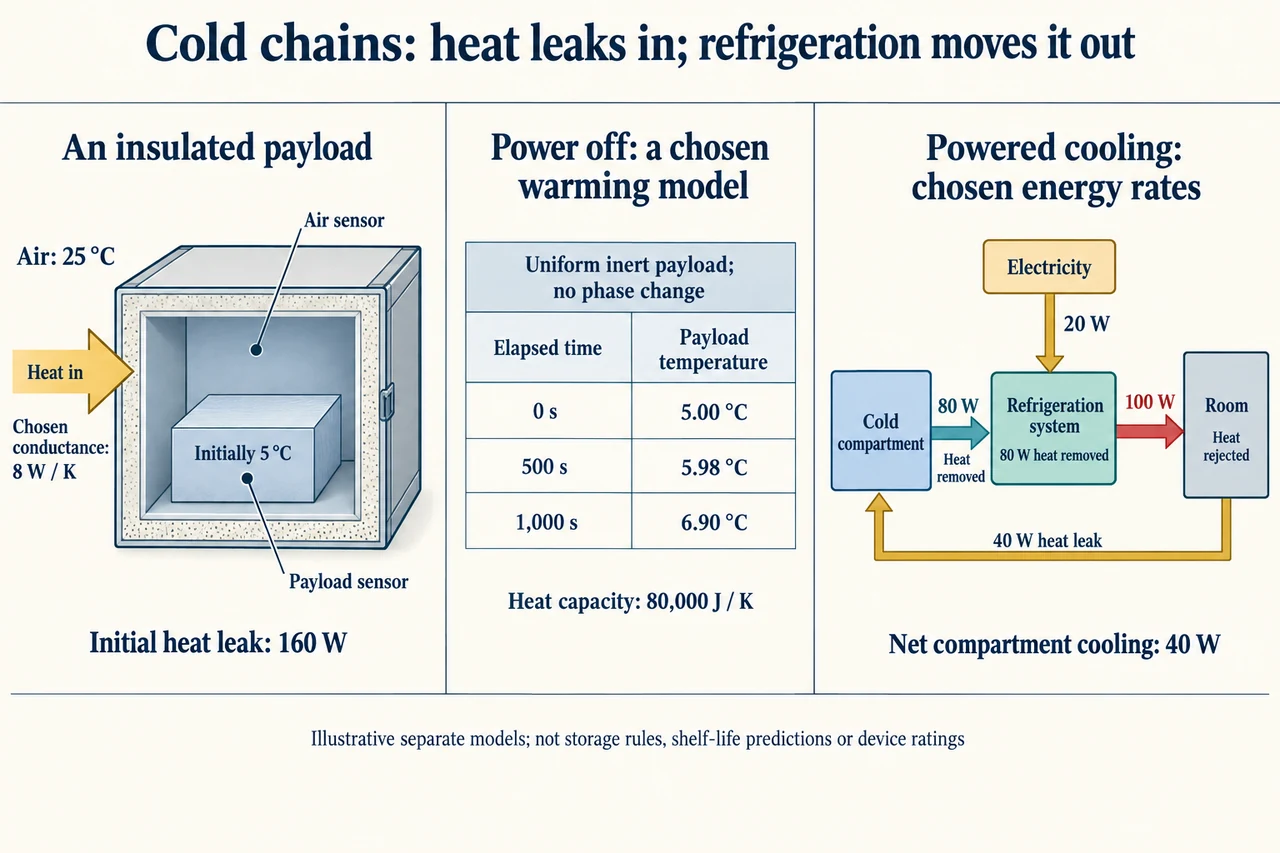
The left panel marks heat entering a cooler payload from a warmer environment. Insulation reduces heat transfer; it does not create cold or make the heat leak disappear. A simple conductive wall model gives thermal conductance H = kA/d, where k is conductivity, A area and d thickness. For the conceptual box, combine its paths into a chosen effective H = 8 W/K and place a uniform inert payload initially at 5°C in an environment at 25°C. The initial leak is H(T_air − T) = 8 × 20 = 160 W. Conductance is not conductivity: W/K describes the chosen whole heat-transfer path, whereas conductivity uses W/(m·K). Real doors, bridges, air exchange and radiation need a more detailed description.
The middle panel adds thermal inertia. Suppose the inert payload's effective heat capacity C is 80,000 J/K, remains constant, and no phase change, internal source or active cooling occurs. Its energy balance is C dT/dt = H(T_air − T). With a constant environment and a uniform payload, integration gives T(t) = T_air − (T_air − T₀) exp(−Ht/C). The chosen time constant C/H is 10,000 s. Thus after 500 s, T ≈ 5.98°C, and after 1,000 s, T ≈ 6.90°C, matching the table. The heat-leak rate falls as the payload warms, so multiplying the initial 160 W by every later interval is only a short-interval approximation. This mathematical model is not a measured food-cooling curve.
A useful check is the limiting behaviour: at t = 0 the equation returns 5°C, and at very long times it approaches 25°C without overshooting in this passive model. The initial rate is 160/80,000 = 0.002 K/s. A linear extrapolation gives 7°C after 1,000 s, slightly warmer than the exact 6.90°C because it wrongly keeps the initial leak constant. Doubling C or halving H doubles the time constant when the other assumptions remain fixed. More thermal mass can buffer an interruption, but also requires more energy and time for initial cooling. A dense product may not be uniform in temperature; its core and surface can have different histories, invalidating the one-temperature approximation.
The air and payload measurement points in the box are deliberately distinct. A controller display, compartment-air sensor and product-core measurement answer different questions. Air can respond quickly after a door closes while an initially warm payload remains warm; conversely, a cold heavy payload can change slowly during a brief warm-air event. Sensor placement, response time, calibration and logging intervals therefore influence the evidence available. A recorded setpoint is a request to a controller, not proof of the temperature at every product location. An alarm and a route trace can identify a problem, but they cannot erase an earlier period of unsuitable conditions simply because the final reading looks satisfactory.
The right panel is a separate chosen instantaneous account, not the numerical box in the first two panels. The refrigeration system removes 80 W of heat from a compartment and takes 20 W of electrical input, rejecting 100 W to the room. This is the first-law balance Q̇_hot = Q̇_cold + P_input, with storage changes neglected. If 40 W leaks into that compartment, its net cooling is 80 − 40 = 40 W. The cooling coefficient of performance in this selected account is 80/20 = 4, a ratio of heat moved to input work rather than a 400% conversion of work into new energy. Fan or other internal loads would increase the required removal. The warm side still needs to release its heat to the surrounding environment.
Maintenance and layout can change both sides of the balance. DOE explains that leaky door seals allow warm moist air in and that clean heat-transfer surfaces and adequate airflow matter. Humidity adds a latent load when water condenses or freezes; an energy account using only a dry temperature difference misses that term. Frozen or phase-change materials can temporarily absorb energy with a smaller temperature change, but their available phase-change capacity is finite. No refrigerant, charging procedure or retrofit is prescribed here. Established refrigeration mechanisms coexist with developing monitoring tools; an inferred temperature or an attractive dashboard must be checked against real measurements and the limits of its model.
An ethical design compares avoided food waste and improved access with electricity demand, refrigerant leakage, packaging and maintenance burdens. More sensors are useful only if people can act on trustworthy information; unreliable alarms can unfairly shift blame to drivers or shop staff who lack resources to correct a failure. Robust insulation, repair access and dependable power may help more than a complex prediction system in some settings. The illustration shows a chosen thermal path, a uniform inert warming model and a separate powered balance. It does not certify a cold-chain product, predict microbial survival or replace consumer or professional food-safety guidance. Heat-pump mechanics and insulation are linked concepts already taught elsewhere; this lesson adds transient payload history and measurement reasoning.
Worked example: For a different inert payload, C = 60,000 J/K, H = 6 W/K, T₀ = 10°C and constant surrounding temperature 30°C, with no cooling or phase change. Find initial heat leak, initial warming rate, time constant and temperature after 1,000 s. Then a separate cooling account removes 120 W using 30 W input while 50 W leaks into its compartment. Find heat rejected, net cooling and COP; explain why they are three different quantities.
Initial leak is 6 × (30−10) = 120 W, and initial warming rate 120/60,000 = 0.002 K/s. The time constant is 60,000/6 = 10,000 s.
T(1,000) = 30−20 exp(−0.1)≈11.9033°C. A linear initial-rate extrapolation gives 12°C, which slightly overestimates warming because the driving difference decreases.
In the separate powered balance, heat rejected is 120+30 = 150 W; net compartment cooling is 120−50 = 70 W; COP is 120/30 = 4. None is a food-safety rating or a claim that all points in a real payload have one temperature.
Answer: The inert model gives 120 W initial leak,0.002 K/s initial warming,10,000 s time constant and about 11.90°C after 1,000 s. The separate refrigeration account gives 150 W rejected,70 W net cooling and COP 4.
Check your understanding: Can a cold air reading certify the product core or erase an earlier warming event? In the original inert model, what happens to the initial leak, initial warming rate and time constant if conductance halves while heat capacity stays fixed? Why does insulation not make an unpowered box cold forever?
Answer: An air reading concerns its location and response, not automatically the core or complete time history. Halving H to 4 W/K halves the original initial leak to 80 W and initial rate to.001 K/s, and doubles the time constant to 20,000 s. With finite nonzero conductance and no cooling, the payload still tends towards ambient temperature; insulation delays heat transfer rather than supplying continuous cooling.
Why: Explain the energy or contamination boundary, calculate the chosen model with units, justify transfer and distinguish illustrative reasoning from clinical validation.