Bicycle gearing: more torque comes with less speed
By How things work · myAudience
myAudience original generated educational illustration · Original commissioned illustration
Bicycle gearing: more torque comes with less speed
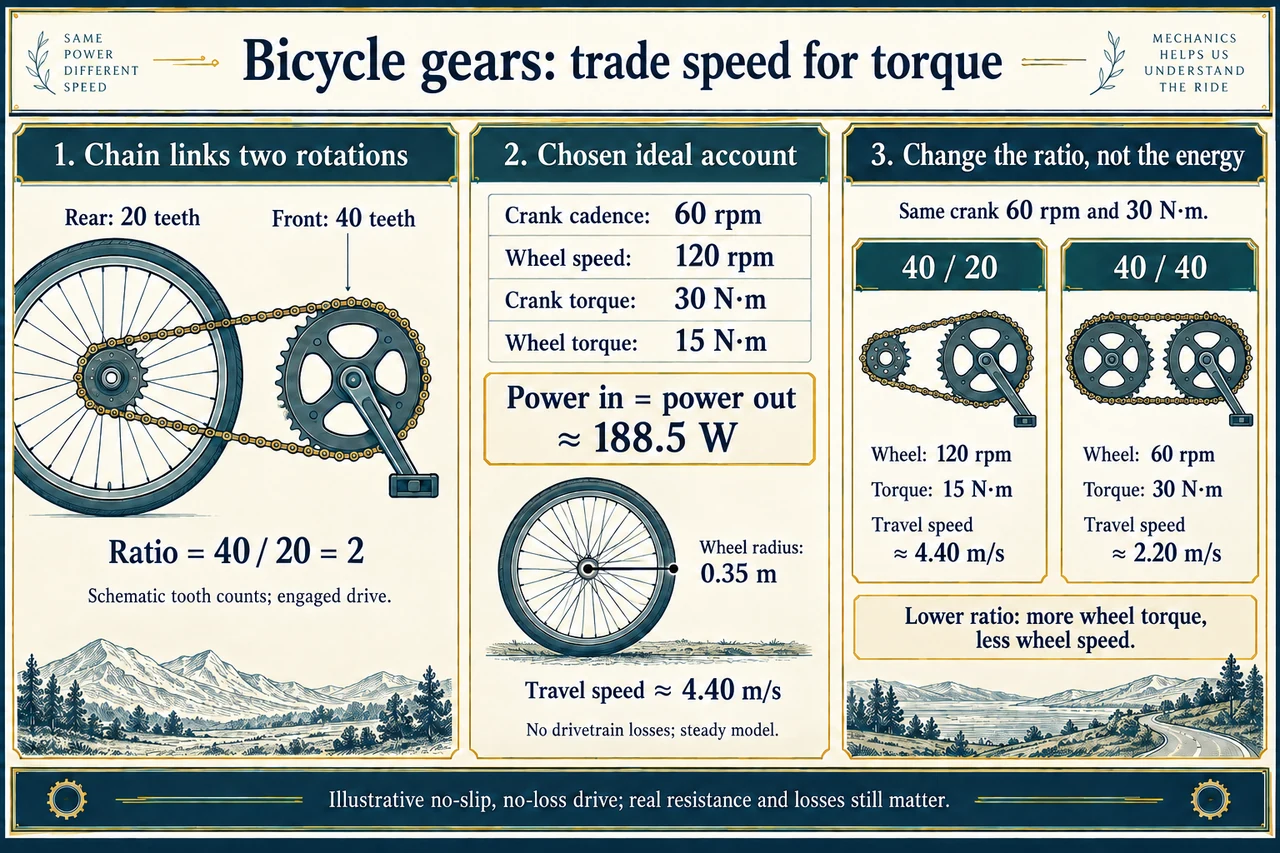
A bicycle drivetrain lets a rider exchange pedal rotation and torque for a different wheel rotation and torque. Gears do not create energy or guarantee a particular road speed. In the image, a chain joins a front chainring to a rear sprocket, rather than two gears meshing directly. The sprocket drives the rear wheel when its drive mechanism is engaged. A freewheel can allow the wheel to continue turning without forcing the pedals around; this lesson's calculations describe engaged drive only. The pictured chain and teeth are symbolic, not an exact tooth-by-tooth component drawing or a promise of parts compatibility. Internal gear hubs, electric assistance, steering and braking need their own mechanisms.
The ratio follows by counting the chain links advanced. In one turn, a front chainring with N_f teeth advances N_f chain pitches. A rear sprocket with N_r teeth takes N_r pitches per turn, so rear turns per crank turn are G = N_f/N_r when engagement is maintained and no pitch is skipped. With chosen 40 front teeth and 20 rear teeth, G = 2. Thus 60 crank revolutions per minute correspond to 120 wheel revolutions per minute in this particular direct sprocket-to-wheel arrangement. The formula is not inverted just because the rear sprocket is the smaller circle. Tooth counts determine the average ratio; the small polygonal changes in instantaneous chain motion are omitted from this steady model.
Convert rotation to travel with a declared rolling radius. The image chooses r = 0.35 m, so one wheel turn advances 2πr ≈ 2.199 m in ideal no-slip rolling. At 120 rpm, or 2 revolutions per second, speed is 2 × 2π × 0.35 ≈ 4.398 m/s, shown rounded to 4.40 m/s. This is a kinematic result for the imposed cadence and engaged gearing, not proof that a rider can sustain that speed up a hill or into a headwind. Real effective rolling radius depends on the wheel and loaded tyre. Slipping, coasting or another hub transmission changes the relationship. Cadence in rpm is also not angular velocity in radians per second: the factor 2π must be included when calculating power.
A torque account must accompany the speed account. In an ideal steady loss-free transmission, crank power τ_cω_c equals wheel power τ_wω_w. Since ω_w = Gω_c, wheel torque is τ_w = τ_c/G. With chosen crank torque 30 N·m and G = 2, wheel torque is 15 N·m. At 60 crank rpm, ω_c = 2π rad/s and input power is 30 × 2π ≈ 188.5 W. Output power is 15 × 4π, the same 188.5 W. Wheel speed doubles while torque halves: multiplying both by two would invent power. These torques are steady equivalent values, not the variable torque within a person's pedal stroke or a statement about human metabolic efficiency.
The right-hand comparison replaces the chosen rear 20-tooth sprocket with 40 teeth while retaining the same front 40 teeth, crank 60 rpm and crank 30 N·m. G becomes 1; wheel speed is 60 rpm and wheel torque 30 N·m. Travel speed becomes about 2.20 m/s with the same chosen radius. Twice the wheel torque comes with half the wheel speed, leaving ideal power unchanged. A translation-equivalent drive-force account gives τ_w/r: about 42.86 N in the ratio 2 case and 85.71 N in the ratio 1 case, neglecting rotational acceleration and other terms. These are not automatically net forward forces: rolling resistance, air drag and an uphill gravity component still have to be balanced. A stationary ideal no-slip road contact is not an energy source; the rider supplies drivetrain energy.
Now change the comparison boundary. At a fixed travel speed of 4.00 m/s and radius 0.35 m, the wheel rate is v/(2πr) ≈1.819 revolutions per second, or 109.13 rpm. With G = 2, the crank rate is about 54.57 rpm; with G = 1, it is about 109.13 rpm. A lower ratio therefore requires a faster cadence to keep this speed. If the required wheel torque remains 15 N·m, ideal crank torque is 30 N·m at G = 2 but 15 N·m at G = 1. The power in both cases is τ_wv/r ≈171.43 W. More favourable torque at a pedal is not a free reduction of the required mechanical work per distance; it redistributes force and motion. Whether a particular cadence suits someone cannot be inferred from this mechanism model.
Real chains, bearings and joints lose energy, so a chosen transmission efficiency η would give τ_w = ητ_c/G under the same steady assumptions. For an illustrative η = 0.95 in the original ratio 2 account, output torque becomes 14.25 N·m and output power about 179.07 W; roughly 9.42 W is transferred to other outputs, principally dissipative effects, rather than disappearing. The value 0.95 is a chosen arithmetic example, not a measured rating. Shimano's component account connects tooth combinations with cadence changes, but its marketing language is not treated as proof of universal efficiency or a current best product. Wear, contamination, alignment and compatibility require appropriate maintenance evidence. This lesson supplies no repair procedure, shifting instruction or recommended gearing for road use.
A bicycle can provide useful transport with comparatively simple mechanical parts, but access depends on routes, storage, physical needs, affordability and repair services as well as gear count. A complex electronic system may offer assistance to some riders while adding cost, batteries or dependence on specialised repair; neither complexity nor simplicity is universally preferable. Lifecycle comparisons should include manufacture and the service actually provided, not only ideal crank-to-wheel power. The plate's chain explains the rotation ratio, its central card balances ideal power and its alternatives compare the same input at different ratios. Full tyre dynamics, component failure assessment, braking, handling, rider physiology and the wider family objectives remain open. The teaching goal is to reason about force, speed and energy without mistaking an attractive specification for a complete transport outcome.
Worked example: Use a chosen front 36/rear 24-tooth engaged drive, cadence 80 rpm, steady crank torque 24 N·m and no-slip rolling radius 0.30 m. Find ratio, wheel rate, speed, ideal wheel torque and input/output power. Repeat output torque/power at chosen drivetrain efficiency 0.90. Then use rear 36 teeth with the same crank torque/cadence; compare torque, speed and ideal power, without recommending a real gear choice.
G = 36/24 = 1.5, so wheel rate is 120 rpm = 2 rev/s. Speed is 2 × 2π × 0.30 ≈ 3.770 m/s. Ideal wheel torque is 24/1.5 = 16 N·m.
Crank angular rate is 80 × 2π/60 = 8π/3 rad/s. Input power is 24 × 8π/3 = 64π ≈ 201.06 W. Wheel power is 16 × 4π, the same value.
At chosen η = 0.90, output torque is 14.4 N·m and power 57.6π ≈ 180.96 W. The difference 6.4π ≈ 20.11 W is transferred to other outputs. This is not a measured bicycle efficiency.
With rear 36 teeth, G = 1. Wheel rate becomes 80 rpm, speed 0.8π ≈ 2.513 m/s and ideal torque 24 N·m. Ideal power stays 64π ≈ 201.06 W: speed is two-thirds of the earlier value while torque is 1.5 times larger.
Answer: The first chosen ideal drive gives ratio 1.5, wheel 120 rpm, speed 3.770 m/s, torque 16 N·m and power 201.06 W. At efficiency 0.90, torque 14.4 N·m and power 180.96 W. Ratio 1 gives 80 rpm,2.513 m/s and 24 N·m with the same ideal input/output power.
Check your understanding: If the original 40/20 drive changes to 40/40 at unchanged crank torque and cadence, can both speed and torque double? At a fixed travel speed instead, what must happen to cadence? Does a low gear reduce the required mechanical work to climb the same height, and does crank-to-wheel efficiency measure human metabolism?
Answer: No: at fixed crank input the wheel speed halves while torque doubles, conserving ideal power. At fixed travel speed the lower ratio requires twice the crank cadence. It redistributes force and motion rather than removing the gravitational energy needed for a given mass/height. Crank-to-wheel efficiency concerns the mechanical drivetrain, not the biological conversion of food energy into crank work.
Why: Derive the conservation or transmission account with declared assumptions and units, then distinguish the chosen model from real transport performance or safety validation.