Earthquake-resistant structures: response, period and limits
By How things work · myAudience
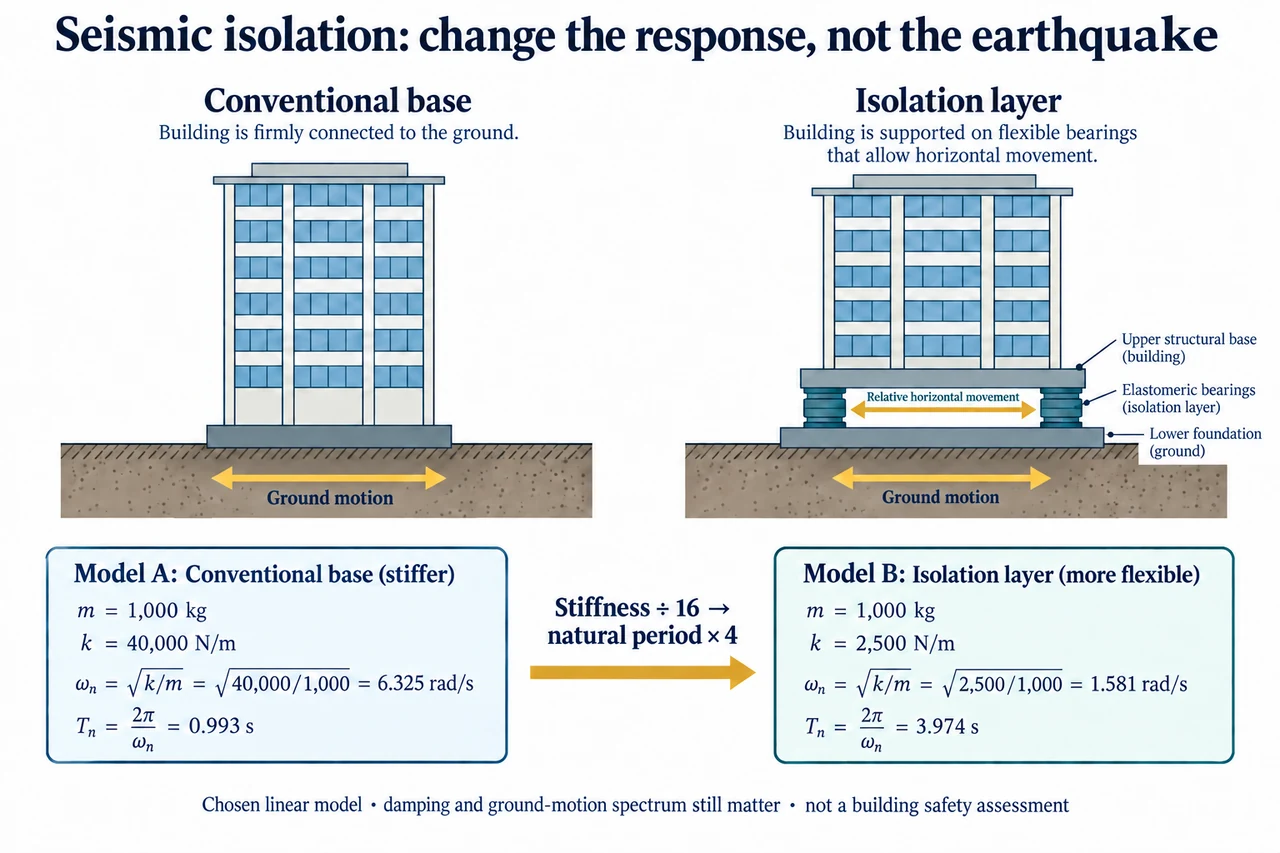
myAudience original generated educational illustration · Original commissioned illustration
Earthquake-resistant structures: response, period and limits
Earthquake-resistant engineering changes how a structure responds to shaking; it does not stop the earthquake or make a building immune to every failure. In the image, the conventional-base icon is connected firmly to its foundation, while the isolation icon has a distinct bearing layer between the upper structural base and lower foundation. Horizontal relative movement can occur in this layer while the structure still needs vertical support. The bearing shapes are symbols, not manufactured component details, and the chosen mass in the cards represents a mathematical effective mass rather than the full mass of the pictured building. The picture is not a safety assessment or a proposal for construction.
Begin with inertia and relative motion. Let y(t) be the prescribed horizontal ground displacement, x(t) the absolute displacement of a chosen effective mass, and u = x − y its displacement relative to the ground. In a linear one-degree-of-freedom model, a spring supplies force −ku and a viscous damper supplies force −c du/dt. Newton’s law gives m d²x/dt² = −ku −c du/dt. Substituting x = u + y yields m d²u/dt² + c du/dt + ku = −m d²y/dt². The right-hand term is an equivalent forcing in the relative-motion equation, not a separate mysterious earthquake force applied in addition to the base motion. Real structures have multiple modes, directions and nonlinear behaviours omitted here.
For undamped free oscillation with a stationary base, this model has natural angular frequency ωₙ = √(k/m) and period Tₙ = 2π/ωₙ. The image chooses the same m = 1,000 kg in both cards. With k = 40,000 N/m, ωₙ = √40 ≈ 6.325 rad/s and Tₙ ≈ 0.993 s. With k = 2,500 N/m, ωₙ = √2.5 ≈ 1.581 rad/s and Tₙ ≈ 3.974 s. Dividing stiffness by sixteen divides angular frequency by four and multiplies period by four. It does not multiply mass or provide a universal fourfold reduction in acceleration. These are chosen linear-model quantities, not earthquake records or a design rating.
Response depends on the forcing and damping as well as this period. A sinusoidal input is useful for analysis but a real earthquake is not one endlessly repeated sinusoid. For a chosen linear model, an acceleration input with amplitude a_g and angular frequency ω gives relative-displacement amplitude U = a_g / √[(ωₙ² − ω²)² + (2ζωₙω)²], where ζ = c/(2 mωₙ) is the damping ratio. This follows by substituting a harmonic solution into the relative-motion equation. It shows that changing ωₙ can reduce response in some frequency ranges while increasing demand in others. Natural frequency and the exact peak of a damped displacement response must not be treated as universally identical; the input and response quantity have to be specified.
Use the two chosen cards to test the formula, not to certify isolation. Let ζ = 0.10 for each model and the imposed ground-acceleration sinusoid have a_g = 0.50 m/s² and ω = √40 rad/s. In model A, ω equals its undamped natural angular frequency, so U = 0.50/(2 × 0.10 × 40) = 0.0625 m. In model B, ωₙ² = 2.5 and the damping term is 2.0 s⁻², giving U = 0.50/√[37.5² + 2.0²] ≈ 0.01331 m. This narrow harmonic comparison is not a measured earthquake and does not establish response to a different spectrum, near-fault pulse, vertical motion or displacement limit. Transients and nonlinear effects are also excluded.
Damping and stiffness are not interchangeable energy mechanisms. An ideal linear spring stores elastic energy ½ku² and can return it; a viscous damper transfers energy to dissipative outputs at the nonnegative rate c(du/dt)². Choose c = 500 N·s/m and relative speed 0.10 m/s: damping force magnitude is 50 N and dissipation is 5 W. Reversing the velocity reverses the force direction but does not make dissipation negative. A real isolation system can involve hysteresis and other mechanisms rather than a constant viscous coefficient. More displacement tolerance, continuity of service connections and assessment of surrounding clearances matter alongside any reduction of some response measures.
Measurements distinguish a prediction from performance. USGS’s structural-monitoring guidance describes recording ground and building response to support assessment of both structural and nonstructural effects. A 1996 USGS-hosted abstract reports good performance of one isolated hospital in the 1994 Northridge event, with changing effective stiffness and nonlinear excursions. That is evidence about a particular observed structure and event, not a promise for every future earthquake. Roof motion relative to ground is also not automatically an inter-storey drift: a storey drift compares displacements of the two adjacent levels. A building may avoid a particular structural failure while equipment, pipes or access still require attention.
Public benefit requires considering who can afford assessment, retrofit and continued maintenance, and which facilities need to remain usable after shaking. An attractive isolation icon cannot replace site-specific engineering, code obligations or a qualified post-event decision about entry. Strength, ductility, connections, soil and foundation behaviour and nonstructural systems are additional parts of earthquake resistance rather than rivals that can be dismissed by one model. The image’s separated base layers explain where relative movement occurs; its period cards explain stiffness–mass scaling only. This lesson provides a bounded dynamics mechanism with original calculations. Complete structural design, nonlinear analysis, hazard characterisation and the family’s remaining objectives stay open.
Worked example: A chosen effective mass is 2,000 kg and horizontal stiffness 20,000 N/m. Find undamped natural angular frequency and period. Reduce stiffness to 5,000 N/m at unchanged mass and compare period. For a separate viscous damping account with c 600 N·s/m and relative speed±0.20 m/s, find force magnitudes and dissipation. Explain what these do not prove about earthquake safety.
ωₙ=√(20000/2000)=√10≈3.162 rad/s;Tₙ=2π/√10≈1.987 s.
At 5000 N/m,ωₙ=√2.5≈1.581 rad/s;Tₙ≈3.974 s. Stiffness divided by 4 doubles period, not a guaranteed response improvement.
Damping force magnitude 600 ×0.20=120 N at either sign; force opposes relative velocity. Dissipation 600 ×0.20²=24 W remains nonnegative.
The inputs are chosen linear parameters. Full ground-motion histories, nonlinear limits, multiple modes, vertical support and professional assessment remain outside this calculation.
Answer: Natural period 1.987 s then 3.974 s; damping force magnitude 120 N and dissipation 24 W. Reversing relative velocity reverses force direction, not the sign of dissipated power.
Check your understanding: Why does changing a natural period not guarantee earthquake protection? Are absolute roof displacement and inter-storey drift identical? What distinguishes the spring’s energy from the damper’s dissipation?
Answer: Input spectrum, damping, displacement limits, nonlinear and other structural modes matter; the earthquake is not changed by the structure. Drift compares adjacent levels, whereas absolute motion uses an external reference. An ideal spring stores and returns½ku²; a viscous damper dissipates at c(du/dt)².
Why: Use the stated displacement references and derive the bounded relative-motion equation; avoid claiming a model period is a safety certification.