Say exactly what an algebraic argument proves
By UK A Level Mathematics · independent study · myAudience
Original myAudience generated mathematics illustration; not a documentary photograph. Diagram geometry is schematic, not a calibrated measurement. · Original generated project artwork; no source textbook or exam-board figures reused.
Say exactly what an algebraic argument proves
Algebra is a language for describing structure. A variable stands for an input or an unknown; a coefficient multiplies a variable; a constant has a fixed value in the situation. The expression 3x + 7 has no truth value by itself. The equation 3x + 7 = 19 asks which inputs make two expressions equal. An identity asserts equality for every input in its stated domain. Before manipulating symbols, decide which kind of statement you are handling.
A proof begins with assumptions and ends with a conclusion linked by justified steps. To prove that the sum of two odd integers is even, write them as 2r + 1 and 2s + 1 with integer r and s. Their sum is 2(r + s + 1), twice an integer. The letters describe every permitted pair, so this argument proves more than several numerical trials. Its prerequisite is understanding integer arithmetic and the distributive law.
A universal claim can be disproved by one counterexample, but it cannot normally be proved by one successful example. The claim “n² + 1 is prime for every positive integer n” fails at n = 3, since 3² + 1 = 10. Explain both why 3 is an allowed input and why its output breaks the claim. A counterexample addresses the exact quantifier: a negative input would be irrelevant to a statement restricted to positive integers.
Proof by exhaustion is legitimate when the allowed cases form a finite set and every case is examined. For an integer n with 1 ≤ n ≤ 4, checking n = 1, 2, 3, 4 exhausts the domain. Checking those same four values would not exhaust all positive integers. Words such as all, some, if and only if change the logical task, so read them as carefully as coefficients.
Equation solving also needs logical care. Adding the same expression to both sides preserves equality in both directions. Dividing by x requires x ≠ 0 and may discard a permitted case. Squaring both sides can introduce extra candidates because opposite numbers have equal squares. Keep restrictions visible and substitute candidates into the original statement. These habits support later work with rational functions and inverse functions; proof by contradiction is a separate A Level requirement still pending.
AS-accessible deduction by contraposition, with optional A Level proof-by-contradiction framing: Prove that an integer whose square is odd is odd. Assume instead that the integer is even, n=2k for integer k. Then n²=4k²=2(2k²), which is even, contradicting the premise. This is also the contrapositive of “even implies even square”. The conclusion depends on n being an integer: √3 has odd integer square but is neither an odd nor an even integer. Naming the domain prevents an invalid extension of the theorem.
For an unfamiliar transfer, prove that there is no integer n with n²=4m+2 for integer m. An even n has square divisible by four; an odd n=2k+1 has square 4k(k+1)+1, leaving remainder one. These two exhaustive parity cases exclude remainder two. Testing the first hundred integers cannot establish this result. Check: does the argument exclude remainder three? Yes: the same two cases allow only zero or one modulo four. Contradiction and modular reasoning receive supporting evidence here, not complete requirement closure.
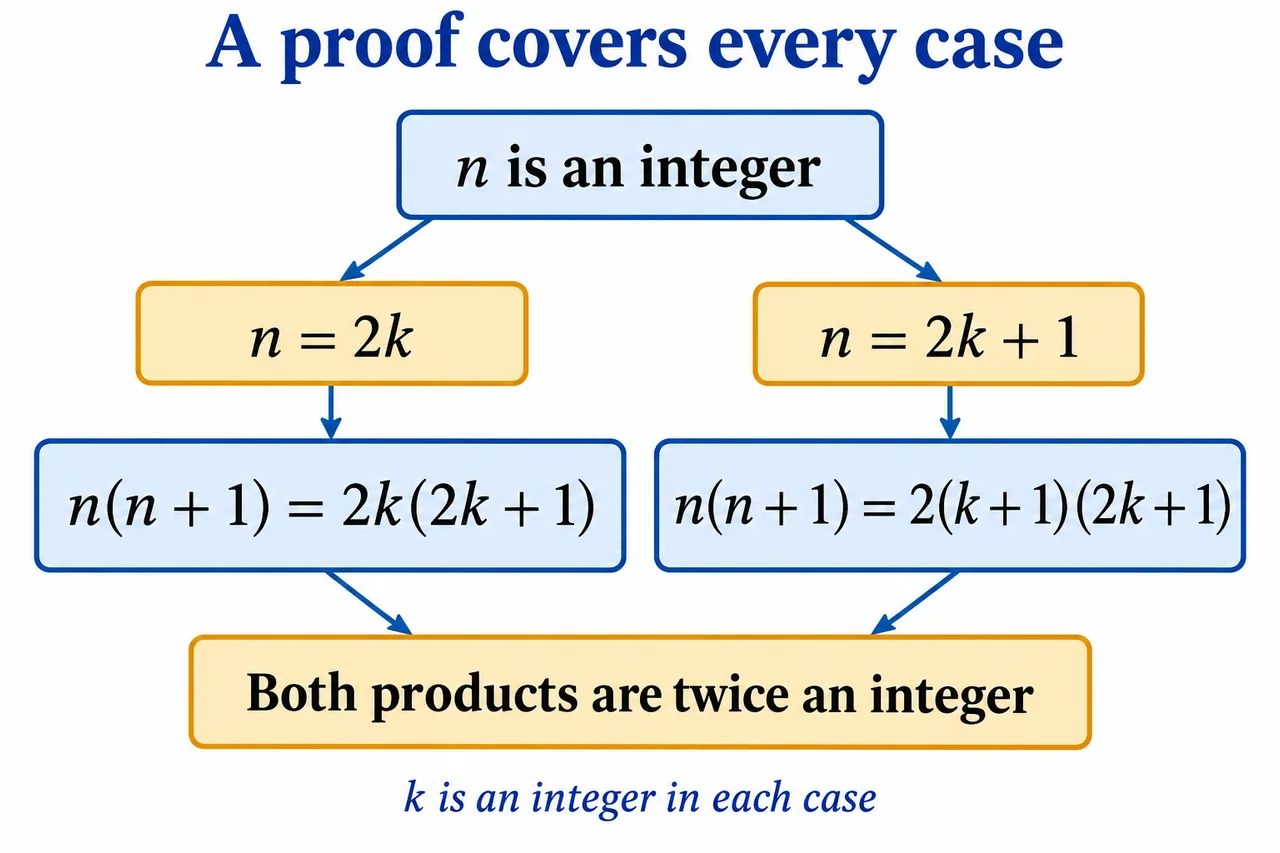
Follow both parity branches in the plate and identify the common conclusion: each product has a factor2. The branches exhaust integer parity, not arbitrary real inputs. Explain why this is a proof rather than a list of successful trials. A further transfer tests whether the reader can repair a false implication: “if ab is even, a and b are both even”. For integers this fails at a = 2, b = 3. The correct necessary conclusion is that at least one factor is even, because two odd factors (2r + 1)(2s + 1) expand to twice an integer plus one. Conversely, one even factor makes the product even, so the corrected statement is an equivalence. A strong response states the integer domain, supplies an admissible counterexample to the original assertion, proves the repaired assertion and distinguishes “at least one” from “both”; trials alone do not establish the repair.
Worked example: Prove that the product of consecutive integers is even.
Let n be any integer. Consecutive integers are n and n + 1.
If n is even, n = 2k and n(n + 1) = 2k(2k + 1).
If n is odd, n = 2k + 1 and n + 1 = 2(k + 1). The product is again twice an integer. These parity cases exhaust the integers.
Answer: n(n + 1) is even for every integer n.
Check your understanding: Does checking n = 1, 2, 3 prove that n² + n is always even?
Answer: No. The checks provide examples; the parity argument proves the universal claim.
Why: A finite test cannot cover an infinite domain. The two parity cases do cover every integer.