Extend index laws to roots and reciprocals
By UK A Level Mathematics · independent study · myAudience
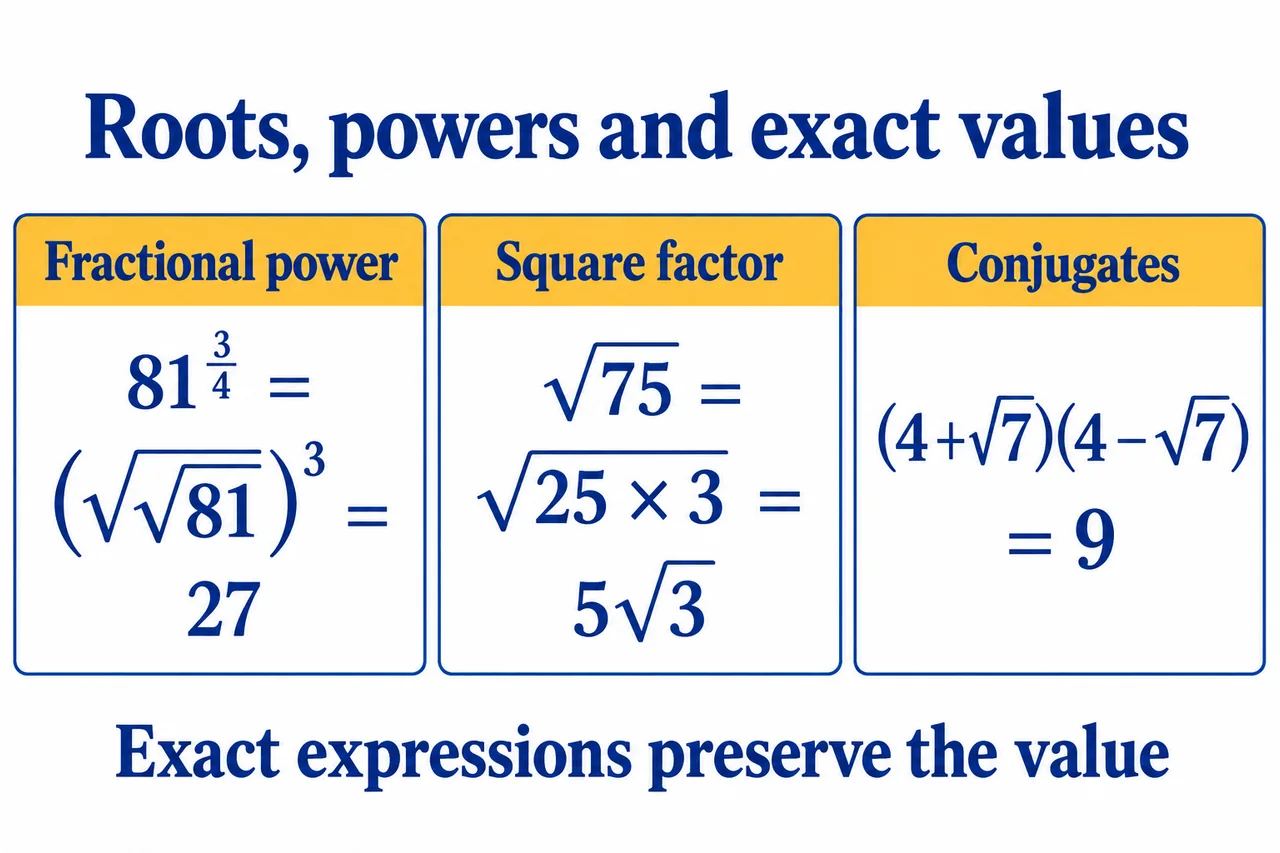
Original myAudience generated mathematics illustration; not a documentary photograph. Diagram geometry is schematic, not a calibrated measurement. · Original generated project artwork; no source textbook or exam-board figures reused.
Extend index laws to roots and reciprocals
An index describes repeated multiplication for positive integer powers. Extending that idea to zero, negative and fractional indices is useful because it lets roots and reciprocals participate in the same algebra. Assume a positive real base for the general rational laws in this lesson. That keeps all roots real and avoids ambiguous operations with negative bases. You should already be comfortable with fractions, integer powers and multiplication of algebraic factors.
The product a^m a^n = a^(m+n) and quotient a^m/a^n = a^(m−n) arise by joining or cancelling equal factors. For a nonzero base, a⁰ = 1 and a^(−n) = 1/a^n keep these rules consistent. A negative index changes the operation to a reciprocal; it does not make the value negative. Thus 5^(−2) is 1/25, while −5² is −25 and (−5)² is 25.
A fractional index asks for a root. For a > 0, a^(1/q) is the positive qth root and a^(p/q) is that root raised to p. Therefore 81^(3/4) = 3³ = 27. Reduce p/q before considering any negative base: real odd roots exist for negative numbers, but unrestricted power identities then need care. Writing √(x²) as |x|, rather than x, is another reminder that domain and sign matter.
When a power is raised to another power, multiply the indices: (a^m)^n = a^(mn) for the positive bases considered here. Do not confuse this with multiplying expressions with the same base, when indices are added. Nor do index laws distribute over addition: (a + b)² contains the middle term 2ab. Always identify the outer operation before selecting a rule.
Exact index manipulation can reduce a complicated expression before a calculator is used. For x > 0, x^(5/6)/x^(1/3) = x^(1/2), since 5/6 − 2/6 = 3/6. State x > 0 when the original denominator and roots require it. A simplified expression may look meaningful at zero even though the original quotient was undefined there; simplification does not erase the original domain.
Solve x^(1/2)+x^(−1/2)=5/2 over the reals. The reciprocal root requires x>0. Set t=√x>0; t+1/t=5/2. Multiplication by the positive nonzero t is reversible, giving 2t²−5t+2=0=(2t−1)(t−2). Hence t=1/2 or 2, so x=1/4 or 4. Substitute into the original: both give 5/2. Returning t directly as x would confuse the substitute variable with the original input.
Transfer: replace 5/2 by a parameter c. Since (t−1)²≥0, dividing by t>0 yields t+1/t≥2. Thus c<2 gives no solution, c=2 gives only x=1, and c>2 gives two positive reciprocal x-values. The quadratic discriminant c²−4 is nonnegative also for c≤−2, but those roots in t are negative and inadmissible. A discriminant alone does not solve a restricted-domain problem.
Read the exact-number plate as a comparison of equivalent representations. Explain each index or root operation using its algebraic law and domain restrictions; apparent decimal similarity is not proof of exact equality. Try an unfamiliar exact expression before reaching for a calculator: for x > 0, (x^(3/2) − x^(1/2))/(x − 1) equals √x when x ≠ 1, after factoring √x(x − 1). The original quotient is undefined at 1 even though the simplified expression has value 1 there. At x = 9 both permitted representations give 3; that check supports the algebra but is not its proof. Reasoned criteria are the common factor, the nonzero cancellation condition and retention of x > 0, x ≠ 1. Calling the formula valid for all positive x loses the original domain.
Worked example: Simplify (32^(2/5) × 32^(−1/5))² exactly.
Combine the inner powers: 32^(2/5 − 1/5) = 32^(1/5).
The fifth root of 32 is 2. Square the result.
Answer: 4.
Check your understanding: For x > 0 simplify x^(−1/2) × x^(3/2). What was excluded?
Answer: x; x = 0 was excluded and negative x was outside the real square-root domain.
Why: Adding the indices gives 1, but the original reciprocal square root still determines the domain.