Keep irrational quantities exact
By UK A Level Mathematics · independent study · myAudience
Original myAudience generated mathematics illustration; not a documentary photograph. Diagram geometry is schematic, not a calibrated measurement. · Original generated project artwork; no source textbook or exam-board figures reused.
Keep irrational quantities exact
A surd is a root that cannot be represented as a rational number. Keeping a surd exact avoids rounding error and often exposes a relationship hidden by decimal approximations. This lesson assumes familiarity with square roots, index laws and distributing brackets. The principal square root √a is nonnegative; the equation x² = a may have two real solutions when a > 0.
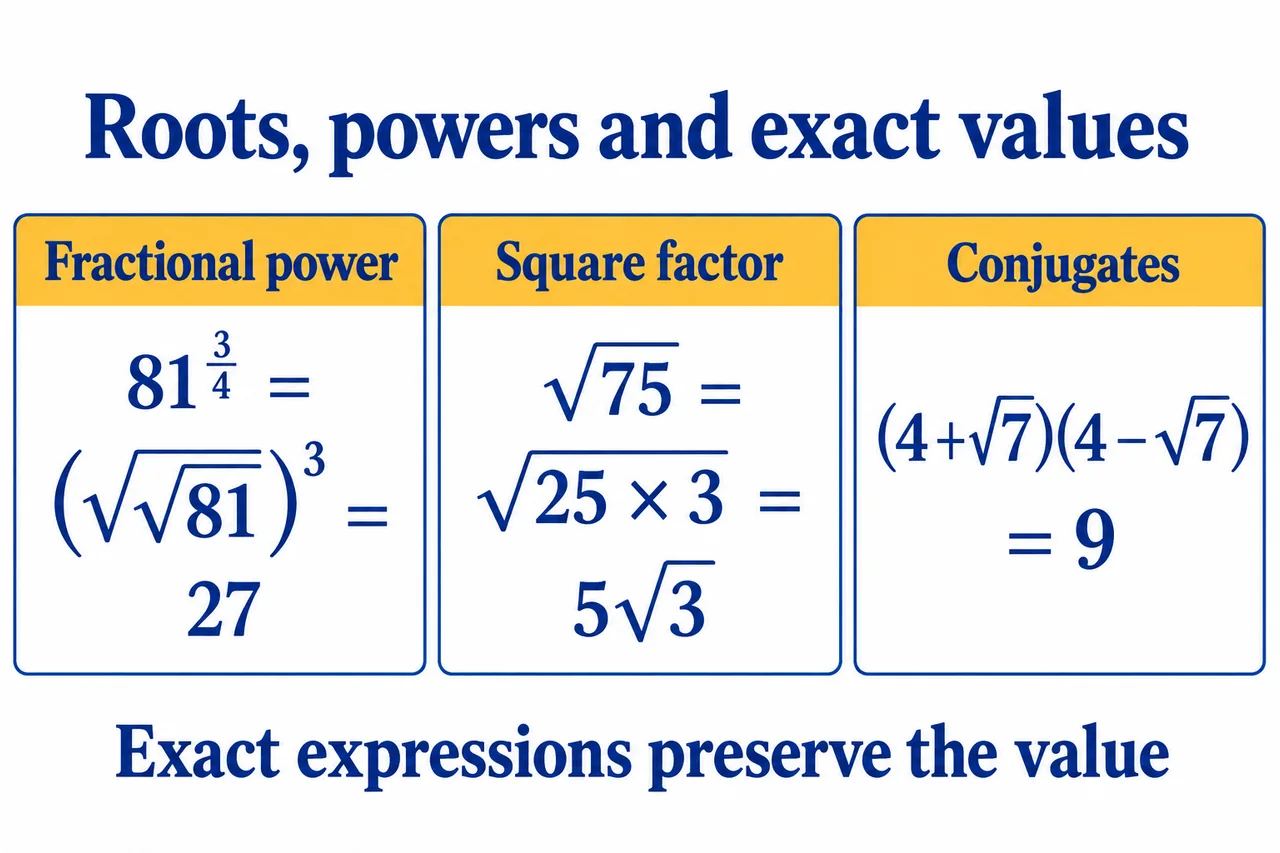
For nonnegative a and b, √(ab) = √a √b. Find a square factor to simplify a root: √75 = √(25 × 3) = 5√3. Like surds combine as like algebraic terms, so 2√3 + 5√3 = 7√3. Roots with different remaining radicands do not combine this way. In particular, √(a + b) is generally different from √a + √b.
Rationalising a denominator rewrites an exact value without a root in the denominator. For 7/√5, multiply numerator and denominator by √5 to obtain 7√5/5. The multiplier √5/√5 is one, so the value is unchanged. This operation is a change of representation, not a numerical approximation or a way of removing irrationality from the value itself.
When the denominator is a sum involving a root, use its conjugate: the same terms with the middle sign reversed. The product (u + v)(u − v) = u² − v² makes the root disappear from a denominator such as 4 + √7. Multiply both numerator and denominator, keep the brackets during expansion, and check that the original denominator is nonzero.
In algebraic expressions, carry the same domain discipline into roots. For real x, √(x²) = |x|; when x < 0, x itself is negative and cannot equal a principal square root. Likewise √(x − 2) requires x ≥ 2, and putting that root in a denominator requires x > 2. Exact arithmetic and domain checks work together: a beautifully simplified expression is still wrong if it silently admits forbidden inputs.
Solve √(x+2)=x over the reals. The left side is nonnegative, so x≥0, which also satisfies the radicand restriction. Squaring yields x²−x−2=0 and candidates 2,−1. Only 2 satisfies x≥0 and the original equation. The candidate −1 makes a true squared equation but the original reads 1=−1. Squaring loses sign information; it is an implication until the sign conditions are imposed.
Transfer: √(x+2)=x−a requires both x≥−2 and x≥a. Before solving the squared quadratic, write these restrictions. For a=1, x²−3x−1=0 gives (3±√13)/2; only the plus value exceeds 1. Check: √((3+√13)/2+2) equals that value minus 1 because their squares agree and both are nonnegative. Equality of squares with matching signs justifies the reverse step.
Use the exact-number plate to distinguish a root expression from an approximation. Check the sign and radicand before simplifying; exact symbolic work prevents rounding from disguising a different value. For a separate demanding transfer, decide whether √(x + 5) − √(x + 1) = 1 has a real solution. First require x ≥ −1. Isolate the first root and square: x + 5 = x + 2 + 2√(x + 1), so √(x + 1) = 3/2 and x = 5/4. Substitution gives 5/2 − 3/2 = 1. Here the isolated right side 1 + √(x + 1) is nonnegative, making that squaring step reversible on the stated domain. Credit the initial radicand restrictions, justified squaring and original substitution; a squared polynomial alone is not sufficient evidence.
Worked example: Rationalise 3/(4 + √7).
Multiply by (4 − √7)/(4 − √7).
The denominator is 16 − 7 = 9, and the numerator is 12 − 3√7.
Divide numerator and denominator by 3.
Answer: (4 − √7)/3.
Check your understanding: Is √50 + √8 equal to √58?
Answer: No. It equals 7√2.
Why: √50 = 5√2 and √8 = 2√2. Root multiplication is valid here; a corresponding root addition rule is not.