Choose the quadratic form that reveals the feature
By UK A Level Mathematics · independent study · myAudience
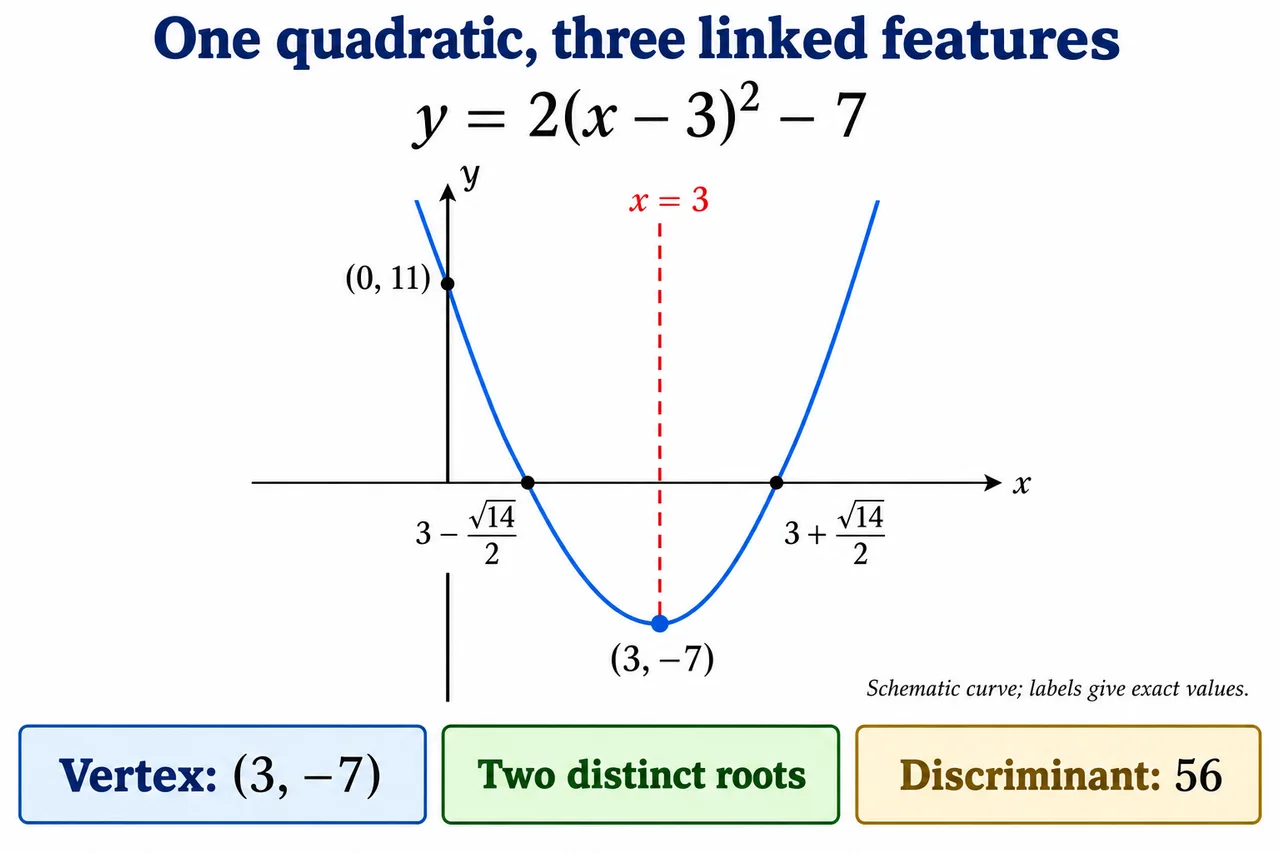
Original myAudience generated mathematics illustration; not a documentary photograph. Diagram geometry is schematic, not a calibrated measurement. · Original generated project artwork; no source textbook or exam-board figures reused.
Choose the quadratic form that reveals the feature
A quadratic function has the form f(x) = ax² + bx + c with a ≠ 0. Its graph is a parabola: it opens upward for a > 0 and downward for a < 0. Expanded form reveals the y-intercept c, factorised form reveals real roots, and completed-square form reveals the turning point. These are equivalent descriptions of one function. Prerequisites are expanding brackets, factorising and understanding coordinates.
Completing the square turns the first two terms into a squared bracket and corrects the constant. For x² + 10x + 17, the bracket (x + 5)² contributes 25, so subtract 8 to recover 17. The result (x + 5)² − 8 has minimum −8 at x = −5 because a square is never negative. This argument identifies the minimum without sampling nearby values.
When a is not one, first factor a from the x² and x terms. In 3x² − 12x + 7, write 3(x² − 4x) + 7, then 3[(x − 2)² − 4] + 7. The function is 3(x − 2)² − 5. Its axis of symmetry is x = 2, and its vertex is (2, −5). For negative a the same method gives a maximum because a positive square is multiplied by a negative number.
To solve f(x) = 0, use the form that makes the algebra clearest. A product equal to zero requires at least one factor to be zero; a completed square equal to a positive number requires both signs of its square root. The quadratic formula x = (−b ± √(b² − 4ac))/(2a) gives roots even when a neat rational factorisation is unavailable. Keep irrational roots exact until an approximation is requested.
A graph sketch should combine these features coherently. Mark the vertex, axis, intercepts and opening direction; do not claim a sketch is to scale unless its coordinates support that claim. The symmetry means two roots, when present, lie equal distances from the axis. Substitute the vertex into expanded form as a quick check against a sign or constant error in completing the square.
For q(x)=2(x−3)²−7 on 0≤x≤2, the unconstrained vertex x=3 is outside the domain. Throughout the interval, 3−x decreases from 3 to 1 and is nonnegative, so its square decreases too. The minimum is q(2)=−5, and the maximum q(0)=11. Quoting −7 as the minimum overlooks the permitted inputs. This gives a proof of monotonicity here without assuming a later derivative rule.
Transfer: minimise q on [a,b], a≤b. If 3 lies inside the interval, the minimum is −7. If b<3, use b; if a>3, use a. Equivalently, choose the point of the interval nearest 3. The maximum occurs at the endpoint farthest from 3; if both are equally far, both attain it. The square measures distance, so the same reasoning works for every positive multiple of (x−h)² plus a constant.
Connect the displayed completed-square form to its vertex and minimum or maximum. The curve is schematic, so use the algebraic expression to justify the vertex rather than estimating from pixels. To transfer the distance argument, let f(x) = −3(x + 2)² + 5 on −1 ≤ x ≤ 4. The unrestricted maximum at −2 is forbidden. The nearest allowed point to −2 is −1, giving maximum 2; the farthest is 4, giving minimum −103. Neither endpoint sampling without explanation nor blindly quoting the vertex is a complete argument. The square of distance increases on this interval, and the negative multiplier reverses the output ordering. A complete response identifies the permitted domain, orders distances, states both extrema with their inputs and checks the values in the original rule.
Worked example: Find the vertex and exact roots of 2x² − 12x + 11.
Write 2(x² − 6x) + 11 = 2(x − 3)² − 7.
The vertex is (3, −7). At a root, (x − 3)² = 7/2.
Take both signs of the square root and rationalise √(7/2) as √14/2.
Answer: Vertex (3, −7); roots x = 3 ± √14/2.
Check your understanding: What is the maximum of −2(x + 1)² + 9, and where does it occur?
Answer: 9 at x = −1.
Why: The square is nonnegative, so its negative multiple cannot increase the value above 9.