Use the discriminant to reason about parameters
By UK A Level Mathematics · independent study · myAudience
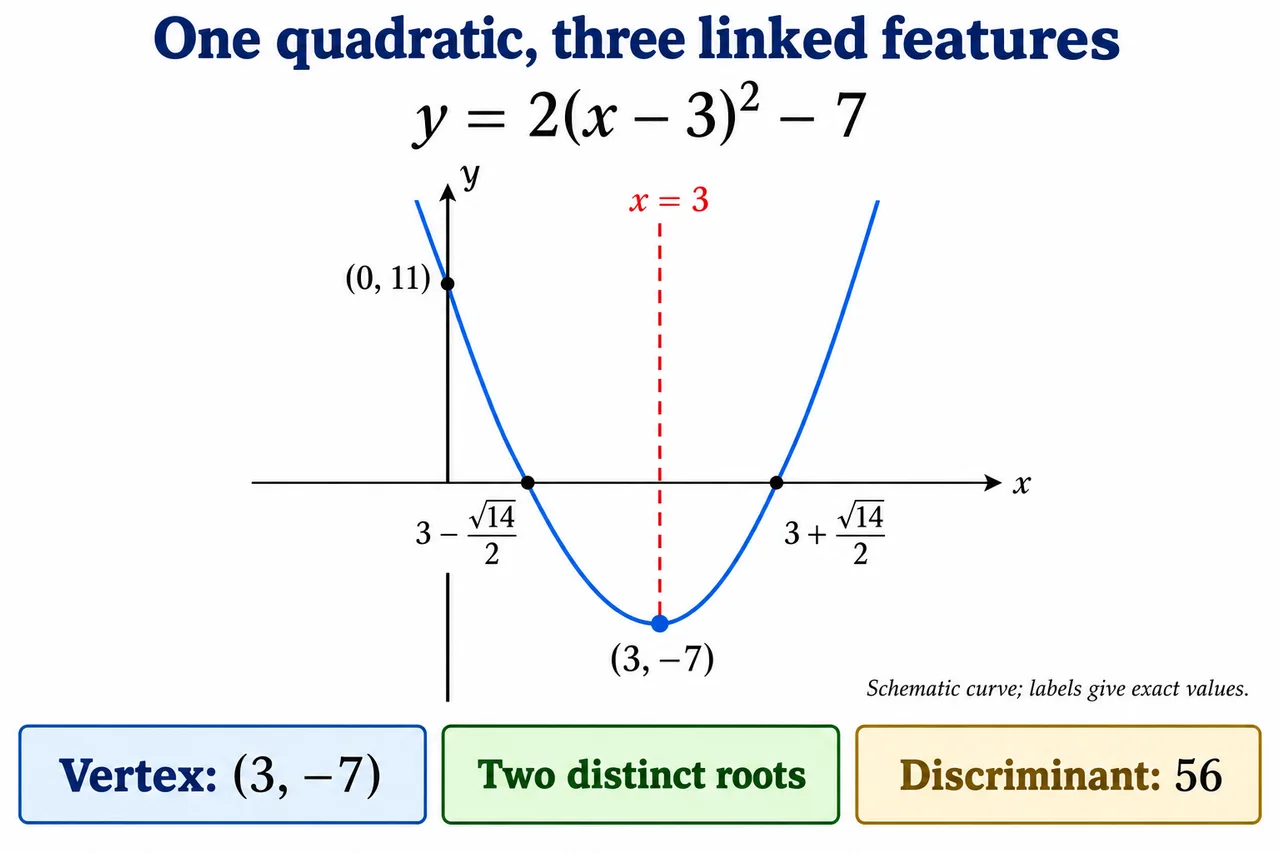
Original myAudience generated mathematics illustration; not a documentary photograph. Diagram geometry is schematic, not a calibrated measurement. · Original generated project artwork; no source textbook or exam-board figures reused.
Use the discriminant to reason about parameters
The discriminant D = b² − 4ac is the quantity under the square root in the quadratic formula. For real coefficients with a ≠ 0, D > 0 gives two distinct real roots, D = 0 gives one repeated real root, and D < 0 gives no real roots. This is a statement about intersections with the x-axis, not about whether the function itself exists. A quadratic with no real roots still has a real graph.
Parameter questions ask which members of a family have a particular feature. Treat the parameter as a fixed number while solving in x. For x² + kx + 9, the discriminant is k² − 36. Two distinct roots require k² > 36, hence k < −6 or k > 6. Both sides of the number line matter; taking a square root and keeping only the positive branch would lose half the possibilities.
Before using the discriminant, check whether a parameter can make the leading coefficient zero. In tx² + x + 1 = 0, t = 0 produces a linear equation, not a quadratic. The discriminant rule applies only after that case has been separated. This habit is an example of logical case analysis: the assumptions behind a familiar formula must remain true.
Line–curve intersections can also be counted with a discriminant. Equate their y-values and bring every term to one side. The resulting quadratic describes the x-coordinates of intersections. A repeated root corresponds to tangency for a genuine line and parabola, while two distinct roots correspond to two crossings. The constant term may change when you subtract the line, so compute D from the resulting equation.
The discriminant tells you a count, but it does not by itself supply a contextually valid solution. A model may restrict x to nonnegative lengths or a limited time interval. Solve and check that domain after classifying real roots. Distinguish no real roots, no admissible roots in a stated domain, and a repeated root: they are different conclusions and deserve different wording.
Classify real solutions of tx²+x+1=0. At t=0 it is linear and has the single solution −1. For t≠0 the discriminant is 1−4t: two distinct real roots for t<1/4, one repeated root at t=1/4, no real roots above 1/4. Remove t=0 from the two-root class. At t=1/4 the root is −2. A “one solution” answer therefore includes two structurally different cases, t=0 and t=1/4.
Transfer: which parameters give a positive root? For t<0 the product 1/t is negative, so the two roots have opposite signs and exactly one is positive. For t>0 any real roots have positive product and negative sum −1/t, so both are negative. At zero the linear root is negative. Thus exactly t<0 qualifies. This combines root existence, Vieta's relations and a contextual domain, rather than using D alone.
The illustrated quadratic has discriminant56 and two distinct real roots. Explain why a positive discriminant gives two real roots, zero gives a repeated real root and a negative value gives no real roots. The plate supplies one example, not all three cases or a proof for every coefficient. A second family reveals another hidden case: (k − 1)x² + 2x + k + 1 = 0. At k = 1 it is the linear equation 2x + 2 = 0 with one root −1. Otherwise D = 4 − 4(k − 1)(k + 1) = 8 − 4k². Two distinct real roots occur for −√2 < k < √2 excluding 1; a repeated root occurs at k = ±√2; outside that closed interval there are no real roots. One real solution therefore means three parameter values, not just the two discriminant-zero values. Credit separating degeneration before classification and using exact endpoints; the count of distinct roots and polynomial multiplicity are different questions.
Worked example: For which real k does x² − 4x + k = 0 have a repeated root?
Here a = 1, b = −4 and c = k.
D = 16 − 4k. Set D = 0, so k = 4.
At k = 4 the expression is (x − 2)².
Answer: k = 4, with repeated root x = 2.
Check your understanding: For which k does x² + kx + 16 = 0 have no real roots?
Answer: −8 < k < 8.
Why: D = k² − 64 must be negative. The endpoints give repeated roots and are excluded.