Recognise a quadratic hidden inside another equation
By UK A Level Mathematics · independent study · myAudience
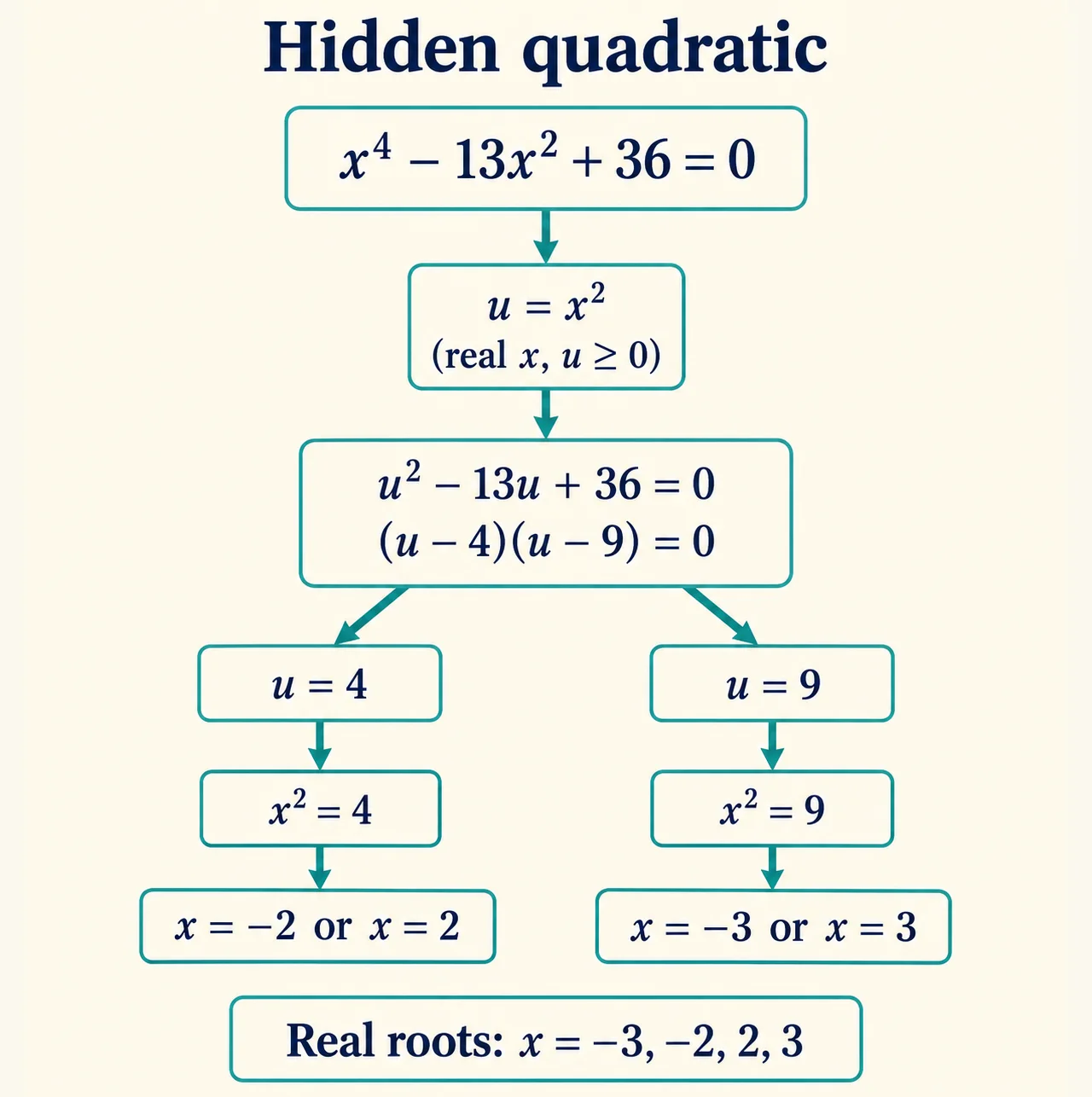
Original myAudience generated mathematics illustration; not a documentary photograph. Diagram geometry is schematic, not a calibrated measurement. · Original generated project artwork; no source textbook or exam-board figures reused.
Recognise a quadratic hidden inside another equation
An equation can be quadratic in an expression even when it is not quadratic in x. The expression x⁴ − 10x² + 9 contains the square of x², then x², then a constant. Setting u = x² gives u² − 10u + 9. Recognising this structure reduces a fourth-degree equation to a familiar quadratic. You need factorisation, real roots and careful handling of domains.
The substitution introduces a restriction: u = x² implies u ≥ 0 for real x. Solve the quadratic in u, then check each u-value before reversing the substitution. For u = 9, x = 3 and x = −3 are both possible. For u = −9 there is no real x. A substitution is a bridge between equations, so returning across it is part of the solution rather than an optional final step.
Always reverse the particular expression you substituted. If u = x² + 1, then u = 5 means x² = 4, not x = 5. If u = √x, then u must be nonnegative and x = u². The same idea later works with trigonometric, exponential and logarithmic expressions, but their ranges and periodicity need separate teaching. This cohort does not count those later applications as covered.
Loss of solutions often occurs when a repeated expression is divided out. In x⁴ = 4x², dividing by x² would discard x = 0. Instead write x²(x² − 4) = 0 and use the zero-product rule, or split the zero case before dividing. An operation that is reversible for nonzero inputs may not be reversible over the entire original domain.
Check each final candidate in the original equation. This catches errors introduced by squaring or by reversing the wrong substitution. It also makes the reasoning reviewable: record the substitution, its range restriction, the smaller equation, and the return to x. A calculator list of roots alone does not explain why all real possibilities were considered.
For x⁴−kx²+4=0 set u=x²≥0. The substitute quadratic has sum k and product 4. If k>4, D=k²−16>0 and both roots are positive, giving four distinct x-values. If k=4, u=2 is repeated but x=±√2 are two distinct real roots. For −4<k<4 there are no real u-roots. At k≤−4, any real u-roots are negative, so there are no real x-roots. Repeated algebraic multiplicity is different from the number of distinct inputs.
The specialist tree for k=13 and constant 36 separates u=4 and u=9 before returning ±2 and ±3. Each arrow back reverses x², which is many-to-one. Check transfer: x⁴−5x²+4=0 gives ±1 and ±2. A branch to a negative u would terminate, not become a real square root with a minus sign.
Follow the substituted expression through the illustration, then check the candidate in the original equations. Substitution must preserve every domain restriction; a new variable is a tool, not permission to ignore invalid inputs. A separate reciprocal transfer requires x ≠ 0: solve x² + 1/x² = 5. With u = x² > 0, multiplication by u gives u² − 5u + 1 = 0. Both u = (5 ± √21)/2 are positive because √21 < 5, and each produces two x-values, giving x = ±√((5 + √21)/2) and ±√((5 − √21)/2). The two u-values are reciprocal, but that does not identify the signs of x. Reasoned criteria require the nonzero original domain, reversible multiplication, positivity check and all four returned roots; writing only the two values of u answers a different question.
Worked example: Solve x⁴ − 13x² + 36 = 0 over the reals.
Set u = x², so u ≥ 0 and u² − 13u + 36 = 0.
Factor (u − 4)(u − 9) = 0. Both values satisfy u ≥ 0.
x² = 4 gives x = ±2; x² = 9 gives x = ±3.
Answer: x ∈ {−3, −2, 2, 3}.
Check your understanding: How many real solutions does x⁴ + 3x² − 4 = 0 have?
Answer: Two: x = −1 and x = 1.
Why: The substituted equation factors as (u + 4)(u − 1) = 0. Reject u = −4 because u = x² ≥ 0.