Solve intersections while keeping paired coordinates
By UK A Level Mathematics · independent study · myAudience
Original myAudience generated mathematics illustration; not a documentary photograph. Diagram geometry is schematic, not a calibrated measurement. · Original generated project artwork; no source textbook or exam-board figures reused.
Solve intersections while keeping paired coordinates
Simultaneous equations require the same values to satisfy every equation at once. Geometrically, a solution pair is an intersection of two graphs. An x-value by itself is incomplete when the question asks for x and y. Prerequisites are solving linear and quadratic equations, substituting a whole expression into another expression, and reading coordinate pairs.
For two linear equations, elimination removes one variable by adding suitable multiples of the equations. If 2x + y = 9 and x − y = 3, adding gives 3x = 12, hence x = 4 and y = 1. Substitution reaches the same result. Parallel distinct lines have no intersection; coincident equations describe infinitely many solution pairs. Do not assume every simultaneous system has exactly one answer.
For a line and a quadratic curve, substitution usually exposes the intersection structure. From y = x + 2 and y = x² − 4, equate x + 2 = x² − 4. Solving x² − x − 6 = 0 gives x = 3 or x = −2. Substitute each separately into the line to find (3, 5) and (−2, 0). Mixing the y-value from one root with the other x-value creates a false solution.
The quadratic produced by substitution may have two, one or no real roots. Its discriminant counts the corresponding intersections, provided the substitution remains valid. When both original equations contain squared terms, choose a variable to isolate and expand its bracket carefully. Squaring x + 2 gives x² + 4x + 4; missing the middle term changes the system.
Finish by checking both equations for each pair. If an equation involved a denominator, preserve its exclusions during substitution. In a contextual model, also check any restrictions on time, length or quantity. A graph can suggest where intersections are, but algebra gives exact values and the checks establish that they belong to the original system.
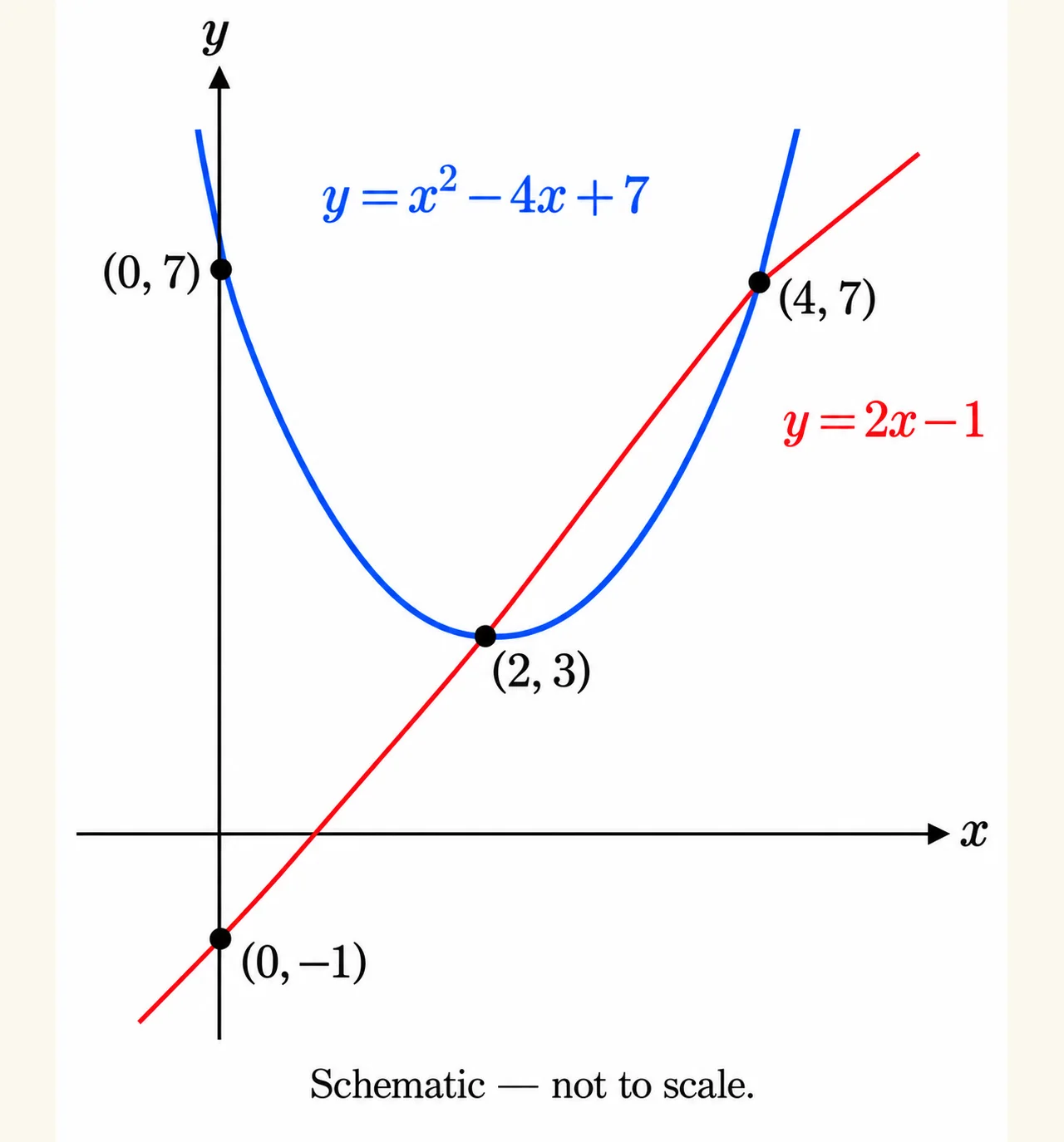
The line y=2x−1 and parabola y=x²−4x+7 intersect when x²−6x+8=0, so x=2,4 and y=3,7 respectively. The specialist visual shows the first intersection at the parabola's vertex, but the line is slanted there while the parabola has horizontal tangent. Crossing at a vertex does not imply tangency. Elimination proves the exact coordinates; the drawing helps interpret the crossings.
Transfer: intersect the same parabola with y=2x+c. The intersection polynomial is x²−6x+7−c, with discriminant 8+4c. Tangency occurs at c=−2 and x=3, giving (3,4). Two crossings occur for c>−2 and none for c<−2. Changing the intercept shifts the line parallel to itself; it does not move the parabola's vertex. Check by completing the intersection polynomial as (x−3)²−(c+2).
The intersections link simultaneous equations to coordinate pairs. Verify each pair in both original equations, including cases obtained after squaring or eliminating a variable; schematic intersections do not certify exact coordinates. Consider a separate system where both variables appear squared: x − y = 1 and x² + y² = 13. Substituting y = x − 1 yields 2x² − 2x − 12 = 0, so x = 3 or −2. The paired answers are (3, 2) and (−2, −3); both give a difference of 1 and sum of squares 13. This is not the displayed line/parabola example. A tempting four-pair cross-product is wrong because each y belongs to its own x. A full explanation records the substitution, recovers paired coordinates and checks each in both originals rather than asserting that a plotted crossing certifies them.
Worked example: Solve y = 2x − 1 and y = x² − 4x + 7.
Equate: 2x − 1 = x² − 4x + 7, so x² − 6x + 8 = 0.
Factor (x − 2)(x − 4) = 0.
At x = 2, y = 3; at x = 4, y = 7. Check in both rules.
Answer: (2, 3) and (4, 7).
Check your understanding: Find the intersections of y = x + 1 and y = x² + 1.
Answer: (0, 1) and (1, 2).
Why: Equating gives x² − x = x(x − 1) = 0. Each x-value needs its own y-value.