Solve inequalities as sets of permitted inputs
By UK A Level Mathematics · independent study · myAudience
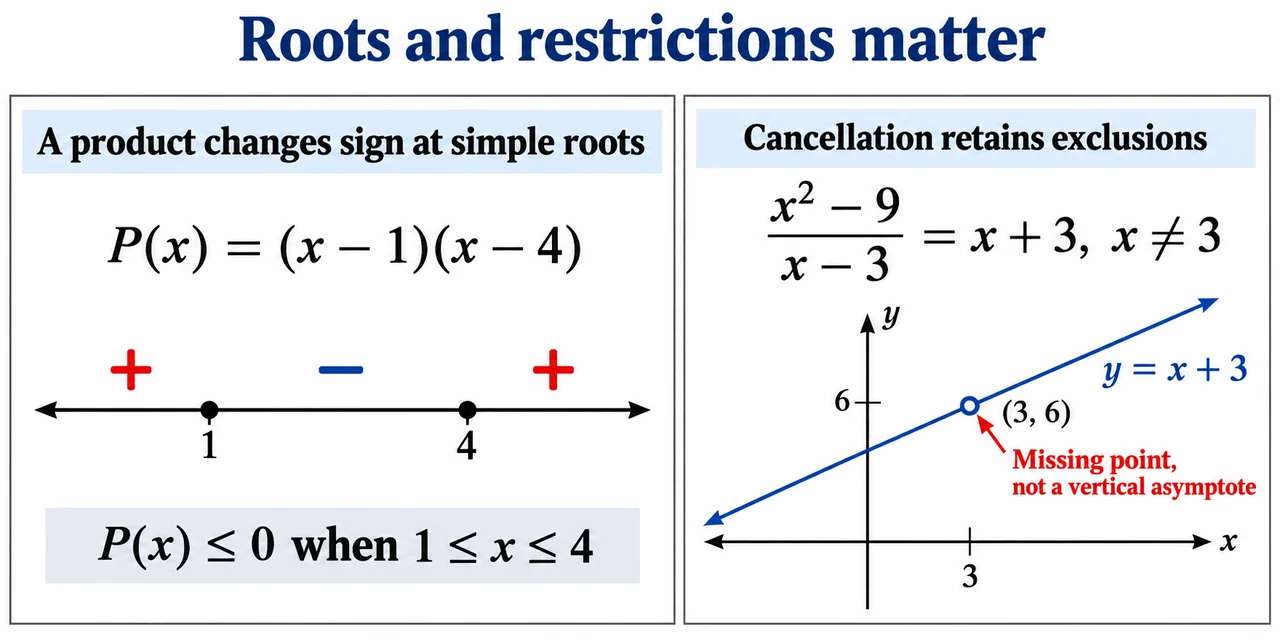
Original myAudience generated mathematics illustration; not a documentary photograph. Diagram geometry is schematic, not a calibrated measurement. · Original generated project artwork; no source textbook or exam-board figures reused.
Solve inequalities as sets of permitted inputs
An inequality asks for a set of inputs, often an interval rather than a few isolated roots. Strict signs < and > exclude equality; ≤ and ≥ include it. Adding the same quantity preserves order, but multiplying or dividing by a negative quantity reverses it: if 2 < 5, then −2 > −5. This lesson requires equation solving, quadratic factorisation and signed-number comparisons.
To solve a quadratic inequality, bring all terms to one side, find the roots, and determine the sign in each interval separated by those roots. For (x − 1)(x − 4) < 0, the factors have opposite signs when 1 < x < 4. The roots are boundaries, not the whole answer. Because the inequality is strict, the endpoints are excluded.
A sign chart explains why an interval works. Between adjacent roots a continuous polynomial cannot change sign without another root. For a quadratic opening upward with two distinct roots, the expression is negative between the roots and positive outside. For a repeated root the sign need not change; (x − 2)² is nonnegative on both sides. Factor signs are safer than an unqualified rule about all roots being crossings.
For a rational inequality, also split the number line at denominator zeros. Never multiply by an expression of unknown sign as if it were positive. In (x − 2)/(x + 1) > 0, the boundaries are −1 and 2. Testing the three intervals gives x < −1 or x > 2; x = −1 is undefined and x = 2 gives equality. Both are excluded for different reasons.
Use and for an intersection of conditions and or for their union. Thus x < −1 or x > 2 is (−∞, −1) ∪ (2, ∞). For a two-variable inequality, shade the side of the boundary satisfying the rule; use a dashed boundary for a strict inequality and a solid boundary when equality is allowed. This paragraph introduces that convention, but sustained region-sketching practice remains pending.
Solve (x−1)/(x−3)≤0. Critical values are the numerator zero 1 and forbidden denominator zero 3. The quotient is positive on x<1, negative on 1<x<3 and positive on x>3. Include 1 because equality is defined there, exclude 3 because the expression is undefined: [1,3). Multiplying straight through by x−3 without knowing its sign would reverse the inequality on part of the domain.
Transfer: solve (x−1)²/(x−3)≤0. The squared numerator is positive except at 1; the quotient is negative for every x<3 other than its zero, and positive for x>3. Equality at 1 still belongs. The answer is (−∞,3). A double root does not change sign, so copying the alternating sign pattern from a simple-root example is unsafe.
Read the sign intervals around each critical value and distinguish a zero from an excluded denominator. Boundary inclusion follows the original inequality, not merely the appearance of a solid or open mark. For a separate mixed restriction, solve (x − 1)²/(x − 3) ≤ 0 together with x² − 5x + 4 ≥ 0. The first condition gives x < 3, including its zero at 1. The second gives x ≤ 1 or x ≥ 4, since the upward quadratic is nonnegative outside its roots. Their intersection is x ≤ 1. Taking the union instead would admit forbidden inputs such as 4; multiplying through by x − 3 without cases would also be unsafe. Credit a sign-based answer for each condition, the excluded pole and a justified intersection with endpoint 1 retained.
Worked example: Solve x² − 5x + 4 ≤ 0.
Factor (x − 1)(x − 4) ≤ 0.
The product is negative between the roots and zero at them.
Include both endpoints because equality is allowed.
Answer: 1 ≤ x ≤ 4.
Check your understanding: Solve (x − 3)/(x + 2) ≥ 0.
Answer: x < −2 or x ≥ 3.
Why: Both factors are negative for x < −2 and nonnegative/positive for x ≥ 3. The denominator excludes −2 even though the inequality allows equality.