Simplify rational expressions without losing restrictions
By UK A Level Mathematics · independent study · myAudience
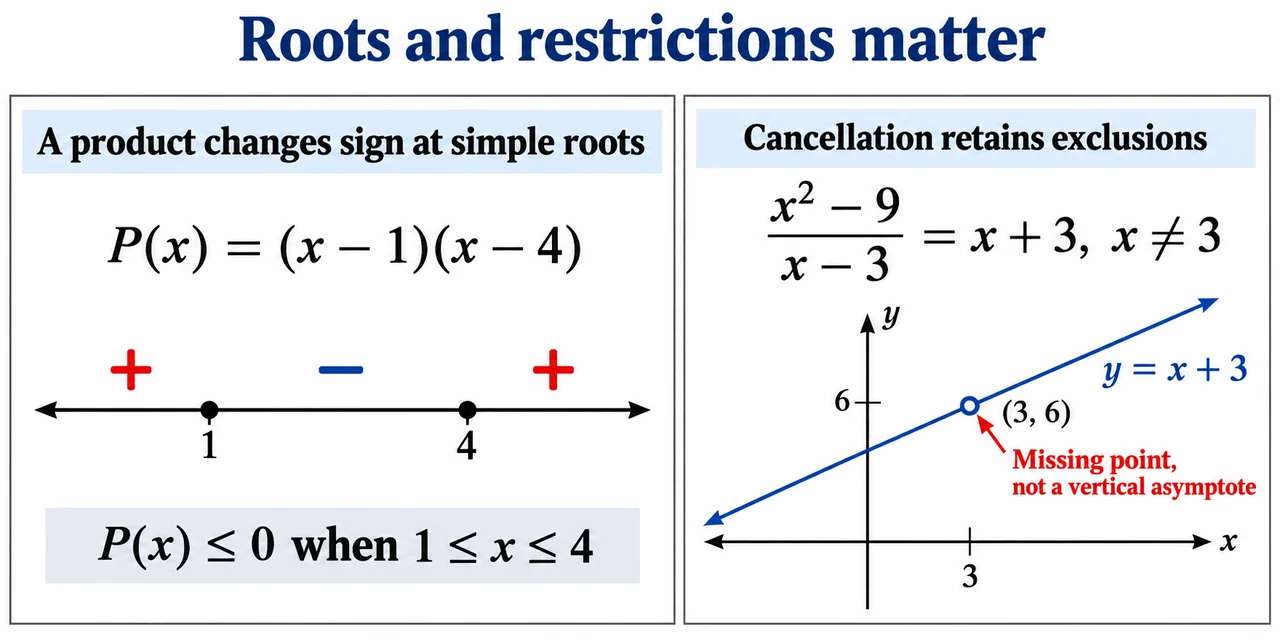
Original myAudience generated mathematics illustration; not a documentary photograph. Diagram geometry is schematic, not a calibrated measurement. · Original generated project artwork; no source textbook or exam-board figures reused.
Simplify rational expressions without losing restrictions
A rational expression is a quotient of polynomials. Its domain excludes every input making the original denominator zero. Factorisation can make the quotient easier to use, but the original exclusions must accompany the simplified result. You need polynomial factorisation, fraction arithmetic and the distinction between an identity and an equation.
Cancellation removes common multiplicative factors, not matching terms inside sums. For (x² − 9)/(x − 3), factor the numerator as (x − 3)(x + 3). Cancelling x − 3 gives x + 3 only for x ≠ 3. At x = 3 the original quotient is undefined. Its graph follows the line y = x + 3 with a missing point at (3, 6), rather than the complete line.
Adding rational expressions needs a common denominator. In 1/(x − 1) + 2/(x + 1), multiply the first numerator by x + 1 and the second by x − 1. The combined numerator is 3x − 1 over x² − 1. Both x = 1 and x = −1 remain excluded. A common denominator is a product structure; guessing by adding denominators does not preserve the value.
Division by a linear polynomial also separates a rational function into a polynomial part and a remainder term. Since x² + 1 = (x − 1)(x + 1) + 2, the quotient is x + 1 + 2/(x − 1) for x ≠ 1. Reconstructing the numerator checks this equality. Decomposition into partial fractions with multiple or repeated factors is a later, separate requirement and is not covered by this example.
When solving an equation involving a rational expression, list exclusions before clearing denominators. The transformed equation may admit a forbidden candidate. When solving an inequality, a denominator of unknown sign needs a sign chart or case analysis. These checks are not presentation details: they distinguish a solution of the original problem from a solution of a more permissive rewritten problem.
Let R(x)=(x²−x−6)/(x²−4)=(x−3)/(x−2), retaining x≠−2,2. The cancelled x+2 leaves a hole at x=−2, with would-be value 5/4. The uncancelled denominator gives a vertical asymptote at x=2. To find the range, solve y=(x−3)/(x−2): x=(2y−3)/(y−1) for y≠1. The forbidden input −2 corresponds to y=5/4. Hence the range is all real y except 1 and 5/4. A hole can remove a range value when no other input supplies it.
Check: R(x)=5/4 implies 4x−12=5x−10, giving x=−2, excluded. R(x)=1 implies −3=−2, impossible. Do not infer that every cancelled factor removes a range value: another branch of a non-injective function might attain the same output. Range reasoning needs the full function and domain.
Use the sign plate to keep numerator zeros and forbidden denominator zeros distinct. A cancelled factor can leave a hole in the original domain, and multiplying an inequality by an expression of unknown sign can reverse its direction.
Worked example: Simplify (x² − x − 6)/(x² − 4), stating the domain.
Factor the numerator as (x − 3)(x + 2), and the denominator as (x − 2)(x + 2).
The original denominator excludes x = 2 and x = −2.
Cancel x + 2 only on this domain.
Answer: (x − 3)/(x − 2), with x ≠ −2 and x ≠ 2.
Check your understanding: Is (x² − 1)/(x − 1) = x + 1 valid at x = 1?
Answer: No.
Why: The right side exists there, but the original quotient does not. The equality holds only for x ≠ 1.